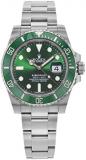
The Rolex Submariner is defined by a set of core specifications that have shaped professional dive watches since 1953. An Oyster case measuring 41 mm in diameter, a unidirectional rotatable bezel with a 60-minute graduated Cerachrom insert, and a luminescent display form the foundation of its identity. These elements are not decorative additions; they are functional requirements engineered for legibility and reliability underwater.
Decades of refinement have kept the architecture of the Submariner collection intact while sharpening its details. The monobloc middle case, screw-down case back, and winding crown work together as a sealed system, contributing to the watch's 300-metre (1,000-foot) water resistance rating.
Oyster Case Architecture And Water Resistance
The Oyster case is the structural heart of the Submariner. Rolex engineers it from a single block of Oystersteel, a proprietary 904L-grade stainless steel known for corrosion resistance and high-polish finish. This monobloc construction eliminates seams that could compromise water tightness under pressure. The screw-down case back and winding crown reinforce this seal, creating a chamber that protects the movement from water, dust, and pressure at depth.
Pressure Tolerance At Depth
The 300-metre rating means the case can withstand the equivalent of 30 bar of pressure. This exceeds the requirements for recreational scuba diving, which typically occurs between 18 and 40 metres. For saturation divers and professional underwater workers, a higher-specification model like the Rolex Deepsea extends the range to 3,900 metres using the Ringlock system, but the Submariner remains the standard for most diving applications.
Case Dimensions And Wrist Presence
The 41 mm case diameter suits a wide range of wrist sizes. It provides substantial presence without becoming unwieldy on smaller wrists. Lug-to-lug measurements and case thickness are calibrated to allow a wetsuit cuff to slide beneath the case back while still sitting comfortably against bare skin during daily wear. The Oyster bracelet, available in Oystersteel, integrates with the case through solid end links and includes an Oysterlock safety clasp with the Glidelock extension system for micro-adjustments.
Calibre 3230 And 3235: The Movement Inside
The Submariner is equipped with calibre 3230, while the Submariner Date is fitted with calibre 3235. Both are self-winding mechanical movements designed, developed, and manufactured by Rolex. These calibres feature the Chronergy escapement, which improves energy efficiency and precision compared to a traditional Swiss lever escapement. The movements also incorporate a blue Parachrom hairspring, resistant to magnetic fields and temperature variations.
The power reserve is approximately 70 hours, meaning the watch can be set aside over a weekend and still run accurately when worn again on Monday. The bidirectional self-winding mechanism uses a Perpetual rotor to convert wrist movement into energy stored in the mainspring barrel. COSC certification ensures the movement meets chronometric standards before it undergoes final assembly and Rolex's own superlative chronometer testing, which specifies a tolerance of -2 to +2 seconds per day after casing.
Unidirectional Bezel And Cerachrom Insert
The unidirectional rotatable bezel is a critical diving instrument. It rotates in one direction only, preventing accidental counter-clockwise movement that could lead a diver to believe they have more bottom time than actually remains. The 60-minute graduations allow tracking of elapsed time from the moment a dive begins.
The Cerachrom insert is made from a hard, corrosion-resistant ceramic. It resists scratching, fading from UV exposure, and colour change from saltwater or chlorine. The numerals and graduations are coated with platinum via a PVD (physical vapour deposition) process, creating a permanent, legible contrast that does not wear away over time. In low-light conditions, a luminescent capsule on the zero marker provides a reference point for orientation.
The bezel system separates the Submariner from dress-oriented references such as the Datejust collection, where a fixed, polished bezel prioritises formal aesthetics over elapsed-time tracking. It also differs from the 24-hour graduated bezel on the GMT-Master II collection, which is built to track a second time zone rather than bottom time.
Dial Legibility And Luminescence
The dial layout of the Submariner follows a strict functional hierarchy. Large luminescent hour markers in simple geometric shapes, a broad handset with a luminescent arrow-tip hour hand, and a contrasting seconds hand with a luminescent dot or lollipop tip ensure instant readability. Chromalight, Rolex's proprietary luminescent material, emits a long-lasting blue glow that remains visible after hours in low-light environments.
Different references within the Submariner range offer variations in dial colour and finish. The black dial with white gold surrounds and the blue dial introduced in specific references provide different aesthetic options while maintaining the same functional clarity. The Submariner Date adds a date window at 3 o'clock with a Cyclops lens for magnification, a feature absent from the no-date model.
When setting the watch, the unidirectional bezel and luminescent display work together. A diver can align the zero marker with the minute hand at the start of a dive simply by rotating the bezel, then read elapsed time directly from the bezel graduations and the minute hand's position. This system requires no separate timer and keeps critical information on the wrist.
Oystersteel: Material And Finish
Oystersteel is a 904L stainless steel family alloy used exclusively by Rolex. It resists rust and corrosion from seawater, chlorinated pools, and everyday chemicals. The material accepts high-polish finishes that resist tarnishing, which is why the Submariner maintains its visual sharpness after years of daily wear.
Oystersteel is also used across other professional models, including the GMT-Master II and the Yacht-Master, and appears in dress-oriented collections like the Oyster Perpetual. The consistency of material across the range reflects a shared engineering standard rather than a cost-driven choice. It is a pragmatic selection for watches expected to encounter water, sweat, and temperature changes.
The Submariner In The Context Of Rolex Collections
In the broader landscape of Rolex, the Submariner sits alongside tool watches such as the Explorer and Explorer II, which were designed for speleology and cave exploration, and the Cosmograph Daytona, built for motorsport timing. Where those models serve specific professions, the Submariner addresses the needs of underwater work and recreation. The core design remains largely unchanged since 1953: a robust case, a rotating bezel, and a highly legible display.
The Submariner's enduring appeal lies in that focus. It adapts to a wetsuit, a business suit, and a t-shirt without pretence. For anyone who values a mechanical instrument that continues to perform decades after purchase, it represents a considered investment in function and longevity.
 Exciting, Best Luxury Watches for Sale!