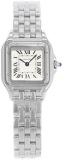
The Cartier Santos de Cartier family traces its lineage to a promise made in 1904 to Brazilian aviator Alberto Santos-Dumont, who needed a wristwatch he could read while keeping both hands on the controls of an early flying machine. That request produced one of the earliest purpose-built men's wristwatches, and it fixed the square bezel with exposed screws into the visual vocabulary of luxury horology. The result, available today through the Cartier collection, is a watch that balances aviation heritage with the kind of geometric discipline few designs achieve.
Many modern references pair a steel case with an automatic movement and a sapphire crystal, and the Santos de Cartier has evolved into a collection that spans steel, two-tone, and solid gold executions. What has not changed is the architecture: a curved square silhouette, a satin-brushed bezel, and the signature screws that give the case its industrial precision. That consistency is the reason the Santos remains one of the most recognizable shapes in the luxury segment.
A Square Case Beyond Convention
Very few luxury watches commit so completely to a non-round form. The Santos case is not merely square for novelty; it is square because the geometry was engineered around legibility on the wrist. The result reads instantly from across a room, and it carries a cuff presence that round cases rarely match under a shirtsleeve.
Reports from Cartier's own product pages place the medium model at 41.9 mm by 35.1 mm, with roughly 9 mm of thickness on comparable mid-size references and a lug-to-lug span near 42 mm. Blue crown cabochons and square-shaped glass appear across the line, alongside water resistance rated at up to 10 bar, or approximately 100 metres. For a dress-oriented watch, that figure outstrips what most peers offer.
Bracelets That Change in Seconds
Cartier markets the Santos collection as offering interchangeable metal and leather straps on several models. Practically, the brand's QuickSwitch system lets an owner swap between the tapered steel bracelet and a leather strap without tools or a visit to a service centre. It is a small engineering decision with a large lifestyle effect: the same watch shifts from boardroom to weekend.
On the gold and steel variants, the interchangeable approach is one of the collection's central propositions. Rather than purchasing two watches to cover formal and casual occasions, a single Santos can carry both roles through a different band alone.
Inside the Case: Automatic Calibre 1847 MC
Cartier fits the steel medium model with the 1847 MC, a self-winding in-house calibre. Published specifications list a power reserve of around 42 hours, which comfortably covers a weekend off the wrist before winding is required. Automatic winding also removes the battery question entirely, keeping maintenance cycles predictable for daily wearers.
On skeletonised references within the Santos line, Cartier takes a different route. A micro-rotor positioned near seven o'clock in the 9629 MC movement allows an elaborately openworked dial while keeping the case remarkably thin, reportedly just 8 mm on that variant. The two approaches show how far the Santos range stretches, from restrained three-hand automatic to technical showcase.
Two Expressions of One Design
- Classic reference: solid dial, 1847 MC automatic movement, industrial square case, tapered bracelet, straightforward timekeeping
- Skeleton reference: openworked dial, micro-rotor architecture, reduced case thickness, a display of mechanical craft as much as a way to read the time
Interchangeable straps tie the two together. Both accept the QuickSwitch treatment, meaning the leather-versus-steel debate resolves without a screwdriver either way.
Materials and Shared Cartier Craft
Steel is the base of most everyday Santos buys, and Cartier describes a medium model combining yellow gold and steel for a two-tone effect at a significantly higher price point. Sapphire crystal, the blue spinel or synthetic cabochon crown, and hand-finished case bevelling carry across the range. The Santos sits within a broader context of hardstone dial work, guilloché engraving, and precious-metal casting that other French-Swiss design houses also draw upon in their dress-oriented lines, a reminder that these ateliers have traded techniques and suppliers for the best part of a century.
The functional decisions Cartier made around the Santos line, waterproofing to 100 metres, magnetic resistance, and bracelet interchangeability, apply today more than they did in 1904. They also explain why the silhouette has remained relevant across more than a century without a fundamental redraw.
Wearing the Santos: Fit, Scale and Occasions
Medium is the size most owners find versatile. At 41.9 mm by 35.1 mm, it sits squarely in unisex territory, and the steel bracelet version with three links removed has been documented near 102 grams on the wrist. That reads as a substantial but not weighty piece, closer to a steel sports watch in feel than a thin formal dress watch.
Sapphire crystal with anti-reflective treatment sits over a square, silvered or patterned dial, and the minute track prints directly to the case lines, angled for legibility from a natural wrist position. The blue cabochon in the crown functions as the visual punctuation mark. On condition and completeness, trusted platforms such as Rolex GMT-Master II references set a comparable bar, and buyers shopping any heavy-hitting luxury reference learn to ask the same questions about provenance, original box and papers, and service history, whether looking at a Santos or a steel dive watch.
Everyday Wear Notes
- Water resistance: 10 bar/100 m covering hand washing, swimming, and rain without compromise
- Bracelet feel: tapered steel with individual screw links; micro-adjust often limited on era-specific versions, so sizing benefits from retention of extra links
- Maintenance: automatic movement, no battery change, service interval generally measured in several years depending on wear
- Fit: medium suits wrists where a 47 mm round case would feel oversized, without the compactness of a 34 mm dress watch
A single steel Santos with the full interchangeable bracelet and strap set addresses formal, casual, and travel purposes. It does the work of two or three watches in one case, and that is arguably the collection's most practical argument.
Buying a Santos Today: Provenance and Reference Codes
Santos references use Cartier model numbers beginning with CRWSSA and related codes, and specification sheets list dimensions, movement, and materials for each variation. When evaluating any example, confirmed provenance materially affects value: boxes, warranty cards, service receipts, and the presence of both the metal and leather bands for interchangeable-strap models all count. Buyers doing heavy research commonly compare value in adjacent categories, and with luxury purchasing tooling used as a benchmark, it becomes easier to judge a Santos offer against the broader dress-watch bracket.
Serialised case backs, correct crown cabochons, and factory bracelet end links are all checkable. Because the industry-standard verification process for mechanical watches is well documented, most questions about a specific Santos reference can be answered through Cartier's own model pages or an authorised service centre.
Newer variations continue to appear, and several current models pair steel or two-tone casework with the interchangeable-strap system, while demand for secondhand examples remains centred on steel medium and large sizes.
The Cartier Santos de Cartier endures because it never chased the round-watch consensus. A square case, exposed screws, and a bracelet swap set it apart in any collection, and its 1904 origin keeps that difference grounded in real function. For anyone considering a luxury watch that balances heritage, daily wearability, and distinctive design, the Santos still reads as the starting point rather than the compromise.
 Exciting, Best Luxury Watches for Sale!