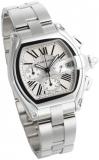
The Cartier Chronograph occupies a distinct position within the maison's watchmaking output, where the stopwatch complication is treated not as an added instrument but as an integrated element of cases already defined by their geometry. The Santos de Cartier Chronograph illustrates this approach, housing a manufacture movement inside a case measuring 47.5 mm by 39.8 mm and 11.6 mm thick, according to dimensions published by Cartier. The result is a chronograph that reads as a natural extension of the Santos silhouette rather than a separate sport model.
The 1904-CH MC Movement And Its Mechanical Foundation
At the centre of the Cartier chronograph proposition sits the Calibre 1904-CH MC, a manufacture chronograph movement developed in-house. The design brief behind this calibre was not simply to deliver stopwatch functionality, but to do so within the constraints of the Santos case architecture, which prioritises flatness and wearability over bulk. The result is an automatic movement with a 47-hour power reserve, a figure that places it within the range expected of contemporary luxury chronographs and allows the watch to remain functional over a weekend without winding.
What distinguishes the 1904-CH MC in daily use is the integration of its chronograph mechanism with a column-wheel system, a traditional approach that provides a crisp and consistent feel when the pushers are engaged. Unlike cam-actuated designs that can feel slightly resistive at the moment of activation, the column-wheel layout offers a tactile distinction that appeals to collectors who value mechanical refinement. The movement architecture also allows Cartier to maintain the Santos profile without resorting to a modular chronograph assembly, which would typically add thickness and complexity to the case.
Case Geometry And The Santos Design Language
The Santos case is one of the most recognisable silhouettes in watchmaking, defined by its visible screws on the bezel and the curved square profile that traces back to Alberto Santos-Dumont's original request for a wristwatch that could be used while flying. In chronograph form, this geometry is preserved across both the large and medium variants, though the proportions shift depending on the reference. The large steel model measures 47.5 mm from lug to lug and 39.8 mm across the case, with a thickness of 11.6 mm, while the two-tone steel and gold version presents a 43.3 mm case width and 12.5 mm thickness, as listed by authorised retailers.
Water resistance is rated to 10 bar, or approximately 100 metres, a specification that covers everyday exposure to water but does not position the watch as a diver. The sapphire crystal features the square-with-rounded-corners profile that complements the case, and the seven-sided crown is set with a synthetic spinel or blue cabochon depending on the variant. These details are consistent with the design vocabulary used across the Santos de Cartier line, and they give the chronograph a coherent identity rather than a pasted-on complication.
Dial Layout And Chronograph Readability
Cartier approaches chronograph dial design with a preference for integration over segregation. The sub-dials are positioned to maintain the visual symmetry of the Santos dial, with the minute counter and running seconds arranged at 3 and 9 o'clock or at 6 and 12 depending on the reference. The silvered opaline or satin-finish dials provide contrast for the applied Roman numerals and sword-shaped hands, while the chronograph hands are often finished in a contrasting tone to distinguish elapsed time from standard timekeeping.
The date aperture is typically placed within one of the sub-dials, a layout that avoids the asymmetry of a standalone date window and keeps the dial surface relatively uncluttered. For users who rely on the chronograph for interval timing, cooking, or athletic activities, the legibility of the sub-dial markings is a practical consideration. The dial side of the Cartier chronograph is designed to be read at a glance, with elapsed-time indicators that are distinct from the permanent time display.
How The Cartier Chronograph Compares Within The Category
The luxury chronograph segment includes a range of interpretations, from motorsport-inspired designs to dress-oriented complications. Watches such as the TAG Heuer Carrera position the chronograph as a tool for measuring speed and intervals, with dial layouts that emphasise elapsed-time functionality and pusher ergonomics. The Cartier approach differs in that the complication is integrated into a case that is already defined by its elegance, so the chronograph reads as a natural extension of the design rather than an added instrument. The same principle applies across related categories: the Breitling Chronomat emphasises a rugged, aviation-derived identity, while the Omega Speedmaster carries a history tied to space exploration. Each of these alternatives offers a different set of design priorities, and the Cartier chronograph occupies a space where mechanical precision is expressed through shape and proportion.
For buyers considering a chronograph, the question often comes down to whether the complication should dominate the watch's character or quietly coexist with it. The Cartier Santos chronograph leans toward the latter, with pushers that blend into the case band and a dial that retains the maison's codes. This makes it suitable for settings where a more overtly sporty chronograph might feel out of place, yet the watch does not compromise on the technical requirements of the complication.
- Calibre: 1904-CH MC manufacture chronograph, automatic winding
- Power Reserve: Approximately 47 hours
- Large Case Dimensions: 47.5 mm x 39.8 mm, 11.6 mm thick
- Two-Tone Case Dimensions: 43.3 mm width, 12.5 mm thick
- Water Resistance: Up to 10 bar (approximately 100 metres)
- Crystal: Sapphire with square-with-rounded-corners profile
Materials, Finishes, And Wearability
The Santos de Cartier Chronograph is available in several material combinations, including steel, two-tone steel and 18K yellow gold, and all-gold executions. The steel version maintains the brushed and polished surfaces that give the Santos its architectural character, with the bezel screws providing both a visual signature and a structural detail. The two-tone variant introduces a gold bezel that shifts the watch toward a dressier register, while the all-gold model positions it firmly in the luxury segment.
Wearability is a central consideration for any chronograph, and the Santos case dimensions are designed to sit comfortably on a range of wrist sizes. The large model's 47.5 mm lug-to-lug measurement is a relevant figure here, because it determines how the watch sits across the top of the wrist more than the case width alone. The curved profile of the case middle and the articulation of the bracelet or strap contribute to a fit that accommodates daily wear without the top-heaviness sometimes associated with larger chronograph cases.
The Santos bracelet system uses Cartier's quick-release mechanism, which allows the wearer to switch between steel, leather, and rubber straps without tools. This practical feature extends the versatility of the chronograph, making it adaptable to different contexts: a steel bracelet for formal and professional settings, a leather strap for dressier occasions, or a rubber strap for casual and active use.
Chronograph Functionality In Practice
The chronograph complication measures elapsed time through a central seconds hand and one or more sub-dial counters. In the 1904-CH MC movement, the chronograph is engaged and reset through pushers positioned at 2 and 4 o'clock, with the column-wheel mechanism controlling the start, stop, and reset functions. This three-function architecture is standard for mechanical chronographs, but the quality of the pusher feel and the precision of the hand alignment at reset are indicators of the movement's refinement.
In daily use, a chronograph on a watch like the Santos de Cartier serves purposes that range from timing a commute to measuring cooking intervals or tracking a workout. The value of the complication lies partly in this practicality and partly in the mechanical interest it adds to the watch. For enthusiasts, the ability to watch the chronograph mechanism engage through a transparent case back, where available, provides a connection to the movement that goes beyond simple time-telling.
Cartier rates the water resistance of the Santos chronograph at 10 bar, which means the watch can be worn while swimming but is not intended for diving. This rating is appropriate for a luxury chronograph that is likely to see more office use than ocean use, though it does provide peace of mind for everyday exposure to water and moisture.
The Broader Context Of Cartier Watchmaking
Cartier's entry into watchmaking began with the Santos de Cartier in 1904, a design created for the Brazilian aviator Alberto Santos-Dumont. That origin story establishes a connection between the brand and practical timekeeping that extends into the present day, with the chronograph representing a logical evolution of the original concept. The maison's other major lines, including the Tank, the Ballon Bleu, and the Panthère, each carry distinct design identities, and the chronograph versions within those lines adapt the complication to fit their respective cases. For collectors, understanding how the Santos chronograph relates to the broader Cartier brand's output is part of assessing its place in a wider watch rotation.
The presence of a manufacture chronograph movement in the Santos line also reflects Cartier's investment in movement development over the past two decades. The brand produces a range of in-house calibres at its facilities in Switzerland, and the 1904-CH MC is part of a family of movements designed to support both simple and complicated watches. This vertical integration gives Cartier more control over quality and supply, which has implications for how the chronograph performs over time and how readily it can be serviced.
Considerations For Buyers
When evaluating a Cartier chronograph, a few practical factors are worth keeping in mind. Case size is the first: the large model's 47.5 mm lug-to-lug measurement and 11.6 mm thickness will wear differently from the two-tone 43.3 mm variant, and wrist size should guide the choice between them. Material is the second: steel offers a sportier and more understated look, while two-tone or all-gold models lean toward formal settings. The third factor is the bracelet and strap configuration, since the quick-release system makes it possible to change the character of the watch without returning to a boutique.
The chronograph market also invites comparison with alternatives that place different emphases on the complication. Models such as the TAG Heuer Formula 1 and the Breitling Transocean offer chronograph functionality with their own design signatures, and the Omega Seamaster brings a dive-watch heritage to its chronograph offerings. Buyers who prioritise a specific sport or style context may find that one of these alternatives aligns more closely with their needs, while those who want a chronograph that reads as formal-first will find the Cartier Santos proposition particularly coherent.
Servicing is another dimension to consider. A manufacture chronograph movement like the 1904-CH MC benefits from Cartier's authorised service network, which has access to specific parts and training. The recommended service interval for mechanical chronographs is typically five to seven years, depending on usage, and keeping to that schedule helps preserve the precision of the movement and the condition of the case and bracelet.
The Cartier chronograph ultimately represents a specific philosophy: that a complication as technical as the stopwatch can be housed within a case defined by elegance, and that the two dimensions do not have to compete. The Santos de Cartier Chronograph, with its manufacture movement, slender profile, and adaptable strap system, is the clearest expression of that philosophy. For anyone drawn to the Santos silhouette but seeking the mechanical richness of a chronograph, the model offers a balanced answer that honours both design and horology.
 Exciting, Best Luxury Watches for Sale!