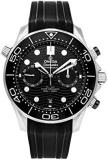
The Omega Seamaster Chronograph takes the familiar architecture of a professional dive watch and adds a stopwatch function that measures elapsed time with mechanical accuracy. The 44 mm case size, as documented in Omega's official specifications, gives the watch a substantial wrist presence, while the ceramic pushers and unidirectional bezel signal that this is a purpose-built instrument rather than a decorative accessory. The model sits within the Omega Seamaster collection, a lineage that dates back to 1948, when the Seamaster name first appeared in Omega's catalogues.
What separates this chronograph from a standard three-hand diver is not simply the addition of pushers. Those pushers are crafted from ceramic, a material Omega has refined across several modern collections. The ceramic construction matches the colour of the bezel insert, producing a cohesive look that avoids the contrast of steel pushers against a coloured bezel. This kind of material consistency reflects a broader movement in watchmaking where unified finishing signals intentional design rather than afterthought.
The dial layout varies by reference. Some versions use a bi-compax arrangement with sub-dials at 3 and 9 o'clock, while others adopt a tri-compax layout with counters at 3, 6, and 9 o'clock. A date window remains a practical inclusion for daily wear. The skeletonized hands and applied hour markers preserve the Seamaster's signature readability, even in low light. The laser-engraved ceramic dial, available in shades such as blue or black, adds a subtle depth that flat dials cannot replicate.
Behind the dial, the movement adheres to Omega's Master Chronometer standard. This certification, achieved after testing by the Swiss Federal Institute of Metrology, ensures resistance to magnetic fields up to 15,000 gauss. The Co-Axial escapement, a hallmark of modern Omega engineering, reduces friction between components and supports consistent long-term accuracy. The automatic winding system, visible through a transparent case back on many references, shows the level of mechanical finishing that justifies the chronograph's position above the standard three-hand Seamaster.
The bezel deserves particular attention. On chronograph models, Omega employs a polished ceramic bezel with a white enamel diving scale. The enamel filling process involves filling engraved recesses with a vitreous material that is then fired, resulting in a scale that resists fading and discoloration far better than printed alternatives. This detail is not merely cosmetic; it affects legibility in bright underwater environments where clarity is critical. The unidirectional rotation mechanism ensures safe timing of dive segments.
Water resistance, as expected from a professional dive watch, is rated to 300 metres. This capability is supported by a helium escape valve positioned at 10 o'clock, a feature that allows the watch to be used in saturation diving without risking case deformation. The screw-in crown and case back further secure the internal environment against water and dust ingress. While few owners will ever subject the watch to such extremes, the engineering provides peace of mind and speaks to the model's legitimate tool-watch pedigree.
The chronograph function operates via a column-wheel mechanism on certain high-end references, though Omega also employs cam-actuated systems in other variants. The column-wheel design is generally favoured for its smoother pusher feel and precise start-stop-reset sequence. In practice, the pushers offer a crisp, defined action that avoids the vagueness sometimes found in lesser chronograph movements. The central chronograph seconds hand sweeps smoothly, allowing for accurate reading of intervals down to fractions of a second.
Beyond its technical attributes, the watch carries a distinct aesthetic identity. The wave-pattern dial, a nod to the original 1957 Seamaster 300, has evolved into a more subtle laser-engraved texture on current models. The case profile alternates between brushed and polished surfaces, giving the watch a dynamic visual character that shifts with the light. The lugs curve downward to hug the wrist, mitigating the perceived bulk of the 44 mm diameter. On the steel bracelet with a diver's extension, the watch feels balanced and secure.
Collectors often compare this chronograph to other luxury chronographs, but the model stands apart through its uncompromising dive credentials. The combination of a helium escape valve, 300-metre water resistance, Master Chronometer certification, and ceramic pushers is unusual in a single package. For the travelling enthusiast, the watch transitions from a day at the beach to a formal dinner, provided the occasion tolerates a chronograph with a robust profile. The available material variations, including titanium-tantalum-Sedna gold mixes, offer an alternative for those seeking a warmer metallic tone or reduced weight on the wrist.
Serviceability and long-term ownership are part of the ownership experience. Omega maintains a global service network, and the Master Chronometer certification comes with the assurance of documented performance. The anti-magnetic properties mean that daily exposure to electronics, from laptops to airport scanners, will not disrupt timekeeping. This practical resilience, combined with the chronograph's utilitarian heritage, positions the Seamaster Chronograph as a surprisingly understated choice for collectors who prioritize function over fashion.
The legacy of The Omega brand's dive watch heritage, which dates back to 1948 and gained fame through its association with ocean exploration, continues in this chronograph offering. It does not rely on nostalgia alone; it builds upon decades of feedback from professional divers and watchmakers. The result is a watch that acknowledges its past while embracing modern manufacturing standards. For anyone seeking a dive chronograph that balances technical rigour with a design language unique to Omega, this model warrants serious consideration. Its value lies not in competing with fashion statements but in delivering reliable, certified performance in a form that respects the tradition of the tool watch. The chronograph's place within the Omega Speedmaster collection underscores how Omega's racing and diving lineages share a common pursuit of precision timing.
 Exciting, Best Luxury Watches for Sale!