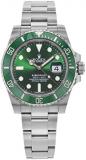
The Rolex Submariner Date reference 126613LB pairs an Oystersteel case with 18 ct yellow gold fittings, a royal blue dial, and a matching blue Cerachrom bezel insert. That specific combination of steel, gold, and blue has earned the watch one of the most recognised nicknames in modern horology.
The Anatomy of a Nickname
Collectors have long referred to the two-tone Submariner as the Bluesy, a shorthand born from its sunburst blue dial and yellow gold accents. The reference sits within the Rolex Submariner collection, a line that has anchored the dive watch category since 1953. While the full-gold variations of the same reference receive their own collector titles, the steel-and-gold version occupies a distinct position: it offers the visual presence of precious metal without abandoning the tool-watch roots of the original design.
The blue-and-gold formula has appeared across several Submariner generations. Earlier references such as the 16613 carried forward the same essential idea, and today's 41 mm version continues that lineage with updated materials and a larger case profile. The continuity matters because it demonstrates how Rolex iterates on a successful design language rather than replacing it.
Materials and Construction
Oystersteel and Yellow Gold
Oystersteel is Rolex's designation for the 904L-grade stainless steel used across its professional models. It resists corrosion in marine environments and takes a high polish that closely matches the lustre of gold. In the two-tone Submariner, this steel forms the case middle and the outer links of the Oyster bracelet, while 18 ct yellow gold appears on the bezel, the crown, and the centre links.
The Cerachrom Bezel Insert
The dive bezel's blue insert is made from Cerachrom, a ceramic material developed in-house. Ceramic resists scratching and fading far better than the anodised aluminium inserts used on vintage references, and it holds its colour under prolonged UV exposure. The numerals and graduations are coated with a thin layer of gold through a physical vapour deposition process, which gives them a metallic sheen while remaining legible in low light.
Dial, Lume, and Legibility
The royal blue dial carries a sunray finish that shifts in tone depending on the angle of light, moving from deep navy to a brighter mid-blue. Applied indices in 18 ct gold are filled with Chromalight, a luminescent compound that emits a blue glow. Rolex states that the display remains readable for up to eight hours in darkness, a specification that matters for divers and for anyone who checks the time before dawn. The characteristic Submariner hands, a broad hour marker and a smaller minute hand, complete the arrangement.
Performance Specifications
The current 126613LB is powered by calibre 3235, a self-winding movement with a 70-hour power reserve, a Chronergy escapement, and a blue Parachrom hairspring. It carries Superlative Chronometer certification, which requires an average daily rate of minus two to plus two seconds after casing.
The case measures 41 mm in diameter and is rated water resistant to 300 metres. A unidirectional rotatable bezel with 60-minute graduations allows elapsed dive time to be tracked without risk of accidental rotation in the wrong direction. The screw-down crown and case back, both elements of the Oyster architecture introduced by Rolex in the 1920s, contribute to that sealing performance. A date window with a Cyclops lens sits at 3 o'clock.
| Specification |
Rolex Submariner Date 126613LB |
| Case material |
Oystersteel with 18 ct yellow gold |
| Case size |
41 mm |
| Bezel |
Unidirectional, Cerachrom insert, blue |
| Dial |
Royal blue sunray |
| Movement |
Calibre 3235, automatic |
| Power reserve |
70 hours |
| Water resistance |
300 metres |
| Bracelet |
Oyster, Oystersteel and yellow gold |
Where Blue and Gold Fits in the Rolex Lineup
Rolex applies the blue-and-gold combination well beyond the Submariner. The same essential palette appears in the Rolex Datejust collection, where a fluted yellow gold bezel and a blue dial create a dressier effect, and in the Yacht-Master series, where the blue dial is paired with a bidirectional bezel in precious metal. Each application adjusts the balance between sport and formality.
Against the Datejust, the Submariner reads as the more overtly utilitarian piece: a rotating bezel where the former has a fixed one, greater depth rating, and a case profile built around underwater use. Against the Yacht-Master, the difference becomes one of intent rather than material. The Yacht-Master targets regatta timing and on-deck wear, while the Submariner remains a certified dive instrument in appearance and construction.
Within the broader Rolex catalogue, a yellow gold case with a blue dial also appears in precious-metal references such as the full-gold 126618LB, which shares the Cerachrom bezel and royal blue dial but replaces Oystersteel entirely with 18 ct gold. That version carries considerably more mass and a different price bracket. The two-tone 126613LB occupies the space between stainless steel references and their solid-gold counterparts.
The association extends further into other Rolex families that lean on colour as a signature. The Rolex brand's approach to colour treats a dial as the emotional centre of a watch, and few colour choices carry as much recognition as blue against yellow gold. That pairing appears in limited executions and anniversary pieces across multiple decades, which helps explain why it retains such strong associations for collectors.
Wearing the Bluesy
At 41 mm, the watch sits close to the wrist despite its depth rating. The Oyster bracelet's flat three-piece links and folding Oysterlock clasp keep the profile manageable, and the Glidelock extension system allows fine adjustment of the bracelet length without tools, a feature originally added to accommodate wetsuit thickness. That adjustability makes the watch easy to fit precisely, whether worn over a shirt cuff or against bare skin.
Weight distribution differs from a full-steel Submariner because the gold centre links add mass, and this shifts the balance slightly. Some wearers notice the additional heft over a full day, while others find that it contributes to the sense of solidity. The blue dial changes character under different lighting: sharp daylight brings out a brighter tone, while evening interior lighting deepens it toward navy.
Value and Longevity
Two-tone sports watches occupy an unusual space in the secondary market. They typically trade below their full-gold equivalents while offering a similar aesthetic, and their production runs are long enough that several references remain available on the pre-owned market. Blue dials tend to hold interest particularly well because the colour combination has remained in continuous production through multiple references.
From a maintenance standpoint, the ceramic bezel insert resists the fading that affects aluminium inserts on older models, and the 3235 movement uses a paramagnetic alloy hairspring that reduces sensitivity to magnetic fields. Routine servicing intervals remain comparable to other Rolex automatic calibres.
The Enduring Appeal of Blue and Gold
Few colour pairings in watchmaking carry the same immediate recognition as royal blue against yellow gold. Applied to a dive watch designed for underwater work, the combination carries a deliberate tension between function and display, and it is that tension that has kept the two-tone Submariner in continuous demand across generations. For collectors drawn to a design that reads equally well with a wetsuit or a dinner jacket, the blue-and-gold reference remains a defining expression of the Submariner idea, one that continues to shape how the model is perceived today.
 Exciting, Best Luxury Watches for Sale!