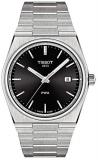
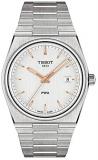
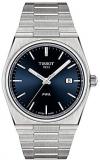
The Tissot PRX with a leather strap transforms a familiar integrated-bracelet silhouette into something warmer and more tactile. Where the steel-bracelet versions emphasise the sharp geometry of the 1970s-inspired case, fitting a leather band softens that architecture just enough to shift the watch from sporty to smart-casual. That single change alters how the piece reads on the wrist, and it is the reason so many owners keep a spare strap on hand.
The platform itself is well documented in Tissot's official specifications. The 40 mm PRX is built around a 316L stainless steel case with a diameter of 40.00 mm, a thickness of approximately 10.93 mm, and a lug width of 12.00 mm. Scratch-resistant sapphire crystal protects the dial, and Tissot lists interchangeable quick release bracelets across the range. Those numbers matter because they explain why the watch sits so flat and why a strap swap takes seconds rather than a trip to a service bench.
Why the PRX Silhouette Suits Leather So Well
The defining trait of the PRX is its integrated case design, where the lugs flow directly into the bracelet without conventional visible spring bars. This is a shape borrowed from the quartz era of the 1970s, when watchmakers treated the case and bracelet as a single sculptural object. When Tissot's official Black PRX 40 mm leather strap is fitted, that design language is preserved through a steel endpiece that bridges the case and the leather.
That steel endpiece is the detail worth understanding. It maintains the seamless line between case and strap while allowing the softness of leather to take over past the first link position. The result reads as a dress watch with a sporty skeleton rather than a sports watch dressed up for the office. For a brand with a deep archive of everyday pieces, the leather-strapped PRX sits comfortably alongside heritage-inspired Tissot references, where vintage cues are treated with the same seriousness as modern specifications.
Movement Options and Strap Pairing
Tissot offers the PRX 40 mm with two distinct movement families, and both work with leather. The quartz references, such as model T1374101104100, use a Swiss Quartz calibre, which keeps the case slim and the ownership experience low-maintenance. The automatic references, including model T1374071135100, carry a Swiss automatic movement with a listed power reserve of up to 80 hours and a see-through caseback.
The automatic version pairs particularly well with leather for a simple reason: the open caseback and sweeping seconds hand already signal a mechanical watch, and a leather band reinforces that traditional character. On the quartz model, the leather strap instead becomes the primary source of personality, which is useful for anyone treating the PRX as a sharp everyday option.
Strap Specifications at a Glance
- Reference: T852.047.562
- Material: Black leather with steel endpiece
- Fits: PRX 40 mm case
- Attachment: Interchangeable quick release
The quick release system is genuinely practical. Rather than choosing between one look, an owner can run the steel bracelet through a working week and switch to leather for evenings or weekends without tools.
Owning Two Straps, Not Two Watches
Much of the PRX's appeal comes down to versatility, and the leather strap is the clearest expression of that. A steel bracelet version carries more visual weight and reflects light more aggressively, which suits casual settings but can feel heavy against a suit. Leather dials that presence down. The watch keeps its 40 mm case and 12 mm lug width, but the wrist presence becomes quieter and more formal.
This is also where the PRX distinguishes itself from tool-oriented designs. Dive-inspired watches, much like those in the Tissot T-Sport collection, prioritise rubber straps and high water resistance for active use, while the PRX with leather stays in the city and at the desk. Neither approach is better; they simply serve different routines, and recognising that distinction helps buyers choose wisely.
Care and Longevity for a Leather PRX
Leather rewards a little attention. Because the PRX strap uses a steel endpiece, the leather section itself is replaceable and can be treated like any quality strap: keep it away from prolonged water exposure, wipe it down after wear, and store the watch flat when it is not on the wrist. The sapphire crystal and 316L steel case need almost no maintenance by comparison, so the strap becomes the component that shapes how the watch ages.
This is a normal trade-off in watch ownership. Leather patinas and develops a personal character over time, which is precisely what attracts many buyers to it, while also meaning it will eventually need replacement. Tissot's decision to use quick release attachments makes that cycle inexpensive and tool-free.
Where the Leather PRX Fits in a Collection
The PRX occupies a specific niche: an affordable Swiss watch with a genuinely distinctive case shape. Adding leather pushes it further toward the dress side of that niche, making it a reasonable companion to other slim, leather-strapped pieces. The broader Tissot brand's approach to everyday wear is remarkably wide, and the PRX leather variant is arguably its cleanest statement of that idea.
The appeal is not novelty for its own sake. It is the recognition that one well-proportioned case, a reliable movement, and a swap-friendly strap system can cover more of daily life than a single fixed configuration ever could. The PRX in leather is a quiet argument for buying fewer watches and wearing them more deliberately, and that argument holds up every time the strap comes off.
 Exciting, Best Luxury Watches for Sale!