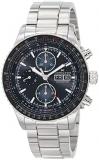
The Hamilton pilot watch represents a distinctive intersection of military utility and civilian sophistication, drawing on a design lineage that traces back to the early days of American aviation. While many contemporary brands chase trends, this family of timepieces remains anchored to functional principles: legibility, durability, and a direct connection to the cockpit. Its enduring appeal lies not in ornamentation but in the quiet confidence of a tool built for a specific purpose.
The Khaki Aviation collection is the primary expression of this philosophy, and the Hamilton brand's aviation range continues to expand on that foundation. For anyone exploring field-inspired or flight-oriented watches, the Hamilton pilot watch stands as a reference point worth understanding in detail.
Historical Foundations of the Hamilton Pilot Watch
Hamilton's involvement in aviation timekeeping dates back to the early twentieth century, when the company supplied precision instruments to the U.S. armed forces. The Model 21 marine chronometer, for instance, was documented as keeping time to within half a second per day, exceeding the Navy's accuracy requirements. That same engineering discipline was later directed toward wristwatches intended for pilots, where reliability under vibration, temperature fluctuation, and magnetic interference was non-negotiable.
This history is not merely a marketing footnote. It explains why modern Hamilton pilot watches retain design cues such as oversized crowns, high-contrast dials, and robust stainless steel cases. These are not stylistic affectations; they are solutions to problems that pilots faced decades ago and that remain relevant for anyone who values a legible, dependable watch.
Key Models and Technical Specifications
The modern Khaki Aviation range offers several distinct interpretations of the pilot watch format, each with its own character and specifications. The following table summarizes the core attributes of two prominent references, based on information published by Hamilton.
| Feature |
Khaki Aviation Pilot Day Date Auto (H64615585) |
Khaki Aviation Pilot Day Date Auto (H64615135) |
| Caliber |
H-40 |
H-40 |
| Case Size |
42mm |
42mm |
| Case Thickness |
11.85mm |
11.85mm |
| Dial Color |
Grey |
Black |
| Case Material |
Stainless Steel |
Stainless Steel |
| Crystal |
Sapphire |
Sapphire |
| Lug Width |
20mm |
20mm |
| Power Reserve |
80 hours |
80 hours |
| Water Resistance |
Not specified in source |
Not specified in source |
| Day-Date Complication |
Yes |
Yes |
| Target Audience |
Pilots, aviation enthusiasts |
Pilots, aviation enthusiasts |
| Design Influence |
Classic cockpit instrumentation |
Classic cockpit instrumentation |
Both references share the same H-40 automatic caliber with an 80-hour power reserve, a movement that allows the watch to be set aside for a weekend without losing time. The primary differentiator is dial color: a grey option for understated versatility and a black option for maximum contrast. The 42mm case size suits a broad range of wrist sizes, while the 11.85mm thickness keeps the profile manageable under a shirt cuff.
The H-40 Caliber and Its Practical Benefits
At the heart of the Khaki Aviation Pilot Day Date Auto is the H-40 movement. Its 80-hour power reserve is a notable feature for a watch in this category, as it reduces the need for daily winding and adds a layer of convenience for owners who rotate between several timepieces. The movement is based on a reliable automatic architecture, and its performance is consistent with Hamilton's reputation for robust, everyday mechanical watches.
Compared to Omega Seamaster models that often prioritize diving capabilities, the Hamilton pilot watch focuses on aerial navigation tools. The day-date display at 3 o'clock is a practical addition for daily wear, providing quick access to calendar information without cluttering the dial. The sapphire crystal offers scratch resistance, a quality that matches the expectations set by higher-priced luxury watches like those from Cartier.
What distinguishes the Hamilton pilot watch from Rolex Submariner or other dive-oriented references is its prioritization of legibility in low-light conditions. The large Arabic numerals and broad hands, often treated with luminous coating, allow for rapid time reading, a critical feature in a cockpit environment. This design ethos is shared by TAG Heuer Link and other tool-watch lineages, though Hamilton's interpretation remains distinctly aviation-focused.
For collectors who appreciate a watch with a story, the Khaki Aviation line offers a tangible connection to mid-century military instrumentation. It sits comfortably alongside field watches from Oris and heritage-inspired pieces in the Tissot Heritage range, each offering its own perspective on functional design.
Design Language and Wearability
The Khaki Aviation Pilot Day Date Auto is defined by a clean, highly legible dial framed by a stainless steel case. The 42mm diameter is a contemporary size that feels substantial without being oversized. The grey dial variant (H64615585) provides a subtle, versatile appearance that transitions easily from cockpit to office, while the black dial (H64615135) delivers a more traditional pilot-watch aesthetic with stronger contrast.
The 20mm lug width allows for straightforward strap changes, so owners can adapt the watch to different occasions. A leather strap can emphasize its heritage character, while a steel bracelet or NATO strap can lean into its utilitarian roots. This flexibility is a hallmark of well-designed pilot watches from brands like IWC and Breitling Avenger, and Hamilton executes it with clarity.
Why the Hamilton Pilot Watch Endures
The enduring appeal of the Hamilton pilot watch lies in its honesty. It does not pretend to be a dress watch, nor does it chase the latest smartwatch features. Instead, it delivers a mechanical experience grounded in a specific purpose: reliable timekeeping for people who value legibility and durability. The 80-hour power reserve, 42mm stainless steel case, and sapphire crystal come together to form a package that is both practical and historically resonant.
For anyone considering a Rolex Explorer or a TAG Heuer Grand Carrera, the Hamilton pilot watch offers a compelling alternative narrative. It is a reminder that a watch can be a tool and an object of desire at the same time, without resorting to excess. That balance, precision without pretension, is what keeps this family of timepieces relevant in an era of digital overload.
 Exciting, Best Luxury Watches for Sale!