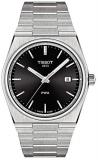
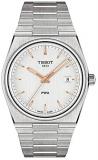
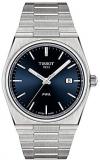
The Tissot PRX 40mm reintroduces a silhouette that dates back to the brand's 1978 catalog, reworking a flat-toned, tonneau-style case into a contemporary 40 mm profile. That decision positions the watch between dressy restraint and casual wearability, with a bezel-free case edge that flows directly into the bracelet. Source material from Tissot's own product pages confirms a 316L stainless steel case, a scratch-resistant sapphire crystal, and, depending on the reference, either a Swiss quartz or Swiss automatic movement.
A Case Built Around Restraint
The 40 mm diameter is not an arbitrary number. It sits in a transitional range that suits wrists of roughly 16 cm to 19 cm, which covers a large share of adult wearers without leaning toward oversized trends. The profile stays slim, and the integrated bracelet means there is no protruding lug gap to catch fabric or add visual bulk. Tissot constructs the case and bracelet from 316L stainless steel, a surgical-grade alloy chosen for its corrosion resistance and its ability to hold a brushed or polished finish without pitting over time.
Thinness as a Design Choice
Because the caseback sits close to the wrist, the PRX 40mm slides under a shirt cuff where many sports watches cannot. The bezel-less edge eliminates the visual step found on dive-style cases, directing attention to the dial and to the bracelet's tapering links. This is a design lineage that connects the model to Tissot Heritage, where historical proportions are treated as the starting point rather than decoration.
Sapphire and Caseback Variations
Every 40 mm reference uses a scratch-resistant sapphire crystal, and the automatic versions add an antireflective coating to reduce glare in daylight. Automatic references also include a see-through caseback, which turns the movement into part of the visual experience rather than a hidden component. Quartz references close the back with solid steel, favoring a thinner overall profile over movement visibility.
Two Movement Paths, One Silhouette
Tissot sells the PRX 40mm across two movement families, and the choice between them changes both the ownership experience and the case profile. Quartz references such as T1374101104100 run on a Swiss quartz caliber that requires only periodic battery replacement, while automatic references such as T1374071104100 use a Swiss self-winding movement visible through the sapphire caseback.
- Swiss quartz: consistent accuracy, minimal maintenance, slimmer case construction
- Swiss automatic: self-winding mechanism, see-through caseback, mechanical character for enthusiasts
- Shared platform: 40 mm case, sapphire crystal, 316L stainless steel
The automatic option appeals to wearers who want a mechanical connection to the watch, since the rotor's movement becomes visible throughout the day. The quartz option suits anyone who prioritizes a grab-and-go routine and specific cosmetic details, much like the Tissot Touch Collection serves a different role in the brand's lineup.
The Dial and Its Integrated Bracelet
The dial follows principles established in 1970s industrial design: geometric indices, a horizontal texture pattern on several references, and a date window placed at 3 o'clock. Applied markers catch light at different angles, and the printed minute track keeps the layout readable without clutter. Several references use a blue gradient finish that shifts between a bright center and deeper edges depending on the light.
Bracelet Architecture and Quick Release
The bracelet is not a separate component bolted onto the case. Its first link integrates directly with the case sides and tapers toward a butterfly clasp with push-button release. Tissot fits the PRX 40mm with an interchangeable quick release system, which allows the bracelet to be removed by hand and replaced with a leather or rubber strap without tools. It is a practical detail that extends the watch's range from office use to weekend wear.
Where the PRX Fits Among Integrated-Bracelet Watches
Integrated-bracelet designs occupy a specific niche, defined by a seamless visual transition from case to bracelet and a dial that often uses texture instead of additional complications. The PRX 40mm applies those principles at a price point and production scale that keeps the format accessible. Its closest stylistic relatives exist in higher segments of the market, where manufacturers use the same architectural idea to signal sport-oriented construction methods and water-ready case engineering, as seen in Tissot T-Sport.
Against those references, the PRX 40mm focuses on proportion rather than added functions. There is no rotating bezel, no chronograph complication, and no oversized case. The product relies on the fit of the bracelet, the reflection of the sapphire crystal, and the rhythm of the indices across the dial to establish its identity.
Wearing the 40 mm Case in Daily Life
Daily wear favors a case that moves with the wrist without catching on desk edges or jacket linings. At 40 mm, the PRX stays within a range that reads clearly on the wrist without dominating it, and the tonneau shape keeps the profile visually narrow from a top-down view. Water resistance covers the kind of exposure that comes from washing hands, rain, and light swimming, though the exact rating depends on the specific reference.
Caring for the Finish
Stainless steel wears differently depending on how it is finished. Brushed surfaces develop a soft patina of micro-scratches over years of use, while polished edges show fingerprints and light swirls more readily. A microfiber cloth and mild soapy water address most of this. Because sapphire crystal sits near the top of the Mohs hardness scale, it resists scratches that would dull a mineral or acrylic crystal, though it can still chip under direct impact.
Choosing the Right 40 mm Reference
Buyers weighing the available configurations should consider dial color, movement type, and caseback style together rather than individually. The price gap between quartz and automatic references reflects the movement and the finishing differences that accompany it. Neither option compromises the outer design, so the decision tends to come down to maintenance preference: quartz for a low-effort ownership cycle, automatic for anyone drawn to mechanical horology and a visible movement.
The PRX 40mm occupies an unusual position in the current market. It is a steel sports-style watch with archival roots, produced in a size that works for a wide range of wearers, and built around a case geometry that rewards close inspection. For anyone drawn to the integrated-bracelet format but not necessarily to its modern price tiers, this remains one of the most direct routes into that design language.
 Exciting, Best Luxury Watches for Sale!