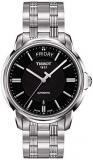
The Tissot PRX Black takes a 1970s integrated-bracelet blueprint and rebuilds it for contemporary daily wear, pairing a slim 40mm stainless steel case with a dial that reads as a graphic black ground rather than a colour option. The platform's core proposition is straightforward: a Swiss movement, a scratch-resistant sapphire crystal, and a case-and-bracelet architecture that flows without conventional lugs. That combination is why the reference has become one of the most recognisable designs to emerge from the Tissot brand, sitting apart from the dive and racing silhouettes that dominate the sports segment.
Where the PRX Formula Comes From
The PRX name is brand shorthand for the model's stated attributes: precise, robust, and X for the ten-year battery expectancy associated with its quartz references. The silhouette traces back to the 1978 Tissot Seastar, a period when Swiss makers were experimenting with monobloc cases and flat-link bracelets that extended directly from the case band. The 2021 revival is not a literal reissue. The case has been re-proportioned for modern wrists, the crystal is flat sapphire rather than the acrylic or mineral options of the era, and the bracelet now uses a quick-release spring bar system so straps can be swapped without tools.
The Three-Link Bracelet Architecture
The bracelet is the defining element. It uses a broad flat-link pattern with a satin-brushed finish on the outer links and polished bevels on the narrow central link, and the top links are integrated into the case band so the transition reads as a single continuous surface rather than a jointed attachment. This construction gives the PRX its visual weight on the wrist without making the watch feel heavy in absolute terms. The clasp is a folding safety type with push-button release, and the links are secured by pins rather than screws, a cost-conscious choice that still delivers a tight, rattle-free fit when adjusted correctly.
Black Dial Variants and Readability
The black dial version is where the design reads as most versatile. A flat black surface absorbs surrounding light, which lets the applied indices and hands carry the legibility load rather than the dial reflecting glare. Applied baton markers sit on raised bases with a thin polished frame around each index, the hands are a simple baton form with a luminous fill, and the date aperture at 3 o'clock is framed by a matching applied surround. On quartz references the dial text is restrained; on automatic references the Powermatic 80 line introduces a broader textural palette, including models with a sunray or vertically brushed finish and two-tone treatments.
Quartz Precision Versus the Powermatic 80 Automatic
Two movement families define the current black-dial PRX range. The quartz references use a Swiss quartz caliber, which keeps the case relatively slim and removes the need for winding and servicing intervals beyond battery replacement. Tissot's own published documentation for these references lists the movement as quartz with a sapphire crystal and an interchangeable quick-release bracelet, which signals that the platform was designed for ownership convenience as much as appearance.
The Powermatic 80 automatic is the alternative for buyers who want mechanical operation. It is a Swiss automatic with an 80-hour power reserve, which means the watch can be set down on a Friday evening and still be running on Monday morning without a winder. That figure is meaningful in a segment where many comparably sized automatics sit closer to 40 hours of reserve. The visual marker of the automatic is often a textured dial and, on premium finishes, a black seconds hand and black-nickeled indexes that Tissot has used to add contrast on the titanium and Damascus steel variants of the platform.
Dimensions, Materials, and Wearability
Official Tissot specification pages list the 40mm PRX with a case width of 40.00mm, a length of 39.50mm, a thickness of 10.93mm, and a lug width of 12.00mm. Those numbers matter more than the headline diameter, because a 39.50mm lug-to-lug distance is compact enough that the 40mm case footprint sits inside the wrist edge on a wide range of wrist sizes. The 12mm lug width is unusually narrow and is a direct consequence of the integrated design; it is the bracelet taper rather than a strap width in the traditional sense.
These proportions explain the perceived comfort advantage of the platform, a quality that carries through related sports references such as the Tissot T-Sport line, which also builds on case-to-bracelet continuity rather than a conventional strap mount. The 316L stainless steel case is the standard in this class of Swiss watches: a low-carbon austenitic alloy that resists corrosion and takes a satin or high-polish finish without pitting. Sapphire crystal covers the dial, which puts the PRX in the same durability class as references from adjacent Swiss brands, including archive-inspired pieces like the Tissot Heritage range, where historical design cues are paired with modern materials.
Water Resistance
Tissot's specification pages for the 40mm PRX list the model as water-resistant, and the design intent is daily wear protection rather than committed aquatic use. Hand washing, rain exposure, and swimming in shallow conditions are within the intended envelope. Saturation diving, high-impact water sports, and extended submersion go beyond what the case construction is engineered for, and the push-pull rather than screw-down crown on many references reflects that positioning.
Black as a Design Strategy, Not a Colour Choice
The black dial is not simply one of several colour options. It is the anchor variant that the visual identity of the PRX is built around. A dark dial suppresses reflection on a flat crystal, which makes the indices and hands read as graphic marks on a solid ground. That visual logic aligns the watch with the studio-driven side of Swiss design rather than the instrument-driven side. References in the same creative neighbourhood include models drawn from Hamilton's dependable field watches, where form is disciplined by function and typography does the heavy lifting instead of applied hardware. Where the PRX departs from that field-watch instinct is in the bracelet, which is polished and architectural rather than canvas and utilitarian.
Servicing, Ownership, and Aftermarket Reality
Ownership economics differ sharply between the two movement families. A quartz PRX requires battery replacement typically on a two to three year cycle depending on the caliber and usage, and a pressure test at the same time if the watch is used around water. An automatic PRX carries a service interval measured in years, generally four to seven depending on wear, and a service bill that reflects the labour of a mechanical overhaul rather than a battery swap.
The interchangeable bracelet system mitigates one common ownership friction point. Because the spring bars release without tools, owners can switch between the steel bracelet and a leather or rubber strap without risking case scratches during the swap. That flexibility gives a single watch two distinct personalities: bracelet-on for formal settings and strap-on for a more relaxed presentation.
Where the PRX Black Sits in the Contemporary Market
The integrated-bracelet sports watch is a crowded category at the top end of the market, with steel sports references commanding far higher entry prices. The PRX competes on a different axis: it delivers the visual codes of an integrated bracelet design with Swiss movement provenance at a cost structure that places it within reach of a first serious mechanical or quartz purchase. Buyers weighing the platform against heritage-driven alternatives often compare it to archive-inspired references elsewhere in the catalogue and to sport-chronograph lines where motorsport cues replace integrated-case restraint.
The black-dial variants remain the safest starting point precisely because they sidestep colour trend risk. A black dial on a steel bracelet has not fallen out of favour in four decades, and a design vocabulary borrowed from a late-1970s Seastar is far enough removed from the present day to read as deliberate rather than dated. That is the quiet case for the PRX Black: it commits to a strong design position and lets proportion, finishing, and movement choice carry the argument.
 Exciting, Best Luxury Watches for Sale!