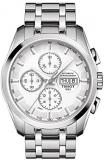
The Baume & Mercier Riviera Baumatic draws its name from a stretch of coastline where alpine composure meets Mediterranean light, and the watch translates that duality into a 42 mm stainless steel case that alternates brushed and polished surfaces. The result is a timepiece that can accompany a boardroom presentation in the morning and remain equally convincing at a dockside dinner in the evening. Few Swiss automatic watches in this segment reconcile robust construction with genuine dress-watch restraint so deliberately.
That balance is not accidental. The Riviera lineage dates to 1973, when Baume & Mercier joined the first wave of luxury steel sports watches equipped with integrated bracelets. Rather than treating that chapter as a museum piece, the brand returned to it in recent years with a modernized case architecture, contemporary proportions, and an in-house developed automatic movement. The Riviera you see today is therefore best understood as part of the Baume & Mercier collection, revisiting heritage without surrendering to nostalgia, sharpening the original silhouette while keeping the twelve-sided bezel that has always served as the model's signature.
At the heart of the reference sits the Baumatic calibre, a self-winding movement developed as part of the brand's wider push toward serious mechanical engineering. It provides a generous power reserve rated by the manufacture at five days, which means the watch can be set aside on a Friday evening and still be running come Wednesday. More significantly for daily wear, the movement is engineered for resistance to magnetic fields commonly encountered around laptops, tablets, and phone speakers, with Baume & Mercier stating that the calibre is designed to withstand everyday magnetic exposure without the need for a soft iron inner cage. That architecture preserves an unobstructed view through the sapphire display back.
Inside The Baumatic Calibre
The Baumatic movement is the persuasive argument that separates this Riviera from countless fashion-forward alternatives. According to Baume & Mercier, the calibre achieves chronometric performance that comfortably satisfies the general standards applied to fine Swiss watches, and the brand positions it as a long-service engine rather than a disposable module. A silicon-based escapement component reduces friction and improves resistance to temperature variation.
Power Reserve And Precision
A five-day reserve changes the ownership experience in practical ways. Watch collectors who rotate several pieces no longer need a winder for every shelf slot, and a traveler can pack the Riviera for a week-long trip knowing it will still be accurate in the drawer on the last morning. Automatic winding replenishes energy through normal wrist movement, and hand-winding through the crown is available when a quick top-up is more convenient than wearing the watch.
Magnetic Field Protection
This generation of anti-magnetic construction deserves a closer look, because the approach is subtler than the sealed iron inner cases used elsewhere in Swiss horology. Certifications established by independent testing institutes draw a clear line between watches capable of resisting fields of 4,800 A/m, the general standard, and those engineered to endure far greater exposure.
Designs following the ISO 764 framework focus specifically on this parameter rather than relying on a thick cage, and working examples can be compared against approaches like the Tissot collection, where similar anti-magnetic priorities appear in different forms. Disassembling these engineering choices explains why the Riviera needs no soft iron cage and instead relies on the movement itself to resist everyday magnetic loads.
Foundational materials grow in importance alongside that architecture. Modern gear trains increasingly use non-magnetic components to reduce drift, a philosophy long popular in precision watchmaking and visible across designs such as those referenced with the Frederique Constant collection, where similar materials-driven approaches appear. Baume & Mercier's strength lies in approaching this through watchmaking strategy rather than treating it merely as a marketing headline.
Case Architecture And Wrist Presence
The twelve-sided bezel sits above a round middle case, a geometry that gives the watch a distinctive shoulder line without compromising the comfort of a standard round caseback. In some markets the Riviera is offered as a 42 mm reference, while Wempe lists a 39 mm stainless steel variant with sapphire crystal that is anti-reflective on both sides, a diamond-free bezel, and the same general design language. The smaller diameter widens the audience considerably. Larger versions traditionally command attention for the wrong reasons at formal occasions, but the smaller Riviera slips cleanly under a cuff shirt. Buyers with wrist circumferences around 17 to 19 centimetres are generally well served by the 39 mm version, and those with broader wrists can consider the 42 mm references as the more assertive expression of the same idea.
Sapphire crystal appears on both the front and the reverse. Anti-reflective treatment reduces glare in bright daylight, an underrated detail on a watch whose dial relies on crisp geometric printing rather than luminous clutter. Water resistance is rated to 100 metres according to coverage of the Baumatic 10616 reference, which the brand fulfils despite the crown not being of the screw-down type. That rating comfortably covers swimming, showering, and incidental splashes without inviting the wearer to treat the watch as professional dive equipment.
Across the broader landscape, integrated-bracelet divers take many different paths. Open-hearted tool divers are a separate tradition entirely.
Consider the segmented, rail-style look used on references within the Omega Seamaster collection, the aggressively chunky skeleton architecture common to the TAG Heuer Aquaracer family, or the polygonal, modernist bezels used as design pivots on models such as those within the Corum series. Each path puts a different emphasis on how a sports watch should read on the wrist, and the Riviera's more restrained interpretation of the same brief gives it a broader vocabulary than many wristwatches aimed at a purely athletic audience.
Design Language And The 1973 Roots
The Riviera story begins with the first generation, one of the earliest luxury steel sports watches to feature an integrated bracelet, sitting alongside the Rolex Explorer collection and other influential pieces of the era. Where some contemporaries evolved toward extreme case shapes, the Riviera kept its identity anchored to the dodecagonal bezel, a geometric motif that has survived nearly five decades of taste cycles. Look through the Rolex Yacht-Master II range and other modern sports chronographs and the contrast is instructive: extreme complication and busy sub-dials dominate many options, whereas the Riviera works with a cleaner scenario.
Dial execution reflects the same discipline. Applied indices replace printed markers, catching the light in a way that gives dimension without drama. A date window at three o'clock maintains everyday utility without breaking the dial's symmetry, and the hands are legible enough for quick reading at a glance. Baume & Mercier keeps the colour range controlled rather than resorting to novelty finishes.
Everyday Ownership And Occasions
There is a practical argument for the Riviera that occupies a smaller share of marketing copy than it deserves. The integrated bracelet flows into the case with polished first links and a comfortable taper, and the watch is equally at ease with denim, knitwear, or tailoring as it is with the tailored shirt it will slide underneath. Owners of a GMT complication will recognise the utility of wearing the same thing through airport security and an evening reservation, and the Riviera's 100-metre water resistance handles either without skips.
From a servicing perspective, the Baumatic's long power reserve and simplified gearing reduce the kind of constant attention some high-reserve movements require. Collectors comparing the Riviera with general Swiss mainstays often include designs from the Jaeger LeCoultre portfolio in the equation. Swiss finishing standards give a hint at the level Baume & Mercier reaches here, and the Riviera holds its own on this axis without reserving the design for special occasions.
Why The Riviera Baumatic Deserves Consideration
The Riviera Baumatic makes a direct case for itself. It offers an in-house automatic calibre with a five-day reserve, meaningful magnetic resistance, a sapphire display back, an integrated steel design with genuine heritage in its twelve-sided bezel, and water resistance rated to 100 metres, all delivered in a silhouette that genuinely suits everyday wear. Comparatively, this combination points to a higher price category, where additional expenditure does not always enlarge the specification list.
Those attributes give the watch a persuasive combination of technical content and aesthetic restraint that is difficult to assemble elsewhere in this bracket. Whether evaluated as a first serious Swiss automatic for a new enthusiast or as a well-rounded addition to an established collection, the Riviera Baumatic carries the architectural confidence of its 1973 ancestor without treating that heritage as its only argument. Baume & Mercier built a modern watch that faces forward as convincingly as it looks back.
 Exciting, Best Luxury Watches for Sale!