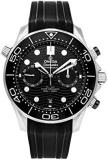
The Omega Seamaster Black occupies a distinct position where professional diving capability meets refined restraint. Within the broader Omega Seamaster collection, black ceramic variants, particularly those belonging to the Diver 300M and Planet Ocean lines, have carved out a following among wearers who prefer their technical instruments to carry a low-key visual signature. The deep, light-absorbing black of a ceramic bezel or dial does not merely look purposeful; it signals a shift in how modern dive watches communicate capability, moving away from high-contrast legibility exercises toward something more integrated and architectural.
That shift is worth examining closely, because it touches on material science, movement engineering, and a broader change in how luxury sports watches are positioned. The black Seamaster is not a single reference but a design direction that runs through multiple collections, each interpreting the formula with its own proportions and complications. Understanding what unites these models, and where they diverge, helps clarify why the black ceramic Seamaster has become such a recognisable presence on wrists that range from dive boats to boardrooms.
A Diving Legacy Reinterpreted in Black
The Seamaster name dates back to 1948, when Omega introduced it as a robust, water-resistant watch built for practical use rather than display. That utilitarian origin matters when assessing the modern black variants, because the design language still carries traces of it. The Seamaster Diver 300M, launched in 1993, brought with it a helium escape valve and a distinctive wave-pattern dial, features that positioned the line as a genuine tool for saturation divers rather than a stylised homage to diving culture.
Black ceramic entered the picture as Omega refined the line through the 2010s and beyond. The material allowed the brand to move away from aluminium bezel inserts, which fade and scratch, toward a surface that holds its colour and resists abrasion far more effectively. What began as a practical upgrade gradually became an aesthetic signature. A black ceramic bezel against a black dial creates a seamless, almost monolithic appearance that reads differently from the classic blue or silver Seamaster configurations. It is a quieter statement, and for many buyers that quietness is precisely the appeal.
Ceramic: More Than a Cosmetic Choice
The technical case for ceramic goes well beyond appearance. Zirconium oxide-based ceramic, which Omega uses for bezel inserts and in some instances for full cases, ranks high on the Mohs hardness scale, meaning everyday contact with door frames, desk edges, and dive equipment is unlikely to leave a mark. It is also chemically inert, so saltwater, chlorine, and sunscreen do not degrade it the way they can affect certain metals or painted surfaces. Colour is baked into the material rather than applied on top, which is why a black ceramic bezel will not fade to grey after years of sun exposure.
Omega has extended ceramic use to full-case constructions in select Planet Ocean references, including models where the case, bezel, and dial are all rendered in black ceramic. The result is a watch that weighs noticeably less than its steel equivalents while offering superior scratch resistance. The trade-off is a different tactile quality; ceramic feels cooler and smoother than brushed steel, and its surface reflects light in a way that can make a large dive watch appear more compact than its dimensions suggest. For wearers who want the presence of a 42 mm or 43.5 mm diver without the visual bulk, that optical effect is a genuine advantage.
The Co-Axial Master Chronometer Standard
Inside every modern black Seamaster sits a Co-Axial Master Chronometer movement, and the certification behind that name deserves attention. Master Chronometer status is granted by METAS, the Swiss Federal Institute of Metrology, following eight separate tests conducted on the fully cased watch rather than the movement alone. These tests cover timekeeping accuracy in six positions, power reserve, water resistance, and exposure to magnetic fields of 15,000 gauss.
That magnetic resistance figure is significant. Traditional mechanical watches can be disrupted by the magnetic fields generated by laptops, tablets, and phone speakers, leading to rate deviations that require demagnetisation. Omega's solution involves a silicon balance spring and non-magnetic components within the escapement, allowing the movement to maintain accuracy even when placed directly against a strong magnetic source. For anyone who spends their working day around electronics, this is not an abstract specification but a practical guarantee of consistent timekeeping.
The co-axial escapement itself, an Omega signature since 1999, reduces the sliding friction between the escape wheel and pallet fork by using radial rather than sliding contact. The theoretical benefit is greater long-term stability and longer service intervals. Combined with the Master Chronometer certification, it gives the black Seamaster a technical foundation that stands apart from many competitors in the luxury dive watch segment.
Configurations Across the Seamaster Range
Because black appears across several Seamaster lines, buyers face a genuinely varied set of options. The Diver 300M in 42 mm with a black ceramic dial and bezel remains the most direct expression of the concept, pairing a stainless steel case with a black rubber strap or steel bracelet. The Planet Ocean 600M pushes further into professional territory, with greater water resistance and, in some references, a fully ceramic case that eliminates the contrast between bezel and case entirely.
Material combinations also vary. Black ceramic can be paired with stainless steel, titanium, or 18K Sedna and yellow gold, each producing a different character. Gold and black ceramic together create a contrast that leans more toward formal luxury, while titanium and black ceramic produce a lighter, more technical object suited to extended wear. Strap choice further shifts the equation: a rubber strap emphasises the sporting origin, a steel bracelet broadens the watch's range into business settings, and a NATO strap introduces a more casual, heritage-inflected note.
- Master Chronometer certification: METAS-tested accuracy and 15,000-gauss magnetic resistance.
- Black ceramic bezels and dials: Scratch-resistant, fade-proof, and chemically inert.
- Diver 300M and Planet Ocean platforms: The primary homes for the black aesthetic.
- Multiple case materials: Steel, titanium, and gold variants broaden the appeal.
Wearing the Black Seamaster
On the wrist, the black Seamaster behaves differently from its more colourful siblings. The monochromatic palette makes the watch read as a single object rather than a collection of contrasting parts, which lends it a formality that dive watches do not always achieve. The legibility remains excellent, particularly on references where the hands and hour markers are filled with white Super-LumiNova, creating a clear contrast against the dark dial. In low light, the effect is dramatic without being ostentatious.
The weight and balance depend heavily on the chosen configuration. A steel Diver 300M on a bracelet carries a reassuring heft, while a titanium Planet Ocean on rubber feels considerably lighter. The ceramic bezel's action, with its precise clicks and minimal play, is one of those details that becomes more appreciated over time, particularly for anyone who uses the dive scale regularly rather than treating it as decoration.
Why Black Endures
Black has a particular staying power in watch design because it does not compete for attention with the wearer's other choices. A black Seamaster works with a wetsuit, a business suit, and casual weekend clothing without requiring any adjustment. That versatility is not accidental; it reflects a deliberate design decision to prioritise integration over contrast. In a market where dive watches often lean on bold colours and oversized proportions to stand out, the black Seamaster takes the opposite approach, and that restraint has proven to have broad and lasting appeal.
The combination of ceramic durability, Master Chronometer precision, and a design language rooted in genuine diving history gives the black Seamaster a coherence that is difficult to replicate. It is a watch that performs at depth, holds its appearance over years of use, and carries itself with a quiet confidence that suits wearers who prefer substance over spectacle. For those drawn to the technical heritage of the Omega brand's dive watch lineage, yet seeking a more understated expression of it, the black variants offer a compelling answer, one that continues to evolve as Omega refines both materials and movements. The same spirit of precision carries into the brand's chronograph heritage, where the Omega Speedmaster collection traces a parallel story of engineering endurance, and into the dress-oriented territory of the Omega De Ville line, where the same movement philosophy is expressed through a more formal design vocabulary.
 Exciting, Best Luxury Watches for Sale!