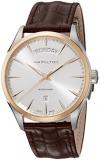
Hamilton gold watches sit at a specific intersection of the brand's catalog: warm gold-tone finishes wrapped around Swiss automatic movements that trace their architecture to the Swatch Group's shared caliber platform. The result is a dress-oriented timepiece that leans on visual warmth and mechanical substance rather than precious-metal content. Hamilton's origins in Lancaster, Pennsylvania, in 1892, followed by its move to Biel, Switzerland, give these models a dual identity that shapes how they read on the wrist.
Understanding what a Hamilton gold watch represents means examining how the brand balances accessibility with genuine horological credibility. Swiss-made automatic calibers, sapphire crystal, and stainless steel cases with gold PVD or electroplated finishes recur across the gold and gold-plated range, according to Hamilton Watch's official specifications. The Hamilton brand's consistent design philosophy runs through this entire range.
The Design Language Behind Hamilton Gold Watches
Hamilton gold watches generally split into two visual families. Yellow-gold tones appear on classic round cases with slim profiles, while rose-gold accents lean toward more contemporary silhouettes. The distinction matters because it shapes how the watch reads in different settings. Yellow gold tends toward traditional, dress-oriented elegance; rose gold skews warmer and slightly more modern.
The Jazzmaster line frequently appears with gold-toned stainless steel cases paired with leather straps in browns, blacks, or deep blues. Case profiles are slim, often between 8 and 10 millimeters in thickness, which allows them to slip under a shirt cuff without resistance. The American Classic series takes a different route, drawing on mid-century cues with applied indices and dauphine hands that catch light in a way that accentuates the gold finish.
Applied indices and polished gold-tone surfaces work together to create depth and legibility that flat-printed dials cannot match. What distinguishes these designs is restraint. Hamilton does not overload gold models with excessive complications or ornamental flourishes. The aesthetic is disciplined, and the gold finish reads as an intentional design choice rather than decoration.
Swiss Movement Expertise in a Gold-Tone Package
The movement inside a Hamilton gold watch is where the brand's Swiss identity becomes tangible. Many models in the gold and gold-plated range use the H-10 automatic caliber or comparable Swiss automatic movements with power reserves of approximately 80 hours. That figure matters in practical terms: a watch set down on Friday evening will still be running on Monday morning.
Hamilton sources these movements through its parent company, the Swatch Group, which provides access to proven Swiss movement architectures. In gold-tone models specifically, these movements are often visible through exhibition case backs, where the rotor, bridges, and perlage finishing can be examined directly. For buyers comparing gold watches from other traditions, mechanisms vary widely. An automatic movement performing at COSC chronometer standards delivers measurable precision that a bracelet or case finish cannot replicate.
Hamilton's Swiss automatic positioning appeals to buyers who want the visual warmth of a gold watch without sacrificing mechanical integrity. The H-10's 80-hour reserve also reduces the need for a winder, which is a practical advantage for a dress watch worn on rotation rather than daily.
Materials, Finishing, and Durability
A frequent question about gold Hamilton watches concerns material composition. Most models in this range use stainless steel cases with PVD or electroplated gold finishes rather than solid 18k gold. This is standard practice across the accessible luxury segment, and it serves a functional purpose: stainless steel beneath the gold layer provides structural integrity, corrosion resistance, and a weight that feels appropriate for a premium watch.
Electroplated gold finishes require care to maintain their appearance over time. Factors that affect longevity include:
- Wear patterns: Friction from desk surfaces and bracelets accelerates plating wear on case edges and clasps
- Moisture and chemicals: Perfumes, lotions, and chlorinated water can dull or discolor gold plating over time
- Cleaning method: A soft dry cloth preserves the finish better than abrasive polishes or ultrasonic cleaning
Sapphire crystal, used across most Hamilton models, resists scratching far better than mineral glass or acrylic. Water resistance ratings generally range from 50 meters for dress models to 100 meters for sportier gold-accented pieces. Buyers who wear a gold-tone watch daily should expect gradual surface refinement rather than permanent perfection, and the movement needs cleaning and lubrication on a schedule measured in years, not months.
How Gold Hamilton Models Fit Into a Broader Collection
The question facing many buyers is not whether a specific gold Hamilton is a good watch, but whether it earns a place in a collection that may already include other pieces. This is where Hamilton's specific positioning becomes relevant. Gold-tone watches work best as the warm counterpoint to a collection anchored by steel or sport watches.
A Breitling collection and its Colt brethren tend toward brushed steel and aviation utility. A Hamilton gold model occupies the opposite end of the spectrum: dress-oriented, warm, and visually quieter. Together, they cover more ground than either could alone. Understanding that contrast matters when building a collection. The gold Hamilton is not trying to be a sports watch with a gold finish, nor is it a status symbol in the tradition of solid-gold luxury pieces.
It is a thoughtfully designed dress watch that prioritizes aesthetics and Swiss mechanics over precious-metal content. Buyers who understand that positioning tend to be satisfied with the value proposition. A classic Rolex Datejust range inherits character from wear on precious metal; gold Hamilton watches follow a similar principle, in a more accessible register.
Gold vs. Steel: A Practical Comparison for Buyers
The decision between a gold-tone Hamilton and a steel equivalent comes down to context rather than objective superiority. Consider how the two finishes compare across the criteria buyers care about most:
| Feature & Selling Point |
Gold-Tone Hamilton |
Steel Hamilton |
| Case Material |
Stainless steel with gold PVD/plating |
Brushed or polished stainless steel |
| Visual Register |
Warm, dress-oriented, formal |
Neutral, sporty, versatile |
| Scratch Visibility |
Hairline scratches more visible on polished gold |
Brushed finishes hide wear better |
| Typical Thickness |
8-10mm |
10-12mm |
| Best Strap Pairing |
Leather (brown, black, blue) |
Steel bracelet or NATO |
| Water Resistance Range |
50m typical |
50-100m typical |
| Occasion Range |
Office to evening, formal events |
Daily wear to active use |
| Finishing Longevity |
Plating may fade with heavy wear |
Stainless surface retains appearance |
| Movement Options |
Swiss automatic, quartz |
Swiss automatic, quartz, mechanical |
| Typical Case Size |
38-40mm |
38-44mm |
| Power Reserve |
Up to 80 hours (H-10 automatic) |
Up to 80 hours (H-10 automatic) |
| Crystal |
Sapphire |
Sapphire |
| Resale Consistency |
Limited secondary market demand |
Broader demand across models |
| Primary Appeal |
Aesthetic warmth and formality |
Everyday versatility and durability |
The most consequential differences lie in visual register, scratch visibility, and occasion range. A gold-tone Hamilton performs best when the buyer's priorities lean toward formal and semi-formal settings, where its warm finish contributes to a coherent look. The steel version wins on day-in, day-out adaptability. Neither is objectively superior.
Caring for a Gold-Finished Watch
Gold plating responds to wear habits. A few practices extend the life of the finish considerably. Rinsing with clean water after contact with sweat, avoiding abrasive cloths, and storing the watch separately from harder objects all reduce micro-abrasion on the edges where plating wears fastest.
Regarding service, the same rules that apply to a broader Omega brand context are worth applying here: the movement needs cleaning and lubrication on a schedule measured in years, not months. Hamilton's Swiss automatic workings run well for years between services, and gold plating is separate from those internals; the case finish and the movement age on different timelines.
Owners should treat the gold finish as part of a living object. Patina and minor wear on a gold-tone case is normal. A watch that accumulates character through wear often reads more naturally than one kept in pristine condition, and the warm tone of gold tends to age more gracefully than many other finishes.
The Hamilton Gold Watch as a Personal Choice
Hamilton has proven across more than a century of illustrated watchmaking that a timepiece can belong to both a military tradition and a formal one. Gold-tone models crystallize the latter side of that heritage. They are watches for people who care about design coherence, movement quality, and a warm visual register.
The decision ultimately rests with the person who will look at the watch every time they check the time. If that view brings pleasure, mechanical substance, and a long-running Swiss movement, then a Hamilton gold watch has done its work. Movement, case, crystal, dial-those can all be measured. What cannot be measured is the quiet usefulness of a watch that makes a person feel ready for the room they are about to walk into.
 Exciting, Best Luxury Watches for Sale!