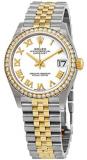
The Rolex Cosmograph Daytona with a white dial is one of the most recognizable chronographs in modern watchmaking, defined by its motorsport DNA and the iconic triplock chronograph pushers that flank the winding crown. Since its introduction in 1963, the Daytona line has evolved through multiple generations, yet the white dial variant has remained a persistent favourite for collectors who value legibility, contrast, and a clean aesthetic that never feels dated.
Rolex currently produces the Cosmograph Daytona in several configurations, including the reference 126500LN in Oystersteel with a white dial, and the reference 126503 in Oystersteel and yellow gold, also available with a white dial. Official specifications confirm that these models share a 40 mm Oyster case, a screw-down case back, and a monobloc middle case, all built for the demands of professional racing drivers.
Design Identity and Racing Heritage
The history of the Daytona is inseparable from the world of motorsport, a connection established by Rolex’s sponsorship of the Daytona International Speedway in Florida. What began as a purpose-built chronograph for racing drivers has evolved into a cultural object worn by actors, musicians, and collectors who may never chase a lap record. The white dial variant distills this dual identity into one surface: a bright, unfussy canvas that makes elapsed-time reading instantaneous.
Dial Architecture and Legibility
The white dial is a study in functional minimalism. Three snailed chronograph counters sit at three, six, and nine o’clock positions, providing a 12-hour totaliser, a 30-minute counter, and running seconds. According to Rolex, the hour markers and hands are crafted in 18 kt gold for certain references, applied with a Chromalight display that emits a long-lasting blue glow in low-light conditions. That combination provides high contrast against the white background while remaining subdued enough for everyday wear.
Oyster Case and Materials
Rolex builds the Cosmograph Daytona case from a range of materials, including Oystersteel, 18 kt yellow gold, 18 kt white gold, 950 platinum, and combinations of Oystersteel and gold. Diameter is fixed at 40 mm across the range, while proportions of the lugs and crown guards remain consistent. Rolex states that the Oyster case architecture includes a monobloc middle case, a screw-down case back, and a screw-down winding crown, a structure that underpins the water resistance rating of 100 metres (330 feet).
For those familiar with the wider sports collection, the white Daytona shares engineering values with the Rolex Submariner line. Each family applies the Oyster case theory differently, but they share the same obsession with sealed construction and long-term reliability. A similar philosophy of robust, purpose-driven design runs through the GMT-Master II collection, where the Oyster case houses a dual-time complication built for travellers rather than divers.
Movement, Chronometric Performance, and Racing Functionality
The current generation of the Cosmograph Daytona is powered by a self-winding mechanical chronograph movement built in-house by Rolex. It carries a vertical clutch and column-wheel architecture, two features prized for crisp pusher feel and precise start-stop-reset behaviour. The movement is a Superlative Chronometer, meaning each watch is certified after casing to a precision standard that Rolex defines as −2/+2 seconds per day.
For a racing chronograph, precision and instant elapsed-time feedback matter more than any decorative detail. The pushers are screw-down, ensuring that water resistance is preserved even under physical stress that racing drivers and collectors inevitably expose their watches to. Elapsed time can be started, stopped, and returned to zero without looking away from the road or the racetrack, which is why the layout has remained fundamentally unchanged for decades.
The broader Rolex sports catalogue approaches performance through different lenses, but the chronometric obsession is shared. The Yacht-Master II, for instance, explores regatta countdown functionality, itself a specialised chronograph expression that benefits from the same high-precision movement culture that underpins the Daytona white.
Dial Variants, Materials, and Collector Choices
Because the white dial is offered across several material combinations, the practical differences between configurations matter enormously to buyers. A 40 mm Oystersteel model keeps the case weight moderate and places emphasis on the dial, while an 18 kt white gold variant introduces extra heft and a more subtle metallic warmth. Diamond-set white gold cases push the aesthetic further towards evening wear, offering a bridge between the tool-watch DNA and high jewellery expression. For collectors comparing other Rolex lines, references such as the Rolex Datejust often stand as an everyday companion alongside a Daytona, and many enthusiasts pursue both simultaneously. Rolex positions these collections as complementary parts of the broader line rather than competition.
Why the White Dial Resonates
Dial colour is often reduced to aesthetics, but in the context of a chronograph it directly affects readability and usability. A white dial reflects ambient light and renders black or metallic hands and markers easier to distinguish, particularly in the vertical or 45-degree angles the driver’s wrist actually occupies. For this reason, the white dial Daytona has been a recurring reference for owners who use the chronograph regularly rather than wearing it purely as jewellery.
Rolex has paired the white dial with the Oyster bracelet and the Oysterlock safety clasp for the majority of references, ensuring a robust purchase that resists accidental opening. The bracelet also includes Easylink for quick length adjustment, a small detail that improves comfort during long drives and warm weather. Rolex describes this as part of its system of comfort extension, illustrating the brand’s holistic approach to usability.
Collector Perspective and Buying Considerations
For first-time buyers, the white dial offers a strong entry point into the Cosmograph Daytona family. It is legible, timeless, and does not lean heavily into trend-driven colour choices. Seasoned collectors frequently favour the white dial for its contrast against the typically darker counters and hands, particularly in photographic and display contexts where the white surface reads almost like a luminescent panel. Values in the secondary market evolve constantly, but the engineering is the constant that endures whatever trends emerge.
When evaluating any Daytona, a few criteria dominate the buying decision: dial variant and material, chronometric certification, bracelet type, completeness of accompanying documentation, and prior service history. Buyers should verify that pushers, crown, and case back threads function smoothly, as these are the surfaces most exposed to stress. A properly maintained Daytona from any generation retains its precision for decades, which is why the reference remains a pillar of competitive sports timing.
Ultimately, the white dial Cosmograph Daytona expresses Rolex’s conviction that high performance and refined design are not opposing forces. It carries the motorsport lineage of the Speedway into everyday contexts, offering its owner a self-winding chronograph that works equally well under stadium floodlights, boardroom lighting, or mid-morning sun on a coastal road. Whether it serves as a first serious Rolex or the crown of a larger collection, the white dial Daytona occupies its own territory within modern horology, and it will continue to do so as long as racing remains inseparable from timekeeping.
 Exciting, Best Luxury Watches for Sale!