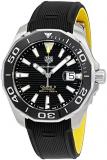
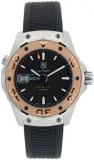
The TAG Heuer Aquaracer Calibre 5 is built around a 300-metre water resistance rating and a unidirectional rotating bezel, two specifications that place it firmly within the professional diver category rather than the realm of decorative sports watches. Since the Aquaracer line was formally named in 2004, it has carried forward a design language rooted in TAG Heuer's long history of producing instrument watches for maritime use, and the Calibre 5 variants represent the core automatic expression of that lineage.
Automatic Movement and Daily Reliability
At the heart of the Aquaracer Calibre 5 sits the Calibre 5 automatic movement, a Swiss-made mechanism that operates at a balance frequency of 28,800 vibrations per hour, equivalent to 4 Hz. According to TAG Heuer's published specifications, this movement delivers a power reserve of approximately 38 hours. That figure means the watch will continue running through a weekend on a desk if it is wound and worn regularly during the week, though it is not intended to be left unworn for extended periods without a winder.
The 4 Hz operating frequency is worth noting for a practical reason. A higher beat rate generally corresponds to smoother seconds-hand sweep and, in many cases, more consistent timekeeping across different positions. For a dive-oriented watch that may be worn during swimming, desk work, and travel within the same week, that positional stability matters more than it would in a dress watch kept primarily in one orientation.
Case Architecture and Wearing Experience
TAG Heuer offers the Aquaracer Calibre 5 in several case sizes, including 36 mm, 41 mm, and 43 mm across the Professional 300 and related references. The 43 mm reference WBP201D.FT6197, for example, pairs a 300-metre water resistance rating with a rubber strap, while the 41 mm WAY211A.BA0928 comes on a steel bracelet with a sunray-brushed dial finish. This spread of sizes is significant because wrist geometry varies widely, and a 36 mm diver will sit very differently on a smaller wrist than a 43 mm version.
The case construction follows a familiar diver template: a screw-down crown, a unidirectional bezel that rotates only counter-clockwise so a diver cannot accidentally extend a timing segment, and a case back that is typically screwed or engraved with the series identity. The bezel action and crown threading are the two tactile points that separate a competent diver from a compromised one, and the Aquaracer line has historically prioritised both. Buyers exploring the range will find the TAG Heuer Aquaracer series covers multiple case sizes and dial finishes.
Dial Legibility and Finishing Techniques
The dial uses a sunray-brushed finish on several Calibre 5 references, a technique in which the metal surface is brushed radially from the centre so that light produces a shifting, fan-like reflection as the wrist moves. The practical benefit is not only visual: a textured dial diffuses glare in bright conditions, which helps the applied indices and hands remain readable when sunlight strikes the crystal directly. This matters for a watch intended for open-water use.
Luminous material is applied to the hour markers and hands, and the bezel frequently carries a luminous pip or triangle at the zero position. Under low light, those elements allow the wearer to read elapsed time without a light source, which is the original reason dive watches adopted the format in the first place. TAG Heuer has also released Aquaracer dials in a range of colours over the years, from classic black and blue to more distinctive tones, so the model line accommodates both conservative and more expressive preferences.
Aquaracer in the TAG Heuer Lineup
Within TAG Heuer's collections, the Aquaracer occupies the dive and sports-elegant position, distinct from the motorsport heritage of the TAG Heuer Formula 1 collection. That distinction shapes the design priorities: where the Formula 1 line emphasises racing-inspired chronograph dials and slimmer profiles, the Aquaracer builds outward, with a rotating bezel, stronger case sealing, and a more substantial case for water resistance. The TAG Heuer Carrera collection takes a different route again, favouring open, legible chronograph layouts rooted in circuit racing rather than underwater capability.
The naming history of the line is also instructive. TAG Heuer produced dive watches before "Aquaracer" was adopted as a collection name, and the series emerged from a long-running series of references that served professional and recreational divers. This is a pattern seen across Swiss watchmaking, in which a functional tool model gradually acquires broader consumer appeal without abandoning its original technical brief. The 300-metre rating on Professional 300 variants indicates the series has not retreated from that brief.
Strap, Bracelet, and Ownership Considerations
Buyers can choose between steel bracelets and rubber straps depending on reference. A steel bracelet with a folding clasp is the more versatile option for office and everyday wear, and it tends to age with a lived-in patina of fine scratches that many owners accept as part of the experience. A rubber strap is lighter, dries quickly after swimming, and flexes with the wrist during sports, though it will eventually require replacement as the polymer ages. The 43 mm WAY201B.FT6150, for instance, ships on a rubber strap, illustrating that strap choice is tied to reference rather than a free-standing accessory decision.
- Calibre 5: automatic movement with approximately 38-hour power reserve
- Frequency: 28,800 vph / 4 Hz for stable timekeeping
- Water resistance: up to 300 metres on Professional 300 references
- Case options: 36 mm, 41 mm, and 43 mm variants
- Dial: sunray-brushed finishing on multiple references
- Bezel: unidirectional rotating dive bezel
Servicing is a routine component of automatic ownership. Mechanical movements benefit from periodic maintenance intervals, and buyers should factor that into the total cost of ownership rather than treating the purchase price as the only figure. Steel bracelets can also be adjusted by adding or removing links or by using micro-adjustment positions on the clasp, which is a practical detail for anyone whose wrist size shifts with temperature or activity.
Why the Calibre 5 Aquaracer Remains Relevant
The enduring appeal of the Aquaracer Calibre 5 rests on a simple proposition: it offers the engineering credentials of a genuine dive watch, including measurable water resistance and a rotating bezel, within a form factor that works in non-aquatic settings. Many competing models in this price bracket lean heavily toward one identity, either a pared-back instrument or a fashion-forward accessory. TAG Heuer has positioned the Aquaracer as something that shifts between both roles without apology.
Collectors who value provenance may also appreciate that the Aquaracer name links to decades of dive-watch production rather than a single recent launch. The series has been refreshed repeatedly, with updated dial colours, case proportions, and movement refinements, but the core architecture of a sealed case, automatic winding, and a 300-metre rating on higher-tier references has remained consistent. For someone seeking a Swiss automatic dive watch that can accompany swimming, travel, and daily wear, the Calibre 5 references offer a coherent and well-documented option worth considering on its technical merits rather than its marketing alone.
 Exciting, Best Luxury Watches for Sale!