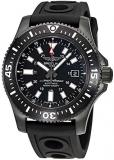
The Breitling Chronomat 44 measures 44 mm across a stainless steel case roughly 16.94 mm thick, and that combination of diameter and depth defines everything about how the watch wears. It is not a shrinking instrument. It is a chronograph built around the assumption that its owner will actually use the bezel, the pushers, and the elapsed-time scale rather than admire them from a distance.
That assumption traces back to 1983, when Breitling worked with the Frecce Tricolori, the Italian Air Force aerobatic squadron, on a chronograph that could be operated under flight conditions. The result reintroduced four patented rider tabs at the quarter-hour marks on the bezel, giving the wearer something to grip and rotate even with gloves on. Those tabs became the visual signature of the Breitling Chronomat line, and they still anchor the 44's identity four decades later.
Case Architecture and the Rouleaux Bracelet
Inside the Chronomat 44 sits a self-winding mechanical movement certified by the Controle Officiel Suisse des Chronometres. COSC certification requires the movement to hold strict daily rate tolerances across multiple positions and temperatures, which gives buyers an independent benchmark rather than a manufacturer's own claim. The movement also delivers a power reserve of roughly 70 hours, enough to survive a weekend off the wrist without stopping.
Water resistance is rated at 50 bars, or 500 metres. That figure is unusual for a chronograph and places the watch in territory typically occupied by dedicated dive instruments. It also reinforces the dual character of the design: the same watch that times a descent profile can sit under a shirt cuff during a meeting. That breadth has long been a defining trait of Breitling watches built for instrument duty.
The Rouleaux bracelet is worth examining on its own terms. Its rounded, bullet-style links echo the original 1980s design and give the watch a retro-futuristic character that few modern chronographs attempt. More practically, the bracelet's construction distributes the weight of the 44 mm case across the wrist, which matters when a watch of this mass stays on the arm for a full working day.
Dial, Bezel, and Functional Readability
Breitling has prioritized legibility in cockpit environments for decades, and the Chronomat 44 follows that brief. Large applied indices and broad hands carry luminescent coating that stays readable in low light. The chronograph subdials are positioned for quick glance recognition, a layout refined through years of instrument design rather than styling exercises.
The rider tabs on the bezel are functional hardware, not decoration. Each tab marks a 15-minute segment, so elapsed-time calculations can be made without staring directly at the dial. In practice, that makes the bezel useful for divers, pilots, and anyone tracking intervals under pressure.
- Case size: 44 mm
- Case thickness: Approximately 16.94 mm
- Water resistance: 50 bars (500 m / 1,650 ft)
- Movement: Self-winding mechanical, COSC-certified
- Power reserve: Approximately 70 hours
- Bracelet: Rouleaux-style with rounded links
Specifications tell one story; the wrist tells another. The wide lugs and 44 mm diameter mean the watch sits large, and the lug-to-lug measurement on certain references approaches 53.7 mm. This is a timepiece that asks for a confident wrist and rewards it with a sense of occasion that smaller chronographs rarely deliver.
Movement and Chronometric Performance
The COSC certification at the heart of the Chronomat 44 is not a casual label. It requires the movement to meet strict daily rate tolerances across multiple positions and temperatures, providing buyers with a verifiable standard rather than a marketing claim. For anyone who values mechanical accountability, that certification carries real weight.
The roughly 70-hour power reserve adds another layer of practical value. Many chronographs in this segment offer 40 to 50 hours, so the extra reserve translates into fewer winding rituals and less disruption to the date function. The movement also drives a date display positioned for balanced dial symmetry.
Within the brand's own catalog, the Chronomat 44 occupies a different conceptual space from the Navitimer, which is built around a circular slide rule for flight calculations. The Chronomat emphasizes structural robustness and bezel-driven timing. Enthusiasts exploring the brand's wider range sometimes consider models including the Breitling Superocean for dive-oriented alternatives. Both are purpose-built instruments, but they serve distinct user priorities and reward different kinds of owners.
Design Context and Market Positioning
The Chronomat name itself is a portmanteau of "chronograph" and "automatic," dating to an era when self-winding chronographs were still relatively novel. Over the decades, the line has passed through several design generations, and the 44 mm variant represents a modern reading of the original formula. It keeps the rider tabs, the Rouleaux bracelet, and the broad case profile, while adding contemporary materials and tighter manufacturing tolerances.
Breitling's aviation heritage is well documented, from cockpit instruments to pilot chronographs. That legacy gives the Chronomat 44 a narrative foundation that fashion-first watches cannot claim. When a design has been developed with an aerobatic squadron and then refined over four decades, its decisions carry a weight beyond aesthetics.
At the same time, the Chronomat 44 is not a narrow pilot's tool. Its 500-metre water resistance, robust bracelet, and 44 mm case make it a general-purpose luxury sports watch. The difference between it and the Superocean lies in emphasis: the Superocean leans toward dive utility, while the Chronomat leans toward chronograph legibility and bezel-driven timing.
Wearing Experience and Practical Considerations
Prospective buyers should think carefully about wrist size. A 44 mm case with wide lugs and a 16.94 mm thickness is not a subtle watch, and it will sit prominently on smaller wrists. For those with larger frames or a preference for substantial timepieces, the proportions feel intentional rather than excessive. The Rouleaux bracelet helps by distributing weight evenly, but the overall mass remains part of the experience.
Servicing and long-term ownership also deserve attention. Mechanical chronographs require periodic maintenance, and the complexity of the movement means service intervals matter. Breitling maintains a global service network, which simplifies the logistics of ownership, though the cost of servicing a chronograph is naturally higher than that of a simple three-hand watch.
The Chronomat 44 is available in several material and finish combinations, including stainless steel and blacksteel variants. Blacksteel, a treatment that darkens the case while maintaining durability, gives the watch a more tactical appearance and appeals to buyers who prefer a less conventional look. Each variant carries the same core architecture but shifts the aesthetic emphasis.
The Enduring Appeal of a Functional Design
What sets the Chronomat 44 apart is not a single specification but the coherence of its design. The rider tabs, the Rouleaux bracelet, the chronometer-certified movement, and the 500-metre water resistance all serve one purpose: to create a watch that performs reliably in demanding conditions while retaining a clear aesthetic identity. That identity has survived shifting fashions because it was built on function first.
For collectors and enthusiasts, the Chronomat 44 represents a specific moment in Breitling's evolution, one where aviation utility and luxury finishing converged. It is a watch that can be worn with confidence in a boardroom or on a dive boat, and that breadth of capability is rare. The design does not chase trends; it extends a lineage that began with a squadron's request and continues to define a category.
 Exciting, Best Luxury Watches for Sale!