The Rolex Cosmograph Daytona carries a tachymetric scale on its bezel, a graduated track that lets a driver convert elapsed time into average speed over a measured distance. That single feature, present since 1963, explains why the model is still discussed as a racing instrument rather than a dress accessory, and why the broader Rolex chronograph lineage revolves around it.
Rolex built the original Daytona around a Valjoux-based movement before moving to its own chronograph calibres. The shift from the Zenith El Primero-based calibre 4030 to the fully in-house calibre 4130 in 2000, and then to the calibre 4131 in current references, marks a steady transfer of chronograph manufacturing into Rolex's own workshops. Each step tightened the relationship between movement design and case architecture.
The calibre 4131 uses a vertical clutch and column wheel arrangement, so the central chronograph seconds hand engages without the visible jump that horizontal clutch designs can produce. A blue Paraflex shock absorber protects the regulating organ, and the Chronergy escapement improves energy efficiency while preserving amplitude. Power reserve sits at roughly 72 hours, which means the watch can rest over a weekend without losing its chronograph counter positions.
Certification and Real-World Accuracy
Every Cosmograph Daytona leaves the factory as a Superlative Chronometer, a Rolex certification requiring an average daily rate of -2/+2 seconds per day after casing. That window is narrower than the COSC standard applied to many Swiss chronometers, and it is measured on the assembled watch rather than the bare movement. The distinction matters for buyers who care about performance on the wrist rather than on a test bench.
The bi-directional winding rotor rides on ceramic ball bearings, reducing friction compared with older rotor designs. Combined with the Chronergy escapement, this supports the 72-hour reserve without demanding a larger mainspring barrel. Rolex states that Cerachrom bezel inserts retain their colour and finish after prolonged sun exposure and abrasion, a claim that matters for a component sitting directly in the path of incidental contact.
Dial, Counters, and Low-Light Legibility
The modern dial places three counters at 3, 6, and 9 o'clock: a 30-minute totaliser, a 12-hour totaliser, and running small seconds. A central chronograph seconds hand sweeps the dial when the pusher is engaged, while the tachymetric scale on the bezel pairs with outer graduations to allow simultaneous reading of elapsed time and speed. Earlier references used Plexiglas crystals and aluminium bezel inserts; current models move to scratch-resistant sapphire and Cerachrom in black ceramic or a metallised variant over gold or platinum.
Dial options across the line include white, black, and sunburst finishes, with mother-of-pearl and gem-set variants appearing in specific references. Luminous hour markers and hands use the Chromalight display, which emits a blue glow and is designed to remain readable for up to eight hours after exposure to daylight. Anyone weighing a three-counter racing dial against a simpler date-plus-sweep layout can study a date-display Rolex Datejust to see how a restrained dial changes daily wearability.
Case, Pushers, and Water Resistance
The Oyster case is machined from a solid block of Oystersteel or precious metal, with a middle case shaped to seal against the screw-down case back and winding crown. The chronograph pushers are screw-down type, which allows the watch to keep its water resistance rating of 100 metres when the pushers are fully tightened. Chronographs with push-button pushers cannot be operated underwater, so this detail separates the Daytona from many competitors in the segment.
The Oyster bracelet with an Oysterlock safety clasp and Easylink extension link provides a 5 mm adjustment for comfort, useful when wrists swell in warm weather. Bracelet finishes typically combine brushed and polished surfaces, and the range covers Oystersteel, yellow gold, white gold, rose gold, and platinum. Case diameter is 40 mm, with a lug-to-lug span that fits wrists from roughly 15 cm upward depending on bracelet configuration, and a thickness near 12.4 mm that slides under a shirt cuff without a visible bulge.
Heritage and Reference Evolution
Rolex has produced the Cosmograph Daytona continuously since 1963, and the model has been tied to endurance racing events and the drivers who competed in them. The reference 6241, launched in the late 1960s, gained traction among collectors, while the Paul Newman dial configuration, with contrasting counters and an outer minute track, remains one of the most discussed vintage variants. In 2023, Rolex refreshed the line with a redesigned case, the calibre 4131, and an updated dial layout, refining proportions rather than reinventing the silhouette.
That continuity is unusual in a market where chronographs from many brands compete at every price tier. The Daytona's position rests on in-house movement manufacturing, chronometric certification, and a design language that has shifted only incrementally for six decades. Collectors who value a documented lineage tend to weigh these factors more heavily than novelty.
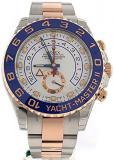
Other Rolex lines approach timing from different angles. A regatta skipper who needs a programmable countdown before the start gun may look at the Rolex YACHT-MASTER II regatta timer, whose countdown mechanism is mechanically unrelated to the standard Daytona movement, while the Explorer II offers a fixed 24-hour hand for distinguishing day from night in polar conditions.
Choosing a Reference for Daily Wear
Prospective buyers should first decide between precious metal and Oystersteel, since this choice affects weight, price, and wrist presence. Steel references on an Oyster bracelet, such as the white-dial 126500LN or its black-dial counterpart, weigh about 135 grams and suit daily wear. Gold and platinum references add mass and a more pronounced profile, which some wearers prefer for formal occasions but may find tiring over extended periods.
Dial colour affects legibility more than performance. A white dial with black counters reads clearly from a distance, while a black dial with silver counters produces a more muted look suited to office settings. Both are functionally identical, so the decision usually comes down to visual preference. Buyers drawn to a nautical rather than motorsport character may prefer a rotating bezel and precious metal finishes, much like the Rolex Yacht-Master with its rotating bezel, which offers a different set of proportions and a softer overall profile.
Servicing is part of long-term ownership. A mechanical chronograph of this complexity typically benefits from service every five to ten years depending on usage. The process involves disassembling the chronograph mechanism, replacing seals and gaskets, re-lubricating the movement, and re-certifying the watch to the Superlative Chronometer standard. Owners should factor this into the total cost of ownership rather than treating it as an afterthought.
The Cosmograph Daytona will not suit every wrist or every budget, but for buyers who want a mechanical chronograph with documented reliability and a continuous production history, it remains a benchmark against which other racing watches are measured. Its appeal rests less on novelty than on the consistency of its engineering and the clarity of its purpose.
 Exciting, Best Luxury Watches for Sale!