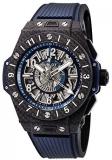
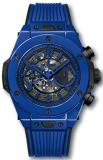
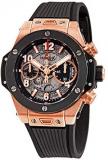
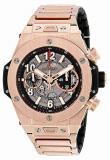
The Hublot Square Bang Unico measures 42mm across a squared titanium or ceramic case, and that geometry alone sets it apart from nearly every round chronograph in the luxury segment. Hublot built its reputation on the Big Bang, a watch that pushed case dimensions and material mixing into new territory, and the Square Bang extends that philosophy into a completely different silhouette. The result is a chronograph that reads as architectural rather than conventional, aimed at buyers who want a recognisable wrist presence without simply scaling up an existing round design.
What makes the Square Bang interesting is not novelty for its own sake. Squaring a case introduces real engineering problems, from sapphire crystal shaping to gasket sealing and crown integration, and how a brand solves those problems reveals its technical priorities. The following sections examine the case construction, the Unico movement, the dial architecture, and how the Square Bang fits into the broader landscape of Hublot watches, so that a prospective buyer can judge whether the square format suits their tastes and daily routine.
A Square Case Built With Big Bang DNA
The Square Bang's case is 42mm x 42mm, a footprint that wears closer to a 42mm round watch than the dimensions might suggest, because square cases sit flush against the wrist rather than extending into lugs. Hublot uses titanium and ceramic across the line, with microblasted and polished finishes applied to create contrast between matte surfaces and reflective edges. Microblasting produces a fine, granular texture that resists fingerprints, while polished bevels catch light along the case flanks. This combination is consistent with the finishing language Hublot has refined since the original Big Bang launched in 2005.
The six H-shaped titanium screws on the bezel are the most recognisable carryover from the Big Bang. According to Hublot, these functional screws serve as a design signature across the collection, and on the Square Bang they are positioned along a rectangular bezel rather than a circular one, which changes how the eye reads the watch. Water resistance is rated at 100 metres, or 10 ATM, which covers swimming and snorkelling but not serious diving. A screw-down crown supports that rating and protects the pushers during water contact. The sapphire crystal is anti-reflective coated, an important detail on a square dial because flat reflective surfaces can wash out legibility at certain angles.
Materials and Finishing Options
The Square Bang Unico Titanium pairs a titanium case with ceramic bezel elements and a rubber strap, while the Black Magic variant uses microblasted and polished black ceramic throughout the case and bezel. Ceramic offers high scratch resistance and holds its colour under UV exposure, though it can chip under sharp impact, whereas titanium resists dents better but shows surface scuffs more readily. Buyers who value a permanently black appearance tend to favour ceramic; those who prefer a lighter, warmer metal tone gravitate toward titanium. Hublot has also introduced versions with diamond-set bezels, broadening the line from pure sport to a dressier register.
The Unico Movement In Context
The Square Bang Unico runs the in-house HUB1280 calibre, a flyback chronograph with a column wheel and a frequency of 4Hz, or 28,800 vibrations per hour. Column wheel chronographs are valued because the column wheel governs pusher feel more precisely than a cam-actuated system, producing a crisper start, stop, and reset action. The movement is a skeletonised automatic with a dual horizontal coupling and a 72-hour power reserve in most references, and the open dial reveals its gear train and date wheel. Hublot makes the Unico in-house, which matters for buyers who track servicing and parts availability over a long ownership period.
Skeleton Dial Legibility and Wearability
A skeletonised dial trades traditional legibility for visual depth, and the Square Bang's square aperture frames the movement in a way round cases cannot. Hands and hour markers are applied and treated with luminescent coating, so low-light reading remains possible despite the openwork. The chronograph subdials sit at 3 and 9 o'clock, with the date window integrated into the movement architecture rather than cut into a solid dial. This arrangement keeps the dial visually balanced across the square format. Buyers accustomed to fully printed dials should expect a short adjustment period; the Square Bang rewards close inspection rather than glance reading.
Wearability depends heavily on strap choice. Hublot fits the Square Bang with rubber straps, which suit the case's sport character and handle moisture well. The strap integrates into the case via a shaped connection, and the squared case means the strap does not taper into traditional lugs but instead follows the case line. On a 16cm to 17cm wrist, a 42mm square case sits close to the edges of the wrist, so trying the watch in person remains advisable. A sapphire caseback is used on some references, which adds thickness relative to a solid back and is worth factoring into how the watch slides under a cuff.
The wider question is which square or angular sports chronograph suits a given collection. Enthusiasts comparing steel sports chronographs often weigh TAG Heuer Grand Carrera models against more experimental designs, while collectors building a versatile core often look to a date-and-sport staple such as the Rolex Datejust as a baseline for daily wear. The Square Bang occupies a different position again: it is a statement piece that trades subtlety for silhouette, which is precisely why buyers choose it over safer options.
How the Square Bang Fits a Collection
Most buyers considering a Square Bang already own at least one round luxury sports watch, which makes the square format an addition rather than a replacement. In that role, the Square Bang functions well: it brings a distinct visual signature to a rotation that might otherwise look uniform, and the skeletonised dial gives it a different character in photographs and in person. For anyone who wants a chronograph that reads as a conversation piece while still offering genuine water resistance for daily life, the Square Bang delivers on both fronts.
Servicing is a practical consideration for any in-house chronograph movement. Column wheel calibres with skeletonised architecture require watchmakers familiar with the specific assembly, so authorised service centres are the safer route for routine maintenance. Hublot's growing presence in major markets supports that requirement, though buyers in smaller regions should confirm local service access before purchase. Power reserve around 72 hours means the watch can rest over a weekend and still run when picked up on Monday, reducing reliance on a winder.
Pricing places the Square Bang in the upper tier of luxury sports chronographs, above many mass-produced Swiss alternatives and in line with brand-adjacent \nhouses that offer manufacture movements and exotic case materials. Whether that value equation works depends on how much a buyer weights movement ownership, material novelty, and case design against more traditional round formats. For those who prioritise a square silhouette, few alternatives exist at this level of finishing, and the Square Bang's combination of titanium or ceramic construction with the HUB1280 calibre keeps it technically credible rather than a styling exercise alone.
Who Should Consider the Square Bang
The Square Bang suits buyers who already own a round chronograph and want a second piece that differentiates their collection visually. It also appeals to collectors interested in column wheel chronographs who want that engineering visible through an open dial. Those who need maximum legibility at a glance, or who prefer traditional round cases and printed dials, may find the format less practical. For anyone drawn to the original Big Bang but seeking something less common on the wrist, the Square Bang offers a direct path into Hublot's design language without repeating what everyone else already wears.
The square case also raises an interesting point about the direction of luxury sports watch design. As more brands revisit angular geometries, the Square Bang shows what a squared case can achieve when the movement, bezel screws, and material choices all support the concept rather than merely restyle an existing model. Hublot's own product timeline, reported in its Watches and Wonders announcements, indicates the company intends to keep expanding the Square Bang line, which suggests buyers are responding to the format. For a collector considering a first Hublot, the Square Bang is a reasonable entry point because it distils the brand's core ideas about materials and movement while offering something no round chronograph can replicate.
 Exciting, Best Luxury Watches for Sale!