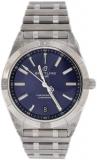
The Breitling Chronomat Silver centres on a polished metal case and the four rider tabs that have defined the collection's bezel since its 1980s debut. Under the crystal sits the Manufacture Caliber 01, an in-house automatic movement running at 4 Hz (28,800 vph) with a 70-hour power reserve and COSC chronometer certification.
Within the brand's catalogue, the Chronomat occupies a deliberate middle ground: less aviation-focused than the Navitimer, more dressable than the dive-oriented Superocean, and more design-led than the instrument-driven Professional line. Silver-finished references sit at the heart of that balance, which is why they remain a common first stop for buyers entering the collection.
Case Architecture and the Rider-Tab Identity
The defining visual signature of any Chronomat is its bezel, fitted with four rider tabs at the quarter positions. These tabs serve a mechanical purpose: they protect the crystal edge, provide grip for rotation, and give the watch its unmistakable silhouette. On silver-cased references, the contrast between brushed case flanks, polished bezel surfaces, and satin-finished bracelet links becomes the primary aesthetic argument.
Case sizing across the collection spans from 32mm and 36mm for smaller wrists up to 42mm and 44mm for chronograph configurations. The 42mm B01 chronograph, for example, was reduced by roughly 2mm compared to its predecessor, a change that reflects the broader industry shift toward wearable proportions without sacrificing wrist presence. A 42mm Chronomat B01 Chronograph reference (PB0158101C1A1) combines stainless steel with platinum elements, an ice blue dial, and a steel bracelet, while maintaining 200m water resistance.
Materials and Finishing Options
Buyers choosing a silver Chronomat are typically selecting between stainless steel, two-tone steel-and-gold, and 18k red gold configurations. Stainless steel dominates the silver category simply because it holds a bright, neutral tone that photographs and wears well across dress codes. Dial colours range from black and blue to silver-white and ice blue, each shifting how the metal case reads on the wrist.
Finish quality matters more on a silver watch than on a dark one, since light reflection exposes every brushed line and polish transition. Breitling applies a mix of satin brushing on the case sides and high polish on the bezel and rider tabs, a combination that gives the Chronomat its slightly architectural, almost instrument-like character.
- Case sizes: 32mm, 36mm, 42mm, 44mm
- Case materials: Stainless steel, two-tone, 18k red gold
- Configurations: Time and date, or chronograph with date
- Water resistance: Up to 200m on chronograph models
- Bezel: Unidirectional rider-tab design
Manufacture Caliber 01 and Chronometric Certification
The mechanical heart of the silver Chronomat chronograph is Caliber 01, an in-house automatic movement that operates at 28,800 vibrations per hour and holds a 70-hour power reserve. That reserve figure matters in practice: it means the watch can be set down on a Friday evening and still be running accurately on Monday morning without winding.
COSC certification confirms that each movement has passed independent chronometric testing across several positions and temperature ranges. This is a verifiable standard rather than a marketing claim, and it places the Chronomat alongside other certified chronometers in the brand's range. For buyers comparing mechanical chronographs, the combination of in-house manufacture, column-wheel architecture, and third-party certification is the central value argument.
Accuracy-minded buyers often cross-shop the Chronomat against the Breitling Superocean Heritage line, which shares the brand's movement philosophy but pushes the design toward vintage aesthetics. The Chronomat counters with a sportier, more contemporary read, particularly in silver.
Wearing the Silver Chronomat Day to Day
A silver chronograph lives or dies by versatility. The Chronomat's steel bracelet uses a butterfly clasp with micro-adjustment, which allows the wearer to fine-tune fit as wrist size fluctuates with temperature. On the wrist, the rider tabs sit flush enough to avoid snagging on shirt cuffs, though the 42mm and 44mm chronograph versions do carry measurable presence.
The silver dial variants tend to read larger than their dark counterparts because light tone reduces perceived depth. Buyers with wrists under roughly 17cm may find the 36mm or 32mm references more proportionate, while the full chronograph sizes suit broader wrists or those who prefer a bolder wrist statement. For anyone weighing a hybrid smartwatch against a mechanical alternative, a silver Chronomat functions as the opposite philosophy entirely: no charging, no app pairing, and a service interval measured in years.
Bracelet finishing also determines how formal the watch appears. A fully polished silver Chronomat skews dressier, while a satin-brushed variant with a dark dial reads more casual and tool-oriented. This flexibility is the reason the Chronomat has sustained its position across decades of shifting trends, much as the Breitling Avenger collection has held its own ground in the segment.
Design Heritage and Market Positioning
The Chronomat was originally released in the 1980s and later revived as the brand's sport-chic line. The rider-tab bezel, the integrated bracelet feel, and the emphasis on a dressable chronograph rather than a single-purpose instrument all trace back to that revival strategy. Placing a silver model in this lineage clarifies why the watch looks equally at home with a suit and with a casual weekend outfit.
Positioning also explains the material spread. Stainless steel houses the accessible references, two-tone and platinum-accented pieces fill the middle, and solid gold sits at the top. A silver Chronomat is therefore rarely the most expensive option in the collection, but it is frequently the most broadly wearable.
What to Weigh Before Buying
Prospective owners should decide between the time-and-date and chronograph layouts first, since that choice determines case size, movement complexity, and price band. Chronograph references carry the Caliber 01 and its COSC certification, while simpler configurations trade some mechanical complexity for a cleaner dial and slimmer profile.
Second, consider bracelet versus strap. A steel bracelet in silver amplifies the case's metallic character, while a leather or rubber strap tones it down and reduces overall weight. Many owners eventually acquire both to extend the watch across seasons.
Service considerations are also worth noting. An automatic chronograph with an in-house movement will require periodic servicing, typically on a multi-year cycle, and buyers should factor that long-term cost into the purchase rather than treating the watch as a maintenance-free object. Against quartz alternatives that need battery changes, a mechanical chronometer asks for a different kind of ownership commitment.
Collectors tracking the brand's broader catalogue sometimes treat this reference as a companion to pilot-oriented pieces such as those in the Breitling Professional range, which serves a more instrument-driven purpose. The comparison highlights what separates the Chronomat from the rest of the line-up: it is built for daily rotation rather than mission-specific duty.
The Value of a Silver Chronomat
A silver Chronomat is best understood as a mechanical chronograph that refuses to specialise. It carries genuine chronometric certification, a genuinely useful power reserve, 200m water resistance on chronograph references, and a bezel that has become one of the most identifiable shapes in contemporary watchmaking. For a buyer who wants one mechanical watch to cover office days, weekend travel, and the occasional swim, the silver-cased versions make a coherent case without forcing the wearer to choose between sport and dress codes. That middle-ground identity is precisely what has kept the Chronomat relevant across generations of watch trends, and it is likely why the silver finishes continue to outsell their bolder counterparts among first-time mechanical buyers. The rider tab, once a functional detail, has become the collection's signature memory point, a reminder that thoughtful engineering can double as enduring design.
 Exciting, Best Luxury Watches for Sale!