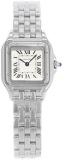
Square-shaped sapphire glass, a visible screw at each corner of the bezel, and a dial framed by Roman numerals: the Santos de Cartier is instantly recognizable from across a room. Few watches carry a silhouette this distinctive while remaining genuinely wearable, and fewer still can trace their form back to a design that predates almost every other wristwatch in continuous production.
That combination of historical weight and modern usability is what makes the Santos such a curious proposition. It sits comfortably alongside dress pieces and sports watches alike, yet refuses easy categorization. Understanding why requires looking at the geometry, the engineering, and the design philosophy that have carried this model across more than a century.
The Original Wristwatch Blueprint
Cartier's relationship with the Santos dates to the early twentieth century, when Louis Cartier designed a wrist-mounted timepiece for the Brazilian aviator Alberto Santos-Dumont. The pilot needed to read the time without releasing the controls of his aircraft, and the resulting watch placed a square case on a leather strap at a moment when pocket watches still dominated. Cartier later developed the model into a commercial series, and the architectural cues established in those early pieces remain legible in every reference produced today.
What survived from that origin story is not merely a shape but an attitude: a watch conceived as a practical instrument that happens to look elegant. The exposed screws on the bezel, often mistaken for decorative flourishes, echo the industrial logic of the original design. They frame the case like rivets on a bridge, giving the Santos its unmistakable mechanical character without sacrificing refinement.
Proportions That Define Wearability
The current Santos de Cartier medium model measures 41.9 mm from lug to lug and 35.1 mm across the case, with a thickness of roughly 8.83 mm and a weight of about 102 grams on the steel bracelet. Those figures matter more than a single case diameter, because the Santos is a square watch. A 35 mm square footprint reads very differently on the wrist than a 35 mm round case, occupying more visual space across the top of the wrist while keeping the lug-to-lug distance compact enough for a wide range of wearers.
Water resistance is rated to 10 bar, or approximately 100 metres, which places the Santos in genuine everyday-wear territory rather than the protected realm of formal-only pieces. The crown is finished in blue, a small chromatic signature that picks up on the cabochon tradition Cartier watches including the Santos line have carried across generations of design.
That blend of measured dimensions and practical sealing is what allows the Santos to move between contexts. It wears slim enough to slide under a shirt cuff, yet it is engineered to withstand rain, handwashing, and the general hazards of daily life.
Engineering Behind the Curved Case
A square watch presents a specific ergonomic problem: flat casebacks and angular lugs tend to sit awkwardly on a rounded wrist. The Santos addresses this through a case profile that curves gently toward the wrist, combined with a sapphire crystal shaped to follow the dial's contours. The result is a square watch that behaves like a much more organic object against the skin.
Automatic winding sits at the heart of the medium model, a self-winding movement that keeps the watch running through normal daily motion. Cartier has refined this mechanical platform over successive generations, and the modern execution reflects a broader shift in the industry toward movements that are both reliable and visually finished for owners who appreciate the view through a caseback.
The Dial as Graphic Composition
The Santos dial is best understood as a piece of graphic design rather than a purely horological surface. Roman numerals anchor the perimeter, a railroad-style track frames the minutes, and the hands sweep across a field that balances legibility with geometric restraint. The square chapter ring echoes the case shape, creating a nested series of frames that draw the eye toward the center.
Luminous treatment on the hands and hour markers gives the Santos practical usability in low light, a nod to its instrument origins. The blue steel hands catch light differently depending on the angle, adding subtle depth to an otherwise disciplined composition. It is a dial that rewards closer inspection without ever becoming busy.
Bracelet Systems and Ownership Reality
Cartier has long championed interchangeable strap systems on the Santos, allowing owners to move between a steel bracelet and a leather strap without tools. This is not a gimmick but a genuine versatility feature: the same watch can read as a formal piece on alligator leather or as a casual daily wearer on the metal bracelet, a flexibility that few competitors match.
Ownership considerations extend beyond aesthetics. The Santos holds value within the secondary market thanks to the enduring demand for Cartier designs, and the steel bracelet models tend to appeal to buyers who want one watch that covers multiple roles. Service intervals and bracelet sizing are worth factoring into a purchase decision, particularly for those considering the medium model as a long-term companion rather than a rotation piece.
Where the Santos Fits in a Collection
The Santos occupies a distinct position that overlaps with both dress watches and everyday sports pieces. It is more formal than a dive watch, more robust than a pure dress piece, and more architecturally distinctive than either. For collectors who already own a round sports watch and a traditional dress watch, the Santos fills the gap between categories without duplicating either.
That positioning explains why the model has attracted such a broad following. It appeals to design-conscious buyers drawn to the geometric silhouette, to history-minded collectors interested in the wristwatch's earliest chapter, and to pragmatic owners who want a single watch that works across most of their wardrobe.
A Design That Keeps Earning Its Place
Very few watches can claim to have shaped the category itself, and fewer still can do so while remaining relevant to contemporary tastes. The Santos de Cartier manages this by holding onto its core geometric identity while evolving in materials, movement technology, and wearability. The square case, the exposed screws, and the Roman numeral dial have survived because they were right from the beginning, and because Cartier has resisted the temptation to sand away the character that makes the model recognizable.
For anyone weighing a first serious watch purchase, the Santos offers something rarer than specifications: a design with genuine historical consequence that still functions as a practical, comfortable, everyday object. That balance between legacy and usability is the real achievement, and it is why the model continues to define what a modern wristwatch can be.
 Exciting, Best Luxury Watches for Sale!