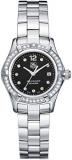
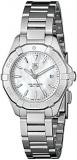
The TAG Heuer Aquaracer quartz is defined by a single number that shapes every design decision: 300 metres of water resistance. That rating, printed on the dial of references such as the 41 mm WBD1111.BA0928, places the watch in professional dive-watch territory rather than the recreational poolside category. The case measures 12.04 mm thick with a 20.50 mm lug distance, dimensions that keep the profile wearable on the wrist while leaving room for the gaskets, screw-down crown and caseback seals that make the depth rating possible.
Quartz movements rarely receive the reverence lavished on mechanical calibres, yet in a dive watch the argument for quartz is straightforward. A battery-driven movement has fewer moving parts, resists positional variation and requires no winding ritual before a dive. TAG Heuer builds the Aquaracer quartz line around that logic, pairing Swiss assembly with a movement that simply works when the wearer needs it. The result is a tool watch that prioritises function over ceremony.
Case Architecture and the 300-Metre Claim
Water resistance at 300 metres is not achieved by a single component but by the sum of several. The caseback threads tightly against a gasket, the crown screws down rather than pulls out, and the crystal sits under compression within the bezel assembly. TAG Heuer lists the case as steel with a fine-brushed and polished finish, a combination that hides the scuffs a dive watch inevitably collects while keeping enough shine for the watch to pass at a dinner table.
The 41 mm reference sits in the middle of the Aquaracer size range, which also includes a 43 mm variant such as the WAY108A.FT6141 with a titanium case coated in PVD. That larger model demonstrates how the collection adapts its materials while retaining the same depth rating. A titanium-coated case reduces weight and adds scratch resistance, though steel remains the more traditional choice for those who prefer a watch with heft on the wrist.
Lug distance matters more than many buyers realise. At 20.50 mm, the 41 mm Aquaracer accepts a wide range of aftermarket straps, from rubber to NATO, which extends the watch's versatility beyond the bracelet it ships with. That interchangeability is a practical advantage for anyone who wants one watch to serve both diving and everyday wear.
Quartz Precision in a Mechanical World
Quartz timing accuracy typically falls within a few seconds per month, a figure that mechanical movements at this price point cannot match without certification. For a dive watch, that accuracy has a functional dimension: dive tables and decompression planning depend on consistent timekeeping, and a movement that drifts less is a movement that demands less correction. The Aquaracer quartz does not need to be wound, does not stop if left on a desk for a week, and does not require servicing at the intervals a mechanical calibre demands.
The trade-off is the battery. A quartz watch will eventually stop and need a replacement cell, a service that is quick but not free. Some purists regard that dependency as a flaw; others regard it as the price of convenience. The Aquaracer quartz makes its case on the latter terms, positioning itself as a watch for people who value readiness over ritual.
It is worth noting that TAG Heuer also offers solar quartz within the Aquaracer family. The Professional 200 Solargraph, in 40 mm and 34 mm versions, uses calibre TH50-00, a solar quartz movement that draws power from light and reduces reliance on battery swaps. That technology sits alongside the conventional quartz references rather than replacing them, giving buyers a choice between a standard cell and a light-powered alternative.
Design Language and Dive-Watch Ergonomics
An Aquaracer is recognisable at a glance. The bezel carries a pronounced grip pattern, the dial markers are large enough to read in low light, and the hands are broad enough to remain legible through a dive mask. These are not aesthetic choices made in isolation; they are responses to the conditions in which the watch is expected to function.
The unidirectional rotating bezel is the central tool on any dive watch. It turns one way only, so a knock against a rock or a boat rail cannot accidentally extend a dive timer. The markings are engraved and filled for visibility, and the action is firm enough to resist accidental movement while remaining operable with wet fingers or gloves.
- Case: Steel, fine-brushed and polished, 41 mm or 43 mm depending on reference
- Water resistance: 300 m on steel references, 200 m on the Solargraph line
- Movement: Quartz, with solar quartz available in the Professional 200 Solargraph
- Lug distance: 20.50 mm on the 41 mm reference, supporting strap changes
- Bezel: Unidirectional rotating, engraved markings
The bracelet on steel references uses a folding clasp with a safety mechanism, a detail that matters when a watch is worn over a wetsuit sleeve or during vigorous movement. The finishing alternates brushed and polished surfaces, a technique that gives the watch visual depth without making it flashy.
How the Aquaracer Quartz Fits the TAG Heuer Line
Each of the brand's collections has its own clear identity. The TAG Heuer Carrera is the racing chronograph, the TAG Heuer Monaco is the square-cased icon, and the TAG Heuer Formula 1 is the entry-level sports line, while the TAG Heuer Aquaracer naturally belongs to the water. Within that family, the quartz references serve as the accessible entry point, while mechanical and Solargraph versions sit above them in the hierarchy.
That positioning matters for buyers. Someone who wants the Aquaracer look and depth rating without the servicing obligations of a mechanical movement will find the quartz references persuasive. Someone who wants a movement they can wind and pass on will look elsewhere in the collection. Neither choice is wrong; they simply reflect different priorities.
The Aquaracer also shares DNA with TAG Heuer's broader dive heritage, a lineage that stretches back through the brand's professional timing instruments. The collection's name signals that heritage without demanding that every owner be a diver. Many Aquaracer buyers never take the watch below a few metres, and the watch serves them perfectly well as a robust daily wearer with a bezel that doubles as a useful timer for everything from parking meters to oven timers.
Ownership, Maintenance and Real-World Use
A quartz dive watch demands less attention than its mechanical counterparts, but it is not maintenance-free. Water resistance depends on gaskets that degrade over time, and TAG Heuer recommends periodic pressure testing, particularly before any serious diving. A watch that has seen years of pool chlorine and salt water should have its seals inspected rather than assumed intact.
The battery replacement interval varies with usage and complications, but a quartz movement typically runs for several years on a single cell. When the time comes, the caseback must be resealed correctly to preserve the depth rating, which is why battery changes on a dive watch are best handled by a qualified watchmaker rather than a general jeweller.
Beyond maintenance, the Aquaracer quartz is a watch that asks little of its owner. It can be worn for a swim, left in a drawer for a fortnight, picked up and worn again without winding or setting beyond a date adjustment. That low-friction ownership experience is the quiet argument for quartz in a tool watch, and it is an argument the Aquaracer makes convincingly.
Who Should Consider the Aquaracer Quartz
The Aquaracer quartz suits the buyer who wants a Swiss dive watch with a genuine depth rating, a legible dial and a bezel that works, without the ongoing cost and ritual of a mechanical movement. It suits the traveller who wants a watch that survives a holiday and does not need winding on return. It suits the swimmer, the snorkeller and the desk diver who values the look and capability of a dive watch in a package that simply runs.
Buyers who prioritise mechanical craftsmanship, exhibition casebacks or the romance of an automatic rotor should look to other references in the Aquaracer range or elsewhere in the TAG Heuer catalogue. The quartz line does not pretend to offer those things. What it offers is precision, depth capability and Swiss construction in a form that is ready whenever it is picked up.
The Aquaracer quartz occupies a specific and honest place in the dive-watch market: a professional-grade case and bezel wrapped around a movement chosen for dependability rather than drama. For a watch that is expected to work under pressure, that is a coherent and defensible philosophy.
 Exciting, Best Luxury Watches for Sale!