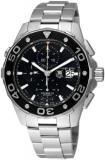
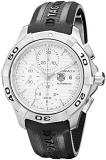
The TAG Heuer Aquaracer Chronograph occupies a distinctive position within the brand's lineup, bridging the tool-watch lineage of the Aquaracer collection with the stopwatch functionality that has defined TAG Heuer since the era of dashboard timers. Where a standard three-hand dive watch records the present moment, a chronograph allows its wearer to measure passing intervals with the press of a pusher, a capability that transforms a water-ready sports watch into an instrument for training, travel and daily logistics.
That dual identity is visible in the official specification sheets. The Aquaracer Professional 200 Chronograph, a 40 mm quartz model, is rated to 200 metres of water resistance and housed in a polished steel case that TAG Heuer describes as ergonomic and pressure-proof. The collection also includes automatic references such as the Aquaracer Professional 300 Date, a 42 mm watch with a 300-metre rating and a movement delivering an 80-hour power reserve at a balance frequency of 28,800 vibrations per hour, or 4 Hz. Together these examples frame the design philosophy of the line: a sealed case, a legible dial and a bezel engineered for timing, whether that timing is a dive interval or a lap split.
Why a Chronograph Belongs on a Dive Watch
Dive watches and chronographs share a common ancestry in legibility and reliability rather than fashion. A chronograph adds a seconds hand that can be started, stopped and reset independently of the running time, which suits tasks like measuring decompression stops, timing a segment on a road ride or tracking the intervals of a swim set. The pushers of a well-sealed chronograph are built to be operated with wet or gloved hands, and the bezel supports a second timing scale that divers have used for decades to track elapsed bottom time.
This is why the Aquaracer line has long appealed to athletes beyond the diving community. The same attributes that make a watch dependable at depth, such as a screw-down crown, a screw-locked caseback and clearly marked numerals, make it dependable on a running track or in a corporate meeting room. The chronograph complication sits naturally on this platform because it extends the watch's function without altering its core architecture.
Design Language and Case Engineering
Case Architecture
The Aquaracer case is defined by a mixture of brushed and polished surfaces that give it a technical but refined appearance. The steel case of the Professional 200 Chronograph measures 40 mm in diameter, a size that suits a wide range of wrists while leaving room for the sub-dials and pushers that a chronograph requires. Its 200-metre water resistance rating places it firmly in the sports-watch category, appropriate for swimming, snorkelling and surface water sports.
On the automatic side of the line, the Aquaracer Professional 300 Date demonstrates the more substantial approach: a 42 mm case with a 12 mm thickness, a lug distance of 21 mm and a 300-metre rating. Those proportions are wider and thicker than the quartz chronograph, reflecting the additional space an automatic movement with a date complication requires. The phrase "Professional 300" is itself a reference to the depth rating and signals a watch built around serious water use rather than light splash resistance.
Bezel, Dial and Legibility
The bezels across the TAG Heuer Aquaracer collection share a common purpose: unidirectional rotation with clear markings for timing. Dial layouts vary by reference, with sub-dials dedicated to chronograph registers on the chronograph models and applied indices with large luminous plots across the line. The priority is reading the time at a glance, even in low light or through a diving mask, and every element of the dial serves that goal rather than decoration.
The Chronograph Mechanism Explained
A chronograph movement uses a set of wheels and levers that connect the pushers to a central chronograph seconds hand and, in a typical three-register layout, to minute and hour counters. Pressing the upper pusher engages a column wheel or cam mechanism that couples the chronograph train to the main gear train; pressing the lower pusher returns all counters to zero via a hammer and heart-piece arrangement. On quartz references, the same logic is executed electrically, with a dedicated stepping motor driving the chronograph seconds hand. In both cases the design goal is the same: a crisp start and stop with minimal backlash and consistent positional accuracy.
Automatic chronographs add a further layer of engineering, because the rotor and mainspring must supply power for both timekeeping and the chronograph train. Power reserve becomes a relevant specification, and the 80-hour figure achieved by the Aquaracer Professional 300 Date movement shows how modern mainspring and escapement design have extended running time well beyond the traditional 40-hour benchmark. A quartz chronograph, by contrast, prioritizes convenience, accuracy and low maintenance, which is one reason it appears at the 40 mm Professional 200 position in the range.
Quartz versus Automatic: Choosing Within the Range
The decision between quartz and automatic chronographs is largely about use case and preference rather than objective quality. Quartz references offer immediate accuracy, a lighter movement and minimal upkeep beyond periodic battery changes, while automatic references offer mechanical character, sweep seconds and an engineering story visible through the caseback. Buyers who want a chronograph as an everyday tool may favour quartz for its simplicity; buyers drawn to watchmaking as a craft may prefer the automatic.
Water resistance, too, should be matched to planned use. The 200-metre rating of the Quartz Chronograph satisfies most recreational activity, while the 300-metre rating of the Professional 300 Date provides a margin many users never strictly require but often value for durability and peace of mind. Neither figure should be read as a suggestion to dive beyond certification limits; both reflect rated, tested capability.
- Quartz reference: 40 mm steel case, 200 m water resistance, chronograph pushers, everyday convenience.
- Automatic reference: 42 mm case at 12 mm thickness, 300 m water resistance, 80-hour power reserve, open caseback engineering.
- Shared attributes: unidirectional timing bezel, luminous dial elements, screw-down crown and caseback construction.
Wearing and Living with the Aquaracer Chronograph
A 40 mm chronograph wears comfortably across a range of wrist sizes, and the 21 mm lug spacing of the larger automatic reference makes strap changes accessible. Steel bracelets with security clasps are the standard fit for the line, and many owners pair the watch with a rubber strap for swimming and a leather strap for the office, which is a practical way to extend one watch across multiple settings. The pushers add visual complexity to the case but do not interfere with cuffs once the wrist settles.
Maintenance follows predictable lines. Mechanical chronographs benefit from service intervals recommended by the brand, while quartz models simply need battery replacement and occasional gasket inspection to preserve water resistance. Chronograph hands collected on shipping or service should be reset according to the user manual, and the timing bezel should be checked for smooth rotation and proper alignment. These small routines keep the tool functioning as intended.
Context Within the TAG Heuer Universe
The Aquaracer sits alongside other landmark families in the brand's catalogue, each with a distinct purpose. The TAG Heuer Carrera collection traces its line to motorsport timing and has long served as the brand's road-racing chronograph, while the TAG Heuer Formula 1 line offers a more accessible steel sports-watch expression. Beyond that, the Aquaracer remains the most explicitly water-oriented of the group, and its chronograph variants translate a racing instrument into a sealed, salt-water-ready package.
This positioning matters for buyers comparing options. Someone drawn to stopwatch heritage might look toward the motorsport-inspired families first, but a chronograph that must also survive a swim or a coastal holiday carries different requirements. The Aquaracer Chronograph answers that brief with pushers sealed against water ingress, a legible dial and a bezel that times intervals without requiring a phone or a timer app.
There is a quiet logic to the Aquaracer Chronograph that resonates with users who value one dependable object over several specialized ones. A watch that can time a sprint set, survive the surf and still look appropriate at a dinner table represents a considered form of versatility, and the chronograph functions on the Aquaracer platform exist not as decoration but as working instruments intended to be used. For that reason, the Aquaracer Chronograph carries a legitimate claim to utility that extends well beyond the pool.
 Exciting, Best Luxury Watches for Sale!