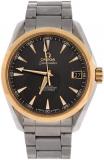
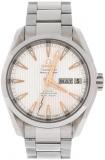
The Omega Seamaster Aqua Terra 150M occupies a distinct position within the Seamaster family, sitting apart from the dive-focused Seamaster Diver 300M and the regatta-oriented Regatta models. Where those siblings lean heavily on bezels, crowns and luminous dive scales, the Aqua Terra strips the formula back to a clean, symmetrical case and a dial defined by subtle horizontal teak lines. This is a watch engineered for people who want the durability and antimagnetic resistance of a modern sports watch without the visual bulk of a professional dive instrument.
The collection is presented across a range of case sizes, with 38 mm and 41 mm models forming the core of the line and a smaller 34 mm piece aimed at slimmer wrists. According to Omega, the 41 mm variants are built around a symmetrical stainless-steel case with a wave-edged design on the caseback, a detail that ties the model back to the maritime heritage of the wider Seamaster family. The proportions are deliberately restrained: case thickness is kept moderate enough to slide under a shirt cuff, while the broad lugs and short caseback curvature keep the watch stable on the wrist during daily activity.
Omega powers these watches with self-winding movements operating at a frequency of 3.5 Hz and offering a power reserve of 60 hours on a full wind. The Co-Axial Master Chronometer certification means each watch has passed the METAS eight-test protocol, which includes exposure to magnetic fields of 15,000 gauss alongside accuracy checks across multiple positions and temperatures. For buyers who care about mechanical honesty rather than marketing language, this certification is one of the most concrete anti-magnetic and precision benchmarks available at this price level.
Dial Design and the Teak Concept
The signature element of the Aqua Terra is the dial, whose horizontal lines are inspired by the wooden decks of sailing yachts. In most references the surface is sun-brushed, catching light in a way that reveals the striations only at certain angles, while some versions add a small subdial or a colour-matched date window. The black dial references in particular adopt trapezoidal date windows and sharp triangular indexes, giving the watch a slightly more architectural character than the round-ended markers used elsewhere.
Index and hand design follows the same logic: applied markers with faceted edges, broad arrow-style hands and a slim seconds hand tipped with a luminous dot. Legibility is strong in low light without the chapter ring becoming busy. Set against the bezel-forward architecture of TAG Heuer Aquaracer dive watches, the Aqua Terra reads as the more formal of the two, with a flatter, more integrated look on the wrist.
Case finishing splits between polished and brushed surfaces, with the lugs carrying a predominantly brushed treatment and the case flanks polished. The result is a watch that photographs well in bright light but does not glare aggressively under office lighting. Bracelet options include a three-link steel bracelet with polished centre links and a rubber strap version for the chronograph and GMT configurations.
Movement, Certification and Real-World Durability
Inside the three-hand references sits a Master Chronometer automatic movement. The key practical benefits are threefold: the 60-hour reserve covers a weekend off the wrist without stopping, the silicon balance spring resists temperature variation and magnetic interference, and the anti-magnetic construction removes the need to worry about laptops, phone speakers or magnetic closures on bags. For anyone who has had a mechanical watch run fast after a day at a desk with strong magnetic sources, that last point is more than a specification on paper.
Water resistance is rated to 150 metres, which places the Aqua Terra in the category of a genuine all-rounder rather than a poolside ornament. It is sufficient for swimming, snorkelling and showering, and the screw-down crown and caseback gasket design support that rating. Buyers should note that the 150 metres rating does not extend to scuba diving, which is where the Seamaster Diver 300M line becomes the appropriate choice.
The 43 mm GMT Worldtimer variant extends the line into travel territory, pairing a self-winding movement with a world-time complication and a rubber strap option. It runs the same 60-hour reserve and 3.5 Hz frequency, and the sapphire crystal and anti-magnetic construction carry over. For frequent flyers who prefer a single watch for both office and airport, this is the reference that removes the need to pack a second timepiece.
Where the Aqua Terra Sits in the Seamaster Line
The Seamaster name covers several distinct design languages, and understanding those differences is the key to choosing correctly. The Diver 300M is a professional dive watch with a rotating bezel; the Aqua Terra is a luxury sports watch with no bezel and a cleaner profile; the Planet Ocean pushes water resistance and case mass even higher. Positioned against Omega Seamaster models, the Aqua Terra is the one intended for daily wear across office, weekend and travel contexts rather than a single-purpose mission.
- Case sizes: 34 mm, 38 mm, 41 mm and 43 mm depending on reference
- Movement: Self-winding Co-Axial Master Chronometer, 3.5 Hz, 60-hour reserve
- Magnetic resistance: Certified to 15,000 gauss
- Water resistance: 150 metres on the core three-hand models
- Crystal: Sapphire on both front and caseback
- Strap options: Steel bracelet, rubber strap and leather depending on variant
Because of those proportions, wrist size matters more than usual. A 41 mm Aqua Terra on a 6.5-inch wrist wears close to the edges of the case but remains comfortable thanks to the down-curving lugs. Buyers with wrists below 6.5 inches are generally better served by the 38 mm version, which keeps the same dial architecture and movement certification in a tighter package. The 34 mm reference is a distinct design with a round date window and its own dial details, and it should be judged as its own model rather than a scaled-down 38 mm.
Buying Considerations and Ownership Realities
Two practical questions decide most Aqua Terra purchases: bracelet or strap, and three-hand or complication. The steel bracelet gives the watch its most versatile look and adds resale stability, while the rubber strap version lightens the package and suits warm climates. On the movement side, the standard three-hand references deliver the cleanest dial and the thinnest case, whereas the GMT Worldtimer adds functionality at the cost of some dial clarity and case height.
Servicing follows the usual mechanical watch rhythm. Omega recommends periodic maintenance, and the Master Chronometer certification can be re-verified during service. Because the movement is widely supported through Omega's authorised network, long-term ownership is predictable rather than exotic. That matters for a watch intended to be worn daily rather than stored in a safe.
For buyers weighing alternatives, the Omega brand offers different personalities at similar price points: the Speedmaster brings chronograph heritage, the Constellation leans dressier, and the De Ville occupies the formal end of the range. The Aqua Terra remains the most flexible single-watch option among them, and that versatility is exactly what the all-occasion positioning describes.
The Aqua Terra's appeal ultimately rests on restraint. It does not chase trends in case shape or colour, and its dial language has stayed recognisable across generations. For a buyer who wants one mechanical watch that handles a morning swim, an afternoon of meetings and an evening out without a change of strap or a second box, the 150M line answers that brief with a movement that is certified to resist magnetic fields most people never think about and a case that stays legible in almost any light.
 Exciting, Best Luxury Watches for Sale!