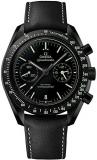
The Omega Speedmaster Professional carries a 42 mm stainless steel case, houses the hand-wound Co-Axial Master Chronometer Calibre 3861, and keeps a black step dial with three recessed counters under a domed sapphire crystal. That combination of a compact, balanced profile with a movement built for sustained accuracy is the reason this chronograph has remained in continuous production longer than almost any other wristwatch of its kind. The design language is instantly legible: a tachymeter scale on the bezel, a small seconds register at 9 o'clock, and a bracelet or strap that keeps the whole package close to the wrist.
A Chronograph Born for Timing and Tested in Space
Understanding the Speedmaster Professional means understanding why a manual-winding chronograph became the reference point for an entire category. In the early 1960s, NASA subjected candidate chronographs to a battery of tests covering temperature extremes, vacuum, shock, acceleration, and magnetic fields. The Speedmaster passed, and it was subsequently qualified for manned spaceflight. That history is not marketing decoration; it explains the priorities baked into the watch. Every element is there to be read and operated under pressure, from the oversized pushers to the high-contrast dial.
The modern reference keeps faith with that brief while updating the engineering underneath. The Calibre 3861 is a Master Chronometer certified by METAS, meaning it has passed tests for accuracy and resistance to magnetic fields of up to 15,000 gauss. For a manual-winding movement, that level of magnetic resistance is a meaningful technical achievement, since it protects rate stability in environments where phones, laptops, and medical equipment surround the wearer.
The movement also carries the Co-Axial escapement, a design that reduces friction between the escapement components and supports long-term consistency. Its 50-hour power reserve and 3 Hz frequency are modest figures on paper, but they reflect a movement tuned for reliability rather than spectacle. Owners wind it daily, and that ritual is part of the appeal: a direct physical connection to the mechanism that a rotor-driven watch cannot offer.
Reading the Dial and the Case Architecture
The dial layout rewards familiarity. A small seconds sub-dial sits at 9 o'clock, a 30-minute recorder at 3 o'clock, and a 12-hour recorder at 6 o'clock, giving the chronograph genuine long-duration timing capability rather than a decorative stopwatch function. The tachymeter scale on the bezel allows the wearer to calculate speed over a known distance, a feature that has survived every generation of the model because it remains useful and because it defines the silhouette.
The case itself is a study in restraint. At 42 mm it suits a wide range of wrists, and the official specifications list a lug-to-lug span of roughly 47.50 mm, which keeps the watch balanced rather than overhanging on smaller wrists. The stainless steel case is paired with a matching steel bracelet on the classic reference, and Omega also offers the model on a coated nylon fabric strap, which brings the total weight down considerably. That strap variant changes the character of the watch, shifting it toward a lighter, more casual daily wearer.
Water resistance is rated at 5 bar, equivalent to 50 metres, which covers splashes, rain, and brief immersion but should not be read as a diving rating. The Speedmaster Professional was never designed as a dive watch, and that distinction matters for anyone comparing it against purpose-built divers. The Omega Speedmaster Professional collection has always positioned this model as a pilot's and astronaut's chronograph, and the caseback engraving commemorating flight qualification reinforces that identity.
The Calibre 3861 and What Master Chronometer Certification Means
METAS certification is worth explaining because it separates the Calibre 3861 from earlier Speedmaster movements. The testing regime evaluates the fully cased watch rather than the bare movement, and it includes exposure to magnetic fields of 15,000 gauss, timing performance across six positions, and power reserve verification. A watch that passes is not merely accurate on a timing machine at room temperature; it holds rate under conditions that resemble real use.
For the wearer, the practical outcome is a chronograph that keeps consistent time whether it is resting on a desk or being worn through a commute filled with electronic devices. The hand-winding architecture removes the rotor and allows a thinner movement profile, which in turn contributes to the balanced case proportions. Servicing intervals for a movement of this type typically run several years, and the five-year warranty Omega attaches to the model reflects confidence in the build.
The pusher action deserves mention. Starting, stopping, and resetting a chronograph repeatedly is a stress test for any movement, and the Calibre 3861 uses a robust cam-and-lever layout refined for crisp engagement. The tactile response is one of the reasons collectors return to this reference rather than a quartz alternative.
How the Speedmaster Professional Compares Within the Omega Lineup
Buyers frequently arrive at the Speedmaster Professional while considering other Omega families, so a clear picture of the differences helps. The Omega Seamaster collection concentrates on dive and sports watches with higher water resistance ratings, screw-down crowns, and typically automatic movements. The Omega De Ville collection moves in the opposite direction, favoring dress proportions and refined dial work over tool-watch functionality. The Omega Constellation collection sits in a more jewelry-oriented register, with integrated bracelets and design cues that read as formal rather than utilitarian.
Against those alternatives, the Speedmaster Professional occupies a distinct position: a manual-winding chronograph with genuine professional heritage, moderate water resistance, and a design that has changed only incrementally for decades. That continuity is a feature. Parts availability, servicing knowledge, and community expertise are all well established, which matters for anyone planning to keep a watch for the long term. The Omega brand's broader catalog gives plenty of choice, but the Speedmaster Professional remains the reference chronograph in the lineup.
It is also worth noting that comparable professional chronographs from other manufacturers occupy similar territory, and the Breitling Professional collection is one of the few families that shares the same aviation-oriented brief. Comparing the two is instructive because they solve the same problem with different design philosophies, and buyers who value legibility and history above all else tend to gravitate toward the Speedmaster.
Wearing It: Real-World Considerations
On the wrist, the 42 mm case wears comfortably for most adults, and the relatively flat profile means it slides under a shirt cuff without snagging. The bracelet option adds visual presence and suits business dress, while the fabric strap version suits casual wear and travel. Because the watch is hand-wound, it rewards a routine: winding each morning takes a few seconds and keeps the movement running consistently, which is also good for long-term accuracy.
Owners should be aware of a few practical points. The 5 bar water resistance rating means the watch should be removed before swimming or showering, and the chronograph pushers should not be operated underwater. The domed crystal and stepped dial are classic design elements but make the watch slightly more vulnerable to knocks than a flat sapphire tool watch, so care around door frames and hard surfaces is sensible. None of this undermines the appeal; it simply reflects what the watch was built to do.
The dial's stepped construction, with its recessed counters and applied markers, rewards close inspection in a way that photographs do not capture. Light plays across the sub-dials and the tachymeter scale differently depending on the angle, and that depth is part of why the design has aged so well. Understanding the design history also puts the current reference in context, particularly when set against the dress-oriented Omega De Ville collection, which shows how the same brand can shift toward elegance while a single functional brief produces a design that outlasts its original purpose.
Collecting, Servicing, and Long-Term Value
The Speedmaster Professional is one of the most documented watches in existence, which makes collecting unusually transparent. Reference numbers, dial variants, and movement generations are catalogued in detail by enthusiast communities and specialist publications, so a buyer can research a specific example thoroughly before committing. That transparency supports confidence in the secondary market as well, since provenance and authenticity can be checked against published records.
Servicing is straightforward for a watch with this production volume. Omega's authorized service network handles the Calibre 3861, and independent watchmakers familiar with the movement are widely available. Routine servicing typically involves cleaning, lubrication, and gasket replacement, and owners should budget for it as part of long-term ownership rather than treating it as an unexpected cost. Strap and bracelet changes are easy to source, which allows the watch to be adapted across different settings without permanent modification.
The Enduring Case for a Manual-Winding Legend
The Speedmaster Professional persists because it does not chase trends. A manual-winding chronograph with 50 hours of power reserve, 5 bar water resistance, and a Master Chronometer certified movement is a specific proposition, and the people who choose it know exactly what they are getting. The ritual of winding, the clear dial architecture, the history of qualification testing, and the availability of parts and expertise all combine into a watch that is meant to be worn and kept rather than admired from a distance. For anyone building a collection around function and provenance, the Speedmaster Professional remains a natural anchor point, and its incremental evolution suggests it will continue to be one for the next generation of wearers as well.
 Exciting, Best Luxury Watches for Sale!