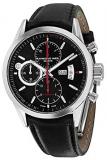
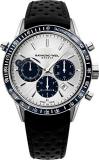
An automatic chronograph combines two demanding disciplines: a self-winding mechanism that draws energy from the wearer's motion, and a chronograph module that must start, stop, and reset without hesitation. Raymond Weil has built a recognizable identity around this combination since its founding in 1976, and the automatic chronograph remains one of the clearest expressions of that identity. Rather than treating the chronograph as an occasional showpiece, the brand uses it as a platform for its broader design language.
Why an Independent Swiss Brand Matters in This Segment
Raymond Weil's position within Swiss watchmaking rests on family ownership and design independence rather than mass-scale output. The brand states that it has remained independent since its founding, and that status shapes how its collections are conceived: smaller production runs, more editorial case shapes, and a dial architecture that often borrows from music and the performing arts. For buyers weighing a mechanical chronograph, that independence is a practical differentiator rather than a marketing footnote, because it tends to influence how consistently a brand revisits and refines its own references instead of chasing every trend cycle.
The Automatic Chronograph Movement in Context
A self-winding chronograph relies on a rotor to wind the mainspring as the wrist moves, and on a cam or column-wheel system to translate pusher input into the start, stop, and reset sequence. Typical automatic chronographs in this class deliver power reserves of roughly 38 to 48 hours, depending on the calibre, which means the watch is usually still running when it comes off the wrist and back on again. The practical trade-off is familiar: an automatic movement adds mechanical interest and visible engineering, but it asks for a minimum of wrist time or a winder to keep the chronograph running accurately.
Reading the Chronograph Function in Daily Use
Pusher feel and sub-dial legibility matter more than most spec sheets suggest. A well-tuned chronograph engages with a short, crisp travel and returns to zero without lag, which is why careful owners avoid resetting while the chronograph is still running. Sub-dials at 3, 6, and 9 o'clock can measure elapsed minutes, continuous seconds, and hours respectively, and the layout should read clearly at a glance rather than requiring a second look under changing light.
Luminous hands and applied indices usually complete the picture, and water resistance in the 5 ATM to 10 ATM range covers everyday exposure without inviting pool wear. Buyers who want to see how a feature-led mechanical chronograph is presented across a full catalogue can browse top Raymond Weil watch selections before narrowing down a specific reference.
Design Language: Cases, Dials, and the Music Influence
Raymond Weil's automatic chronographs tend to favor balanced, classical proportions: case diameters most often clustered between 40 mm and 43 mm, slimmer bezels than motorsport-inspired chronographs, and dials that pair circular or rectangular sub-dials with restrained typography. Steel cases with brushed flanks and polished bevels are common, and many models add a display case back to frame the oscillating rotor. The brand has repeatedly referenced music in its naming conventions, which translates more into a rhythmic layout on the dial than into literal graphics: clean tracks, generous negative space, and hands that stay proportional to the case.
Materials and Finishing Standards
At this price tier, finishing decisions tell the story. A sapphire crystal protects the dial, stainless steel carries most of the case and bracelet construction, and folding clasps with push-button releases are common throughout the range. Dial surfaces vary from sunray brushes that shift tone with wrist rotation to matte finishes that suppress reflection. Buyers who prefer a visual benchmark of how surface treatment changes a watch can study comparable finishing decisions on several sport-chronograph references.
How the Chronograph Compares in the Broader Market
A mechanical chronograph naturally invites cross-shopping with both boutique independents and the large heritage houses. Motorsport lineages emphasize bold bezels and timing-centric dials, while broader value brands cover everything from entry automatic models to chronographs aimed at daily wear. The real question is not who offers the most complications for the least money, but which brand's proportions, dial legibility, and wear comfort most closely match the wrist that will actually carry the watch.
- Case size: typically 40-43 mm, with short to moderate lugs for flat-wrist comfort
- Movement: self-winding chronograph calibre, often based on a proven Swiss ébauche
- Crystal: sapphire with anti-reflective treatment on many references
- Water resistance: commonly 5 ATM to 10 ATM across the range
- Strap options: steel bracelet, leather, and occasional two-tone configurations
Price positioning varies by reference and region, so individual models should always be checked against an official specification sheet rather than a marketplace listing. Chronograph movement architecture and case dimensions differ from reference to reference within the same collection, which is why a hands-on try-on is more useful than comparing numbers alone.
Care, Service, and Ownership Reality
Mechanical chronographs reward attention. Magnetic fields around laptops, tablet covers, and audio speakers can affect rate, and a full chronograph service usually becomes relevant every five to seven years under normal wear. Pushers should not be operated underwater, crown and pushers should be screwed down where applicable, and the watch should be kept away from hard impacts that can unseat a hand or damage the balance assembly. These are ordinary responsibilities for a Swiss mechanical movement, and they form part of the ownership experience rather than a drawback.
Who the Raymond Weil Automatic Chronograph Suits Best
The product fits well with buyers who want visible mechanical engineering, a legible three-register layout, and case proportions that transition between office dress and weekend wear. Those who prioritize water sports, extreme shock resistance, or smartwatch-style notifications should look elsewhere, because a classical chronograph is designed around timing and finish rather than connectivity. Buyers who value the elegance of thin profiles against the wrist might instead explore dress-oriented mechanicals from other independent houses, which take a different approach to wearing comfort and case architecture.
A Note on Collecting and Long-Term Value
Limited-edition chronographs and anniversary references carry the strongest collector interest, while standard steel models tend to hold value in proportion to condition and the completeness of box and papers. Buyers working across collections should read the reference number carefully: the numbers following the case-code prefix usually indicate dial and strap configuration, and two visually similar models can sit at very different resale positions. Seasoned collectors often compare a chronograph against a three-hand classic purely to understand where a simple timepiece sits relative to a complication, even when the two are not direct rivals.
What to Verify Before Buying
A careful buyer should confirm four things: that the chronograph starts, stops, and resets cleanly; that the power reserve sustains the advertised duration; that the case has not been over-polished on the lugs and bezel; and that the bracelet or strap retains its original clasp hardware. For a pre-owned automatic chronograph, service history is the single most useful piece of paperwork, because a movement overhaul can represent a meaningful share of the purchase price.
Within the Swiss mechanical landscape, the appeal of a Raymond Weil automatic chronograph comes down to a specific balance: the pull of an independently run brand, the measurable engagement of a mechanical chronograph, and dial proportions that stay wearable across a long day. That combination rewards owners who value a watch chosen for its mechanics as much as its looks.
 Exciting, Best Luxury Watches for Sale!