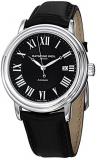
The Raymond Weil Maestro Tradition distills Swiss dress watchmaking into a polished stainless steel case measuring roughly 40 mm across, pairing a silver sunray guilloché dial with classical black Roman numerals. Those numerals sit against a surface that catches light in soft radial waves, a detail that positions the Maestro line within a long tradition of formal timepieces rather than the sporty mainstream.
A Dress Watch Built on Classical Proportions
The tradition of the dress watch rests on restraint: thin profiles, clean dials, and cases that slip beneath a shirt cuff without announcement. The Maestro Tradition follows that brief closely. Its polished stainless steel case frames a dial dominated by Roman numerals and a simple date aperture at 3 o'clock, an arrangement that press coverage of the square-cased Maestro variant has described as a classic dress watch formula.
Raymond Weil has offered the Maestro family in several case shapes, including the square steel reference with a silver sunray guilloché dial noted in press coverage. The Maestro Tradition draws on the same design language, favoring legibility and proportion over complication. Owners looking for a watch that reads clearly in a boardroom and equally well at dinner will find the layout familiar and unfussy.
Known for formal mechanical pieces that sit between accessible luxury and genuine horological craft, the Raymond Weil brand's positioning matters when judging the Maestro Tradition, because the watch is measured against both mass-market quartz pieces and far more expensive mechanical dress watches.
Movement and Mechanical Character
The Maestro line has historically relied on automatic winding movements with a 38-hour power reserve. Reporting around the launch of earlier Maestro references noted the RW4200 automatic caliber, a self-winding Swiss movement with a date function. The Tradition continues that specification approach, meaning the watch runs on wrist motion rather than a battery and requires the regular winding rituals that mechanical watch owners tend to value.
A 38-hour reserve is modest by contemporary standards, where some movements reach 70 or 80 hours. In practice, that figure rewards daily wear. A watch wound by routine use will keep running through a weekend left on a nightstand; one ignored for three days will need resetting. Buyers comparing specifications should weigh this honestly rather than expecting long-reserve performance from a dress watch in this price class.
What the Automatic Caliber Means Day to Day
Automatic dress watches impose a specific discipline on their owners. Setting the time and date after a pause becomes a regular habit, and the sweeping seconds hand replaces the ticking one found on quartz alternatives. The reward is a movement with visible mechanical character and no battery replacement cycle.
Water resistance across the Maestro line is typically rated at 50 meters, according to retailer specifications for skeleton and automatic variants. That rating covers rain, handwashing, and accidental splashes. It does not support swimming, and owners should treat the leather strap accordingly, since prolonged moisture degrades leather faster than any other component.
The Dial as the Defining Feature
Silver sunray finishing and guilloché texturing are among the most traditional dial treatments in Swiss watchmaking, and the Maestro Tradition uses them to establish visual depth. Roman numerals reinforce the formal character, while a discreet date window keeps the dial practical. Blade-thin hands maintain the dress watch proportions rather than weighing down the face with heavy luminous elements.
This design vocabulary places the Raymond Weil Maestro Tradition in conversation with other formal options on the market. Owners who prefer a sportier aesthetic often cross-shop within the same price bracket; the Rolex Explorer collection represents a very different answer to the everyday watch question, favoring tool-watch durability over dress formality.
Strap options across the Maestro range vary considerably. Retailer catalogues for the Maestro Tradition list mostly leather straps, with a minority of bracelet configurations. Steel bracelets suit warmer months and more active routines; leather straps deliver the classic dress watch look but demand care around water and perspiration.
Who the Maestro Tradition Suits
This is a watch for the person who needs one dependable formal timepiece rather than a collection. It pairs naturally with business attire, works for weddings and evening events, and slides under a cuff without bulk. The automatic movement adds mechanical interest for wearers who enjoy knowing a mainspring is doing the work.
Buyers weighing alternatives often look at established dress models from other houses. Cartier offers a distinct design heritage with recognizable case shapes that appeal to owners who prioritize style history over specification sheets, while Swiss contemporaries such as Longines and Tissot compete on value within the same segment.
Points of Comparison Within the Segment
- Case size: Around 40 mm, a versatile diameter that suits most wrists
- Movement: Automatic with a 38-hour power reserve and date
- Water resistance: Typically 50 meters, suitable for daily wear
- Dial treatment: Silver sunray guilloché with Roman numerals
- Strap options: Predominantly leather, with limited bracelet variants
The price positioning also matters. Raymond Weil sits above entry-level fashion watches but below prestige Swiss houses, which means the comparison set includes both mechanical dress watches from specialist brands and quartz pieces from luxury names. Buyers who value a mechanical movement and traditional dial work will find more to like here than in a quartz alternative at similar cost.
Craft, Materials, and Long-Term Ownership
Stainless steel cases remain the practical backbone of dress watchmaking, offering corrosion resistance and the ability to take a high polish that reads as precious without the cost of gold. The Maestro Tradition applies that logic to its case finishing, with polished surfaces that reflect light along the lugs and bezel.
Long-term ownership involves routine movement servicing, generally recommended every five to seven years for automatic calibers. Leather straps are consumable items and typically require replacement every one to two years depending on wear. Buyers comparing total cost of ownership against a quartz watch should factor in both servicing and strap replacement, since neither appears on the purchase receipt.
Hamilton approaches the dress watch category from a different angle, blending American design history with Swiss production and offering several formal mechanical models that compete directly on price. For shoppers comparing automatic dress watches across Swiss brands, these two names frequently appear on the same shortlist.
Where the Tradition Fits in a Broader Collection
As a second or third watch, the Maestro Tradition fills a clear gap: the formal slot. Dress watches occupy a narrow but important role in a collection, complementing divers, chronographs, and sports models rather than replacing them. Owners who already have a rugged everyday watch will find the Maestro useful for exactly the occasions the sportier pieces cannot cover.
Raymond Weil's identity has always leaned toward music and classical aesthetics, and the Maestro family reflects that orientation more directly than the brand's sportier lines. The resulting watch speaks to buyers who want Swiss mechanical construction and formal design without the pricing of heritage luxury houses.
The Maestro Tradition remains a considered choice for those who value understatement, an automatic caliber, and the quiet pleasure of a guilloché dial beneath a polished steel case. It asks for regular wear and modest care, and in return it delivers the ritual and precision that make mechanical dress watches endure.
 Exciting, Best Luxury Watches for Sale!