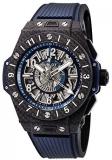
The Hublot automatic watch occupies a distinct position in contemporary haute horlogerie, defined by a design language that treats the case as a sculptural object rather than a quiet vessel for the movement. Since the brand's founding in 1980, Hublot has built its identity on the concept of the Art of Fusion, a philosophy that deliberately juxtaposes materials, textures, and proportions that traditional watchmaking houses once kept separate. Where many luxury makers chase restraint, Hublot pursues a confident, architectural presence on the wrist.
For readers navigating the extensive Hublot range, the Hublot brand's core families, from the flagship Big Bang to the understated Classic Fusion, deserve a closer look in one place. Understanding what separates these lines, and what an automatic movement actually contributes to each, is the key to choosing the right reference for daily wear, collection display, or both.
The Unico Caliber and the Meaning of Automatic in Hublot Terms
Hublot describes the Unico as its first 100 percent in-house movement, and the caliber has become a signature element of the automatic chronograph range. According to Hublot, the movement measures roughly 30mm by 6.75mm and is assembled from 354 components, figures that explain both its visual footprint and the complexity on show through open dials and case backs. An automatic caliber relies on a rotor that harnesses the motion of the wrist to wind the mainspring, so the watch remains ready whenever it is worn with reasonable regularity, with no battery replacement to schedule.
The engineering choices matter as much as the ownership convenience. A modular chronograph design, when executed well, allows the pushers to feel crisp and the sub-dials to remain legible despite the layered architecture. The Unico's skeletonized treatment turns the movement itself into part of the aesthetic, which suits a brand that has always treated mechanical transparency as a design feature rather than a secret.
Owners tracking how a self-winding caliber fits into broader collection planning often compare finish and layout choices across references. Questions such as whether to prioritize an exposed chronograph mechanism or a cleaner three-hand dial sit at the heart of that decision, and the same reasoning applies when evaluating competing luxury sport watches with a very different architectural agenda.
Case Architecture: The Big Bang, Classic Fusion, and Material Fusion
The Big Bang is the clearest expression of the brand's material experimentation, and Hublot lists titanium and ceramic constructions among its most prominent variants. A titanium case reduces weight while retaining rigidity, and ceramic bezels resist scratching across years of wear, a practical combination for a watch that is meant to be seen and used. Sizes range widely across the family, with 43mm and 44mm cases appearing frequently in current references, and larger dimensions reserved for statement pieces such as the Meca-10 line.
The Classic Fusion takes the same fusion philosophy in a quieter direction. Hublot presents the line in titanium and ceramic configurations at 43mm, alongside additional ceramic references that broaden the color palette. For buyers drawn to the brand's silhouette but wary of an aggressive wrist presence, the Classic Fusion is the more versatile entry point, pairing clean dial proportions with the layered case construction that distinguishes Hublot design.
Case dimensions deserve careful reading because Hublot designs carry visual weight beyond their millimeter figures. Thickness and lug-to-lug span influence how a watch sits under a shirt cuff and on narrower wrists, and the published geometry of individual references is the only reliable guide. Trying on more than one size before committing is sound practice for any luxury watch, and it matters especially here, where case mass is part of the intended impression.
Titanium Versus Ceramic: Practical Trade-offs
Titanium offers a warm, slightly darker tone and a lighter feel on the wrist, making larger diameters easier to carry for extended periods. Ceramic delivers high scratch resistance and a deep, uniform color, though it is less forgiving of sharp impacts at the edges. Hublot combines the two frequently, using ceramic for bezels where abrasion resistance is most valuable and titanium for the mid-case where weight reduction counts most. Buyers comparing options should weigh how the watch will actually be worn, since a desk-based routine and an active outdoor schedule put different stresses on each material.
For those constructing a collection with several sports references, understanding these material roles helps avoid redundancy. A closer look at comparable tool-watch approaches from other houses shows how durability gets translated into design language, providing useful context for what Hublot emphasizes by contrast.
Dial Design and the Visual Signature of an Automatic Hublot
Hublot dials favor depth over minimalism. Skeletonized mainplates, applied indices with luminous filling, and layered sub-dial frameworks create a sense of machinery visible from the outside, consistent with the open-worked character of the Unico movement. Legibility is preserved through contrasting hands and generous hour markers, a necessary balance when an intricate dial could otherwise become decorative noise.
Color strategy reflects the brand's fashion-conscious streak. Blue ceramic and darker metallic finishes appear across the Big Bang for those drawn to cooler, monolithic looks, while warmer tones and gold accents give several references a dressier edge. The choice is aesthetic first, but it carries practical weight too, since darker dials tend to read as more versatile across dress codes.
How to Choose Within the Hublot Automatic Line
A structured approach shortens the decision. Start with wrist size and the intended use case, then narrow by complication, then settle on material and color. The list below summarizes the main decision points collectors typically work through:
- Case size: Confirm the diameter and thickness suit the target wrist; 43mm to 44mm references dominate the core range
- Complication: Decide whether an exposed automatic chronograph or a time-only layout better matches daily needs
- Material: Titanium for reduced weight, ceramic for scratch resistance, or a fused combination for both
- Dial treatment: Skeletonized and layered designs trade some legibility for mechanical drama
- Family positioning: Big Bang for a bold statement, Classic Fusion for a more restrained silhouette
Each point interacts with the others, so a rigid preference on one factor can eliminate otherwise strong candidates. Working from the wrist outward, and treating materials and finishes as the final refinement rather than the opening question, produces a more coherent outcome.
The Wider Context: Automatic Sport Watches and the Art of Fusion
The automatic sport watch segment has shifted over the past two decades toward mixed-material cases and transparent movements, and Hublot has been among the most consistent proponents of that direction. A self-winding caliber with a visible chronograph module, housed in a case that actively combines ceramic, titanium, and composites, tells buyers that the engineering and the styling are meant to be evaluated together rather than in isolation.
That positioning also clarifies who the automatic range suits. Buyers seeking a pure dress watch with a slim profile will find better matches elsewhere, and those who prioritize maximum function for minimum form should consider instrument-first references. Hublot automatic watches are for collectors who want mechanical transparency and a strong wrist presence to coexist, and who accept that the watch is part of the outfit rather than a hidden tool.
Owners describe the experience as an ongoing engagement with the object. An automatic movement encourages regular wear, keeps the owner connected to the watchmaking process through an open case back, and rewards attention to detail during daily handling. That relationship, more than any single specification, is what the Hublot automatic line is built to deliver.
 Exciting, Best Luxury Watches for Sale!