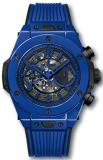
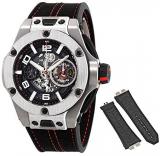
The Hublot Big Bang has, since its debut in 2005, served as the brand's most recognizable platform for material experimentation and architectural case design. Among the most closely followed variants are the limited edition releases, which typically cap production at several hundred pieces and introduce combinations of titanium, ceramic, and King Gold that do not appear in the standard catalog. The Big Bang 20th anniversary collection illustrates this approach directly: the case moves to a 43mm diameter with a slightly curved profile, and production is split between a titanium ceramic edition limited to 500 pieces and a King Gold ceramic edition limited to 250 pieces, as confirmed by Hublot's own announcement.
Understanding what separates a limited edition Big Bang from a regular production model requires attention to three areas: the case architecture and its material pairing, the Unico movement that powers most current references, and the production numbers that govern long-term collectability. Each of these factors shapes not only the visual identity of the watch but also the way it holds its position in the secondary market and how it sits within a wider assortment of references, much like the pieces gathered under the Hublot brand's broader catalog of fusion-driven designs.
Case Architecture and the Logic of Material Pairing
The defining gesture of the Big Bang is its multi-layer case construction, often described in horological circles as a fusion approach. Rather than carving a case from a single block, Hublot assembles the middle case, bezel, and caseback from distinct materials and fastens them with the brand's signature H-shaped screws. This is not decoration for its own sake: pairing a titanium mid-case with a ceramic bezel allows the watch to combine low weight with high scratch resistance on the surface most exposed to daily contact.
In limited edition releases, this pairing becomes the primary identifier. The 20th anniversary collection, for instance, presents four distinct material combinations: full titanium, titanium and ceramic, full ceramic, and King Gold and ceramic. Each combination changes the weight, the thermal feel on the wrist, and the way light interacts with the polished and brushed surfaces. For collectors, the material recipe is often more significant than the dial color, because it determines how the watch ages and how many examples of that exact configuration exist.
Titanium and Ceramic in Practice
Titanium brings a noticeably lighter feel than steel and a darker, more muted tone that resists corrosion. Ceramic, by contrast, is produced through sintering and delivers a surface that resists scratching far better than coated metals, though it is more brittle under sharp impact. Combining the two produces a watch that reads as technical rather than ornamental.
King Gold, Hublot's proprietary rose gold alloy, is the opposite proposition. It introduces warmth, density, and visible mass, and when paired with a black ceramic bezel it creates the high-contrast look that has become associated with the brand's more extravagant references. The choice between these paths is fundamentally a choice about how the watch should be worn and perceived.
The Unico Movement and Skeletonized Presentation
Many current Big Bang references, including the anniversary editions, are powered by the Unico manufacture caliber. The movement is deliberately designed for visibility: the dial side is open, exposing the column wheel and the chronograph mechanism rather than hiding them beneath a solid plate. This skeletonized presentation has become a defining characteristic of the modern Big Bang and distinguishes it from the earlier, more conventionally dialed generations.
The technical significance of an integrated chronograph caliber lies in how the chronograph functions are built into the movement architecture rather than added as a modular layer. This affects the thickness of the case, the tactile quality of the pushers, and the long-term serviceability of the mechanism. Hublot positions the Unico as the performance backbone of the Big Bang line, and the visible column wheel serves as both a functional component and a piece of mechanical theater.
For a collector comparing options, the movement generation matters. Earlier Big Bang models used outsourced chronograph movements, while the Unico represents an in-house approach with a different parts ecosystem and service pathway. A limited edition built around the Unico therefore sits in a different technical category than a first-generation Big Bang, even if the external silhouette is similar.
Why Production Numbers Drive Collectability
The number stamped on a limited edition is not marketing trivia. When Hublot caps a titanium ceramic reference at 500 pieces and a King Gold ceramic reference at 250, it establishes a fixed supply that will never expand. This has practical consequences for anyone building a collection: scarcity affects availability, resale behavior, and the likelihood that a specific configuration can be found in unworn condition years after release.
It also affects how the watch should be assessed against other luxury categories. Someone weighing a limited Big Bang against a classic dress watch from Cartier is comparing two different value systems: one built on mechanical exclusivity and audacious design, the other on restrained heritage. Neither is superior; they serve different collector intentions, and understanding that distinction prevents a purchase driven purely by hype.
Reading a Limited Edition Correctly
Several details separate a genuine limited edition from a standard model with cosmetic differences:
- Engraved numbering: the piece number and total production run appear on the caseback.
- Unique material combination: the case and bezel pairing does not appear in the regular catalog.
- Distinct dial treatment: limited variants often use skeletonization or finishing not offered elsewhere.
- Documentation: the certificate and box set confirm the edition and its position within the run.
Checking these points guards against confusion with dealer-exclusive or regional variants, which may be scarce but are not always numbered editions in the strict sense.
Wearability and the Honest Trade-offs
A 43mm Big Bang with a curved case profile wears more comfortably than its dimensions suggest, because the lugs angle downward and the caseback sits close to the wrist. Titanium versions feel almost insubstantial relative to their visual bulk, while King Gold versions make their presence known through weight as much as through color. Neither is objectively better; the choice depends on whether the wearer prefers a watch that disappears on the wrist or one that anchors it.
The honest trade-offs deserve mention. Ceramic bezels resist scratches but can chip if struck sharply against a hard edge. Skeletonized dials are visually arresting but can reduce legibility in low light compared with solid dials. And the very boldness that makes a limited Big Bang desirable to one collector makes it a difficult daily companion for another. These are design decisions with consequences, not flaws, and a buyer should weigh them against the intended use.
It is also worth considering how such a watch fits alongside a broader collection. A collector who already owns a conservative piece from Rolex Datejust II might find a limited Big Bang serves as the deliberate contrast: a watch chosen for expressive impact rather than understatement. That contrast is itself a form of curation, and it explains why these editions appeal to collectors who already have their formal needs covered.
The Design Language and Its Wider Context
The Big Bang's visual vocabulary, layered case, exposed screws, and aggressive bezel geometry, was controversial when it arrived and is now embedded in the brand's identity. Limited editions function as a testing ground within that vocabulary: new material pairings appear first in small runs, and successful ideas gradually migrate toward broader production. Observing which limited editions sell out quickly offers a reasonable signal about which directions the brand will pursue next.
This pattern is common across the luxury watch landscape. Brands with strong design signatures, whether a sports chronograph from IWC or a dive-oriented reference from another house, tend to use limited runs to explore the edges of their own aesthetic without committing the entire line. For buyers, this makes limited editions a window into the brand's thinking as much as a product in their own right.
Hublot has consistently treated material research as the core of its proposition. The fusion of titanium, ceramic, and gold alloys is not incidental styling but the central technical narrative, and the limited edition format is where that narrative is tested most aggressively. A watch acquired under that premise should be understood as an example of a specific material experiment, with a fixed number of companions worldwide.
How to Approach a Purchase Decision
The first question is not which edition looks best in photographs but which material combination suits the way the watch will actually be worn. A titanium ceramic piece works well as a frequent wearer because of its lower weight and scratch-resistant bezel; a King Gold ceramic piece is better suited to selective wear and occasions where its visual mass is an asset rather than a liability.
The second question is whether the specific numbered edition has documentation and a verifiable production count. Limited editions derive much of their value from provable scarcity, so the certificate and caseback engraving carry real weight. A buyer who intends to hold the watch long term should also consider service access: in-house calibers require authorized service, and the availability of parts for a given generation can change over the years.
The third question is stylistic longevity. A limited edition is still a watch that must be worn, and the layered, high-contrast Big Bang aesthetic is not neutral. Anyone drawn to it should be confident that the design will still feel right a decade later, because the production cap means there is no later run to fall back on if the first choice proves wrong. Buying with that in mind turns a scarce object into a considered part of a collection rather than an impulsive acquisition.
The Hublot limited edition ultimately represents a specific philosophy: that mechanical watchmaking can be a laboratory for materials as much as a guardian of tradition. The numbered caseback and the fixed production run document that philosophy in physical form, and the watch's value to its owner rests on the same foundations as its scarcity: a deliberate material experiment, executed once, in a quantity that will not be repeated.
 Exciting, Best Luxury Watches for Sale!