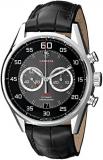
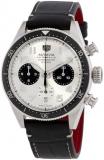
The TAG Heuer Carrera 1887 carries a name that connects two distinct chapters of watchmaking history: the minimalist racing chronographs of 1963 and the revival of a manufacture chronograph movement in the early 2010s. That combination gives the watch a dual identity. It reads as a descendant of Jack Heuer's original Carrera, yet it also marks the point at which TAG Heuer brought chronograph movement production back under its own roof.
For anyone weighing a modern steel chronograph, the reference matters. The Calibre 1887 is not a generic outsourced movement dropped into a familiar case; it is a modular, integrated-column-wheel design that shaped the brand's chronograph lineup for years. Understanding what that means in practice, from case sizing to dial architecture, is the core of this guide, and it serves as a durable reference for choosing the right variant.
What the Calibre 1887 Represents
The Calibre 1887 is an automatic chronograph movement built around a column wheel and a modular construction. TAG Heuer positioned the calibre as a return to in-house chronograph production, and the movement became the technical anchor for a broad range of Carrera references through the 2010s. Its architecture favors a horizontal clutch and an oscillating weight that keeps the winding mechanism efficient during daily wear.
The practical value of a column wheel is tactile. Pusher feel is crisp and consistent, and the start-stop-reset sequence avoids the spongy resistance sometimes found in cam-actuated chronographs. In a racing-inspired watch, that distinction matters because the chronograph is not decorative; it is the primary instrument.
Owners also benefit from the movement's serviceability. Because the calibre was produced in large numbers across many Carrera references, parts and servicing knowledge are widely available, which supports long-term ownership in a way that limited-run movements often cannot match.
Case Sizes and Reference Variants
The Carrera 1887 family spans several case diameters, and the choice affects how the watch sits on the wrist as much as how it looks. Official specifications list steel-cased references at 41 mm and 43 mm, with fixed bezels and 100 m water resistance across the core steel models.
The smaller references suit wrists that prefer a more classic chronograph proportion, while the 43 mm cases lean into the modern, broader stance that became common in the 2010s. Materials also vary by reference, with some models pairing steel with ceramic bezel elements and others using a fine-brushed or sand-blasted finish for a more technical character.
- 41 mm steel references: Calibre 1887 Automatic, fixed bezel, 100 m water resistance
- 43 mm steel references: Calibre 1887 Automatic, polished or brushed case finishes
- Mixed-material references: steel and ceramic case elements on selected 43 mm models
- Carbon-cased references: a 45 mm variant with an alligator strap
That spread is useful when comparing alternatives such as the Grand Carrera line, which took a more complex approach to dial detailing. The standard Carrera 1887 stays closer to the clean, legible formula that defined the original racing chronograph.
Dial Design and Legibility
Carrera dials are built around clarity. The 1887 references keep that principle with well-separated sub-registers, applied markers, and hands that read quickly at a glance. On three-register layouts, the sub-dials handle running seconds, chronograph minutes, and chronograph hours, letting a user time an event without hunting for information.
Finishing varies across the range. Some references use a clean, matte or sunray surface that keeps contrast high in daylight, while others introduce texture or open-worked elements for a more technical look. Tachymeter scales appear on many versions, tying the watch visually to motorsport even when the owner never uses the function.
Legibility under real conditions is the real test. Luminous hands and markers allow quick reading in low light, and the sub-dial spacing avoids the visual crowding that plagues some oversized chronographs. The result is a dial that looks composed on the wrist rather than busy.
Wearing the Carrera 1887 Day to Day
A 100 m water resistance rating covers the practical realities of daily life: rain, hand washing, and accidental splashes. It is not a dive rating, and the watch should not be taken into serious water, but for an office-to-weekend rotation it is entirely sufficient.
The automatic movement means no battery changes, and the chronograph function stays ready whenever it is needed. Steel bracelets on the core references give the watch a substantial feel that balances the case size, while leather or alligator straps shift the character toward formal wear. Owners who alternate straps often find the Carrera 1887 works in both contexts, which is part of why it remained in production for an extended period.
For readers drawn to the brand's sportier side, the Carrera collection remains the reference point for this blend of racing DNA and everyday usability, and the 1887 generation is central to that story.
Collecting and Market Position
The Carrera 1887 sits in an interesting place for collectors. It is not a limited-production curiosity, and it is not the earliest Carrera. What it offers is a documented, well-understood movement family paired with a design language that has aged well. Buyers can choose between steel, mixed-material, and carbon references without leaving the same movement platform, which makes comparison straightforward.
Condition and completeness matter more than rarity for most references. Boxes, papers, and service history carry weight, and original bracelets are worth confirming because replacement parts can be difficult to source. The movement's serviceability supports confident ownership, and independent watchmakers familiar with the calibre are common.
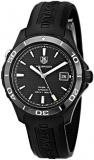
Compared with more specialized tool watches, such as models built for dive-oriented duty like the Aquaracer, the Carrera 1887 trades water-first specification for chronograph capability and a dressier profile. That trade-off defines its role in a collection.
Why the 1887 Still Resonates
The appeal of the Carrera 1887 is not nostalgia alone. It is a watch that combines a mechanically interesting movement with a design brief that dates to 1963 and still reads clearly today. The column wheel, the automatic winding, the balanced dial, and the range of case sizes give buyers real choices within a coherent family.
For someone building a first serious chronograph collection, the 1887 offers a documented movement, practical water resistance, and a design that moves between casual and formal settings. For the experienced collector, it represents a specific moment in TAG Heuer's manufacturing history, when the brand reasserted control over its chronograph engineering. Either way, the watch earns its place on the wrist through function rather than marketing, which is the most durable kind of relevance a chronograph can have.
 Exciting, Best Luxury Watches for Sale!