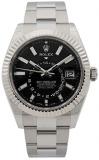
The Rolex Sky-Dweller displays two time zones simultaneously while an annual calendar tracks the date, a combination housed inside a 42 mm Oyster case. Reference 336934 pairs Oystersteel with white gold, and every variant shares the same architecture: a monobloc middle case, a screw-down case back, and a fluted rotatable Ring Command bezel that controls the watch's functions. It is the most complicated modern Rolex to sit outside the Day-Date and Daytona families, and it was built for people who spend their working lives in more than one place.
Few mechanical watches translate long-haul travel into a single dial layout as clearly as the Sky-Dweller, a model that anchors the brand's travel line. The Sky-Dweller occupies a specific position within that lineup: above the GMT-Master II in complexity, below the Day-Date in formality, and distinct from both in the way it solves the problem of knowing what time it is back home.
Designing a Dial for Two Places at Once
The dial is organized around a simple question: which time do you read first? Local time is indicated by the central hands, conventional hour, minute and seconds. A second time zone appears as a 24-hour disc displayed through an aperture below the dial's center, read against a fixed triangular marker at 12 o'clock. Rolex calls this off-center display intuitive, and the geometry supports the claim: the home reference sits at a glance without competing with the hands for the same visual space, which is an improvement over GMT layouts where a fourth hand sweeps across an already busy dial.
The annual calendar arrives through twelve apertures placed just outside the hour markers, each window corresponding to a month. The current month is shown in red, so the wearer reads the calendar as position rather than text. Below the 24-hour aperture is the date window. This is a Saros annual calendar, named after the astronomical cycle, and it needs correcting only once a year, at the transition from February into March, because it recognizes the month lengths and tracks 30- and 31-day months automatically. The design keeps the dial legible despite carrying a second zone and a full calendar, which is the central achievement of the reference.
Materials give the Sky-Dweller its physical character. Reference 336934 combines an Oyster case in Oystersteel with a white gold fluted bezel, an arrangement that separates the setting element from the body in two tones. Reference 336933 follows the same logic in Oystersteel and yellow gold with a champagne dial, while reference 336935 is executed entirely in 18 kt Everose gold with an Oyster bracelet of three-piece solid links and a folding Oysterclasp with comfort extension. The fluted bezel is not decorative alone: it grips the Ring Command system, turning bezel motion into mode selection.
How the Ring Command Bezel Actually Works
Setting a watch with a second time zone, an annual calendar and a date usually requires separate pushers, recessed correctors or a crown with multiple pull positions. The Sky-Dweller replaces all of that with a bezel that rotates through three positions, each linked to a function. In the first position the crown and bezel set local time, which moves the hour hand without disturbing the minutes or the running seconds, allowing quick adjustment on arrival. The second position sets the reference 24-hour time zone, typically home time. The third position sets the month through the calendar apertures and the date simultaneously, and it must be performed once annually to keep the Saros calendar aligned.
This interplay between bezel and crown is the watch's technical signature. Mechanical complexity behind the dial is controlled entirely from the exterior, without extra protrusions on the case flank. A traveler changing zones simply rotates the bezel, pulls the crown, adjusts, and returns the system to its neutral position. It is a solution to the problem of complexity that favors clean case lines over visible functionality. Set beside Rolex's Datejust line, which also prioritizes a flowing case profile, only the Sky-Dweller asks the bezel to serve as a control interface.
The Movement Behind the Dual Display
Inside the 42 mm Oyster case, the Sky-Dweller runs a perpetual rotor automatic movement of an advanced specification. The annual calendar mechanism adds some of the complications found in the brand's calendar repertoire, packaged to be operated externally and sealed against intrusion. The architecture follows six decades of automatic movement development, from the milestone self-winding calibers of the late 1950s onward, and its selling point is not novelty for its own sake but the number of functions it delivers while remaining a wear-and-forget watch. The case is water resistant and screw-down sealed, which keeps the mechanism trustworthy across climates and time zones.
For buyers who value mechanical sophistication alongside a bracelet built for daily wear, it sits at the practical end of high-complication Rolex ownership. Compared with sub-$5,000 watches that add a second time zone by sacrificing dial clarity, the Sky-Dweller accepts a larger case and a more involved setting procedure in exchange for an integrated design. The case profile and end links are engineered for a close fit.
For readers weighing other Rolex travel references, the GMT-Master II delivers a fourth hand and a rotating 24-hour bezel at a lower level of mechanical complexity, while remaining a serious professional tool. The Sky-Dweller and Rolex's Explorer line pursue different ends: the latter strips the formula to a robust time-only instrument for crossing time zones in either direction.
The Sky-Dweller occupies an unusual space. It is often bought as a first complication Rolex, yet it contains a second time zone and an annual calendar. Its case is 42 mm, larger than the Datejust 41, and its setting system is unique within the catalog. It works for the owner who wants a watch that reads as one thing to a stranger, a dual-zone annual calendar that handles the mental arithmetic of two-city existence.
The watch speaks to a specific wearer: someone who moves between cities, keeps a home reference active, and prefers a dial that says destination time without announcing that it is a travel instrument. The numbered month apertures and the off-center home arrow are quietly correct design decisions. Its material combinations promise that seasonal change and the February question can arrange themselves around the wrist. For brand specialists, the Sky-Dweller is justified by a simple proposition: one calibration, one crown pull, and then the world has correct hours and a correct date.
 Exciting, Best Luxury Watches for Sale!