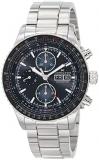
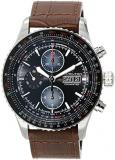
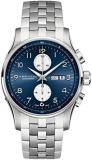
The Hamilton Jazzmaster Chrono answers a question many watch buyers wrestle with: how does one wear a chronograph to the office without looking like they just left a racetrack? Hamilton's answer sits in a 42mm stainless steel case, usually between 14.83mm and 15.23mm thick depending on the reference, with a sapphire crystal over a dial that keeps its composure. The Jazzmaster line has long served as the brand's bridge between its American design heritage and Swiss watchmaking precision, and the chrono variants carry that dual identity with unusual poise.
Two automatic calibres power this collection, and the distinction matters for anyone comparing references. The H-21 and the H-31 both drive a chronograph with date, but the H-31 is specified with a 60-hour power reserve, which gives it a meaningful edge across a weekend off the wrist. Hamilton fits both movements into identical 42mm cases with steel construction and a 22mm lug width on the silver-dial Auto Chrono reference, so the choice often comes down to dial colour and movement rather than wrist presence.
What Defines the Jazzmaster Chrono Design Language
The Jazzmaster family rejects the bulked-up proportions of many sports chronographs. Its case lines lean toward the classic mid-century dress watch: a modest bezel, a dial dominated by applied indices, and sub-dials arranged to preserve reading clarity rather than to shout about mechanical complexity. This is a chronograph designed to be worn with a shirt cuff, not strapped over a wetsuit.
Dial Architecture and Case Geometry
Official specifications list dial options including blue, black, and silver across the Auto Chrono references, paired with stainless steel cases and sapphire crystal. The silver-dial H32606555 and the black-dial H32616533 share a case thickness of 14.83mm, while the blue H32586541 and black H32616133 measure 15.23mm. On the wrist, that roughly 0.4mm difference is unlikely to be noticed, but it reflects how Hamilton tunes each reference slightly around its dial and movement combination.
The 42mm case diameter places the Jazzmaster Chrono firmly in modern unisex territory. It reads as substantial on slimmer wrists and restrained on larger ones, which is exactly why the line has found a broad audience among people who want one watch to cover meetings, dinners, and weekend travel. A chronograph, a date window, and a clean three-register layout share the dial without crowding it, and the result is a face that stays legible in low light and under artificial office lighting alike.
A Dress Chronograph With Tool-Watch Discipline
Sapphire crystal is standard across the collection, a practical detail that resists the scratches that accumulate on a watch worn daily. The chronograph pushers and crown sit flush enough to avoid snagging on a jacket, and the 22mm lug width opens up an enormous range of strap options, from the factory steel bracelet to leather and textile alternatives. That versatility is a quiet selling point: a single watch can shift from boardroom to casual Friday with nothing more than a strap change.
Inside the H-21 and H-31 Movements
Hamilton equips the Jazzmaster Chrono with automatic calibres that bring Swiss mechanical watchmaking into an accessible bracket. The H-21 appears in references such as the blue-dial H32586541 and the black-dial H32616133, while the H-31 is specified for the silver-dial H32606555 and the Jazzmaster Performer Auto Chrono H36606130, according to Hamilton's own product pages. Both calibres are automatic, both provide chronograph and date functions, and both eliminate the battery concern that owners of quartz chronographs eventually face.
- H-21 calibre: automatic chronograph with date, fitted to several Jazzmaster Auto Chrono references
- H-31 calibre: automatic chronograph with date specified at a 60-hour power reserve
- Case: 42mm stainless steel with sapphire crystal on listed references
- Dial options: blue, black, and silver across the Auto Chrono range
The 60-hour reserve on the H-31 is the kind of detail that separates a dress watch from a chore. Take it off Friday evening, put it back on Monday morning, and it is still running. For people who rotate between two or three watches, that capability reduces the temptation to keep a winder on the nightstand. The H-21 references offer the same chronograph function and automatic reliability, so the decision between the two movements often comes down to which dial a buyer prefers rather than any noticeable gap in daily performance.
How the Jazzmaster Chrono Fits Into Real Wardrobes
The strongest argument for this watch is not any single specification but the way it behaves across contexts. A 42mm steel chronograph with a sapphire crystal and an automatic movement is overqualified for a desk job and understated enough for a wedding. Set beside the field-inspired and aviation-themed pieces found throughout the Hamilton brand's wider catalogue, the Jazzmaster Chrono deliberately steps back from tool-watch styling and leans into the classic dress chronograph tradition.
That positioning makes it a natural first serious mechanical watch for someone moving up from quartz, and a sensible second watch for an owner who already has a diver. The chronograph itself remains genuinely useful beyond decoration: timing a commute, a meeting overrun, or a pasta boil all fall within its purpose. The date window covers the daily practical requirement without forcing the wearer to check a phone.
What to Weigh Before Choosing a Reference
Prospective buyers should decide on three things before picking a reference: dial colour, movement, and thickness tolerance. The blue-dial H32586541 and the black-dial H32616133 use the H-21; the silver-dial H32606555 uses the H-31 with its specified 60-hour reserve. The blue and certain black references are listed at 15.23mm thickness, while the silver and other black references sit at 14.83mm, a difference that is measurable on paper but minor in wear.
Strap choice is the second decision. The 22mm lug width on the silver Auto Chrono reference means almost any strap from Hamilton's own range or a third-party maker will fit. Leather for office wear, rubber for summer, and a steel bracelet for formal occasions turn this chronograph into a small collection in itself. Buyers should also confirm water resistance figures for the specific reference, since these vary across the wider Jazzmaster lineup and should not be assumed from one model to another.
Heritage, Positioning, and Long-Term Ownership
Hamilton's history includes its American roots and its later move into Swiss manufacturing, and the Jazzmaster line carries that story in a restrained way. The chrono references do not lean on nostalgia graphics or aviation iconography; instead they rely on proportion, clean dial design, and Swiss automatic engineering. That makes them easy to service, easy to live with, and easy to match with clothing that is not trying to make a statement.
For anyone cross-shopping within the same general bracket of Swiss automatic chronographs, the Jazzmaster Chrono represents a deliberate alternative to racing-inspired designs. It keeps the chronograph complication but dresses it in a suit rather than a racing jacket, which is precisely the gap many buyers discover when they start looking at chronographs and realise most of them are styled for the track.
The watch ultimately earns its place through a combination of restraint and capability. A 42mm steel case, a sapphire crystal, an automatic calibre with a chronograph and date, and a dial that works with a blazer or a t-shirt: these are the qualities that keep a watch on the wrist rather than in a drawer. The Jazzmaster Chrono delivers them without asking the wearer to adopt a persona first, and that quiet flexibility is what makes it a lasting choice for anyone building a wardrobe around one dependable mechanical chronograph.
 Exciting, Best Luxury Watches for Sale!