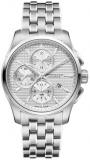
The Hamilton chronograph occupies a distinctive place in the watchmaking landscape: a Swiss-made instrument with an American soul, shaped as much by aviation and military logistics as by the design studios of Pennsylvania. Hamilton's chronograph line does not chase novelty for its own sake; it refines a formula rooted in legibility, robustness, and the kind of utilitarian elegance that has defined the brand since its founding in Lancaster in 1892. That lineage gives every pusher click and sub-dial layout a sense of purpose that modern collectors recognise immediately.
Why Hamilton Chronographs Carry a Military Pedigree
Hamilton's history is inseparable from the field. The brand supplied timepieces to the American armed forces during both world wars, and its mid-century military contracts demanded the sort of stop-second accuracy that allowed units to synchronise operations down to the second. According to Hamilton's own historical records, its military watches were equipped with hacking movements that could be stopped and reset for precise coordination in the field. That doctrine of functional clarity still echoes through today's chronograph range, where oversized pushers, matte dials, and high-contrast hands are design decisions rather than styling flourishes.
This heritage also explains why Hamilton chronographs tend to favour brushed steel over mirror polish, and why their dials resist decorative clutter. The field, aviation, and dress registers all draw on the same design language, and the Hamilton brand carries that shared grammar across every family: readable, durable, and built around the mission at hand.
The Khaki Field Auto Chrono: A Tool Watch With a Heart
At 42mm wide and 14.5mm thick, the Khaki Field Auto Chrono is the most overtly utilitarian chronograph in the current lineup. Its stainless steel case carries a sapphire crystal and a 100-metre water resistance rating, which places it firmly in everyday-robust territory rather than cautious dress-watch ground. The 20mm lug width keeps the strap ecosystem broad, and Hamilton specifies a 60-hour power reserve from the automatic movement inside.
The dial arrangement reflects field-watch logic: bold Arabic numerals, a clear minute track, and chronograph counters positioned so the running seconds stay readable at a glance under stress or low light. For buyers weighing a chronograph against pure flight or dive references, the Khaki Field Auto Chrono functions as a capable analogue for pieces such as a Breitling Navitimer chronograph, which occupies a similar space in aviation history but at a far higher price point.
Intra-Matic: Mechanical Chronography in a Classic Suit
The Intra-Matic family demonstrates the other side of Hamilton's chronograph personality. The American Classic Intra-Matic mechanical chronograph measures 40mm across and 14.35mm thick, with a 49mm lug-to-lug span that keeps it wearable on most wrists. Under a sapphire crystal, the blue dial pairs a tachymeter scale with two sub-registers on the hand-wound H variant, while the automatic version adds a date window and a white dial option at a comparable 40mm case size.
What distinguishes the Intra-Matic is its mid-century proportion discipline. Slim bezels, faceted lugs, and restrained dial printing create a piece that works as comfortably with tailoring as with a field jacket. That crossover ability is rare in the chronograph segment, and it places the Intra-Matic in conversation with dress-oriented complications like models within the Omega Speedmaster range, though Hamilton executes the formula at a decidedly more accessible price tier.
Aviation Chronographs: The X-Wind Legacy
Hamilton's aviation chronographs deserve separate consideration because they solve a different problem entirely. The Khaki Aviation X-Wind GMT Chrono Quartz, for example, uses a 46mm stainless steel case with a 22mm lug width, a 13.75mm profile, and a sapphire crystal, pairing a GMT function with a drift-angle calculator built into the bezel. That tool is not decorative: it allows pilots to compute crosswind components before landing, a nod to the brand's long association with instrument panels and cockpit cockpits.
Quartz regulation in this model is a deliberate choice rather than a compromise. For a cockpit tool, stable timekeeping across temperature swings and long intervals between maintenance is a genuine operational advantage. Enthusiasts who appreciate the engineering logic behind such instruments often also follow a TAG Heuer Grand Carrera chronograph and similar Swiss instrument watches, since both brands built their reputations on timing and dash-mounted precision.
Movement, Materials, and What the Specification Sheet Really Says
Across the chronograph range, Hamilton leans on automatic or hand-wound movements with power reserves in the 60-hour region, sapphire crystal on both sides of the case where the design allows, and stainless steel as the default case material. These are not exotic choices, but they are consistent ones, and consistency is precisely what matters in a daily-worn chronograph. The key specifications worth noting include:
- Case sizes: 40mm on Intra-Matic, 42mm on Khaki Field, 46mm on X-Wind
- Thickness: roughly 13.75mm to 14.5mm depending on the family
- Water resistance: 100m rated on the Khaki Field Auto Chrono, suitable for swimming and daily wear
- Crystal: sapphire across the modern chronograph lineup
- Power reserve: 60 hours on the Khaki Field Auto Chrono
- Lug geometry: 20mm on field and Intra-Matic models, 22mm on aviation references
Those figures matter more than marketing language. A chronograph is a tool with an operating envelope, and Hamilton publishes its envelope without hyperbole.
How the Chronograph Fits Into the Broader Hamilton Landscape
Hamilton positions its chronographs as pieces for people who need timing functions in adult life, not just on a race track. The field chronographs appeal to outdoor professionals and weekend hikers, the Intra-Matic references suit formal and business-casual wear, and the aviation GMT chronographs target pilots and frequent travellers who want a second time zone and a wind calculator on one wrist. Understanding that segmentation is the key to choosing correctly.
The brand also carries a deep bench of dress and everyday references beyond the chronograph category, from the Jazzmaster line to the broader American Classic family. Buyers exploring alternatives with strong value-for-money positioning frequently cross-shop within the Tissot Heritage collection, which shares Hamilton's Swatch Group parentage and a similarly heritage-driven design philosophy.
Buying Advice: Which Hamilton Chronograph Should You Choose
For Daily Wear and Field Use
The Khaki Field Auto Chrono is the most versatile entry. Its 42mm case fits most wrists, the 100-metre water resistance covers showers and swims, and the 60-hour power reserve means it can be set down on Friday and picked up on Monday without fuss. Choose it if you want one chronograph to do almost everything.
For Dress and Smart-Casual Occasions
The Intra-Matic variants deliver mechanical chronograph charm in a 40mm package that slips under a cuff. The hand-wound H model offers a more connected ownership experience, while the automatic version with date suits buyers who want fewer winding rituals and more everyday practicality.
For Aviation and Travel
The Khaki Aviation X-Wind GMT Chrono is the specialist pick. Its 46mm case and built-in drift calculator are unashamedly purpose-built, and its quartz movement removes winding and regulation anxiety from the cockpit equation.
The Enduring Appeal of a Watch Built for a Job
What separates Hamilton chronographs from the wider field is not a single specification but an attitude: the sense that every design decision was made to serve a wearer with something to time, somewhere to be, and a need to read the dial without hesitation. That is a quiet kind of luxury, and it has kept the Hamilton chronograph relevant across decades of changing tastes and technologies. For anyone building a collection around dependable Swiss mechanics wrapped in genuine American character, the Hamilton chronograph remains one of the most compelling starting points available today.
 Exciting, Best Luxury Watches for Sale!