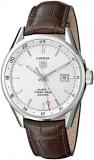
The TAG Heuer Carrera Day-Date arranges its calendar information across the upper half of the dial: a day aperture beside the TAG Heuer shield at twelve o'clock and a framed date window at three. That layout is the model's defining gesture, and it places the watch in a narrow niche where a full weekly calendar joins a sports-chronograph silhouette rather than a dress-case profile. The Carrera name has carried this brief since the line's revival as a modern everyday range, and the Day-Date variant sits at its practical centre.
How the Day-Date Fits Inside the Carrera Family
The Carrera name reaches back to 1963, when Jack Heuer devised a clean, legible chronograph intended for racing drivers who needed to read elapsed time at speed. The modern catalogue interprets that brief across several branches. The three-hand Carrera Date models are offered in 29mm, 36mm and 39mm cases, with the 39mm reference WBN2110.BA0639 running the Calibre 5 automatic and measuring 11.50mm thick. The Day-Date takes a different path: it steps up to a 41mm case and adds the weekday complication on top of the date.
That progression matters when comparing references. The official specification pages for the Day-Date list a 41mm diameter with a thickness of 12.6mm or 12.7mm depending on the variant, values that sit roughly a millimetre above the three-hand 39mm Carrera Date. The extra depth accommodates the calendar mechanism and keeps the proportions balanced on the wrist. Set beside the rest of the TAG Heuer brand's current catalogue, the Day-Date reads as the sober, function-first option within the Carrera line rather than a showpiece.
Dial Architecture and Legibility
A day-date watch lives or dies on how quickly the calendar can be read. TAG Heuer places the weekday in an arc-shaped aperture directly beneath the logo, with the date in a rectangular frame opposite. Both openings are cut into the dial surface rather than applied on top, so the layout stays flat and uncluttered. The baton hour markers remain long and thin, and the hands keep the needle-like profile associated with the Carrera line.
Because the calendar occupies the twelve and three positions, the remaining indexes carry the visual weight of the dial. This is a deliberate trade-off: the watch sacrifices the symmetrical purity of a no-date three-hander in exchange for information a weekday wearer actually uses. The result is a face that rewards a glance rather than a study, which suits the model's role as a daily companion.
The Calibre Behind the Calendar
Inside the 41mm case sits an automatic movement with an 80-hour power reserve, according to the official technical specifications for references including WDA2111.BA0043 and WDA2150.BA0043. That figure is significant for a calendar watch. A movement that can rest for more than three days without stopping means the day and date displays do not need resetting after a weekend on the bedside table, which removes the most common irritation of owning a calendar complication.
The self-winding architecture also keeps the case free of battery hatches and preserves a conventional profile. The 12.6mm to 12.7mm thickness quoted across the Day-Date references is evidence that the extra complication was integrated without inflating the case into something unwearable under a cuff.
Case, Bracelet and Everyday Wearability
The Day-Date references documented on the official site pair a steel case with a steel bracelet, and the finish follows the Carrera house style: brushed surfaces along the links with polished flanks catching light at the edges. A 41mm diameter is a genuinely modern size, large enough to read clearly and small enough to remain versatile. The measured thickness of roughly 12.7mm places it firmly in the wearable band for a steel sports watch, well short of the slab-sided proportions that make some calendar models uncomfortable.
For buyers weighing alternatives, the Carrera line is not the only route. Divers who want a rotating bezel and a higher depth rating often turn to the Aquaracer, including the dive-oriented references, which prioritise water resistance and luminous bezel markings over calendar functions, while the TAG Heuer Monaco series takes the square-case, racing-heritage route. Someone who wants a weekday display in a round steel case with a bracelet will find the Day-Date the most direct answer among them.
Where the Day-Date Sits Against Rivals
The obvious comparison points are the classic calendar watches from other houses. The Rolex Day-Date range established the full weekday-and-date concept as a prestige signature, typically in precious metal and at a considerably higher price point. TAG Heuer's interpretation keeps the same functional idea in stainless steel, which changes the ownership calculus without changing the utility.
Within the broader market, several references compete on similar ground:
- Case size: 41mm steel, versus 36mm and 41mm options common among calendar-focused dress-sports watches
- Power reserve: 80 hours, a figure that reduces calendar resetting after periods of disuse
- Display: Day aperture at twelve, date window at three, baton indexes retained
- Positioning: Steel construction with an integrated bracelet look rather than precious-metal formality
None of these attributes is unique in isolation. The combination is what defines the model: a full weekly calendar in a case that still reads as a sports watch rather than a formal accessory.
Movement Reliability and Long-Term Ownership
Automatic calendar movements impose specific maintenance expectations. The day and date mechanisms involve additional wheels and levers that must engage cleanly at the changeover point, usually around midnight. Owners are advised to avoid manually correcting the calendar during the hours when the mechanism is mid-shift, since forcing the displays while the changeover train is engaged can damage the teeth. With an 80-hour reserve, the movement rarely needs manual winding, which reduces the opportunities for such mistakes.
Service intervals follow the usual pattern for modern automatic calibres. The 80-hour reserve also means the watch tolerates a rotational wear schedule, where it shares wrist time with other pieces and returns to service without a full reset.
Who the Carrera Day-Date Is Built For
The strongest case for this reference is made by a specific user profile: someone who wears one watch through the working week, values knowing the day as much as the date, and prefers a steel bracelet to a leather strap. For that person the weekday aperture is not decoration but a small daily convenience, and the 41mm case provides presence without excess.
Collectors who already own a three-hand Carrera Date in 39mm may find the Day-Date redundant unless the calendar function genuinely appeals; the two sit close in spirit. Conversely, anyone moving from a smaller dress watch into a larger steel piece will notice the difference in wrist presence immediately. The Formula 1 range, like the quartz chronographs in the current line-up, offers a sportier entry into the brand, but it does not attempt the same balance of calendar utility and restrained design.
The Enduring Appeal of a Practical Calendar Watch
Calendar complications have a quiet persistence in watchmaking because they solve a problem the wearer notices every morning. The Carrera Day-Date treats that function with the same seriousness as the rest of its specification: a measured case, a legible dial, and a movement with enough reserve to keep the display accurate through ordinary neglect. It does not chase novelty. Instead, it refines an established formula, and in doing so makes a case that a steel watch with a full calendar remains one of the most rational objects a person can wear on a daily basis.
 Exciting, Best Luxury Watches for Sale!