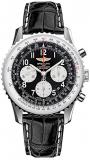
The Breitling Navitimer’s stainless-steel case is not merely a container for its complex movement but the foundational element of its iconic, tool-watch identity. This specific material choice, favoring resilience and a utilitarian sheen over precious metals, speaks directly to its origins in the cockpit. It is a watch designed to be used, its brushed and polished surfaces telling a story of purpose before ornamentation. Its design philosophy is deeply rooted in the Breitling Professional collection, a lineage dedicated to creating instruments for experts.
At the heart of the Navitimer’s enduring appeal is the legendary circular slide rule bezel, an analog computer that allows pilots to perform critical calculations like fuel consumption, climb rates, and average speeds. This feature, more than any other, cemented the Navitimer’s status as an essential piece of equipment for the Aircraft Owners and Pilots Association (AOPA) in the 1950s. The intricate, knurled bezel rotates with a satisfyingly precise click, its engraved logarithmic scales requiring a learned touch to master, transforming the wearer into an active participant in its functionality.
Beneath the famously busy yet perfectly legible dial beats a chronometer-certified automatic movement. Breitling’s commitment to precision is absolute, with each movement undergoing rigorous COSC testing. The watch’s ability to measure elapsed time with its central chronograph seconds hand and sub-dials is executed with mechanical fluency. This internal machinery represents decades of horological refinement aimed at achieving unfailing accuracy under demanding conditions, a non-negotiable requirement for its intended professional user.
The choice of stainless steel for the case and often the bracelet is a masterstroke in balancing durability, comfort, and aesthetic coherence. The metal’s ability to be finely brushed on top surfaces to diffuse light and resist scratches, while its sides are polished to catch the light, creates a dynamic visual texture. This interplay of finishes gives the watch a sophisticated presence that transitions seamlessly from the flight deck to a formal setting, a versatility that few professional tool watches can claim.
While it shares the sky-bound heritage of like the Breitling Chronomat, the Navitimer’s specific focus on the slide rule bezel makes it uniquely indispensable. The Chronomat may emphasize robustness and a rotating bezel for elapsed time, but the Navitimer’s bezel is for calculation, embedding a layer of intellectual utility into its design. This distinction highlights how Breitling tailors specific tools within its aviation portfolio for different, though sometimes overlapping, professional and enthusiast needs.
For those drawn to more overtly robust tool watches, the rugged Breitling Avenger offers a compelling alternative with a more aggressive stance. The Avenger series often features larger cases, more pronounced crown guards, and a design language screaming of extreme durability. The stainless-steel Navitimer, in contrast, packages its immense capability within a more classically proportioned and stylistically refined frame, appealing to those who value technical prowess wrapped in timeless elegance.
Wearing a stainless-steel Navitimer today connects the individual to a narrative of human achievement and technical exploration. It is a piece of wearable history that refuses to be relegated to the past. Its design, largely unchanged in its core elements, validates the principle that true functionality breeds timeless form. The watch feels substantial on the wrist, a constant, reassuring reminder of engineering excellence and a design that was perfected for a specific, demanding purpose.
Ultimately, exploring Breitling’s legendary Navitimer series reveals a watch that is far more than the sum of its stainless-steel parts. It is a symbol of a specific kind of competence, a bridge between the analog past and the digital present, and a statement that the most sophisticated tools are those that empower the human mind. It represents a choice to carry a piece of instrumental history, a commitment to craftsmanship, and an appreciation for designs that are born from necessity and mature into icons.