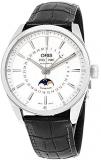
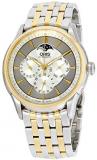
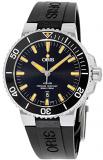
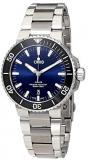
An Oris limited edition is defined less by a number on a case back than by the reason that number exists. Whether the reference supports a marine conservation project, marks a partnership, or simply explores a colour palette the brand would never place in permanent series, each release is produced for a fixed run and then closed. That structure gives the watches a double appeal: mechanical credibility on the wrist and a defined production ceiling behind it.
For collectors, this creates a useful distinction between two ideas that are often blurred in marketing language. A regular production Oris can be bought at leisure and serviced without urgency, while a limited run rewards a decision made with some knowledge of how the brand approaches design, movement supply and case engineering. This guide sets out what actually defines these watches, how the Aquis dive family connects to the wider automatic Oris dive watch range, and which details deserve attention before a reference is chosen.
What the Limited Edition Structure Actually Means
Oris works with a deliberately narrow movement philosophy. Most of its core references are powered by the Calibre 733, an automatic movement derived from the Sellita SW 200 architecture, with the Calibre 752 appearing in models that require a day-date display. Both run at 28,800 vibrations per hour and deliver a power reserve in the region of 38 hours. These are not exotic calibres, and that is precisely the point: they are widely understood, well supported by watchmakers, and predictable in daily use.
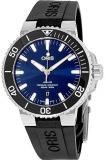
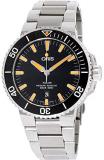
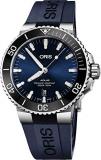
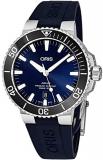
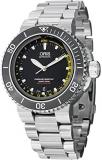
The value of a limited edition therefore sits in the case, dial treatment and thematic packaging rather than in an exclusive engine. A watch like the Aquis Date New York Harbor Limited Edition II illustrates the pattern precisely: a 43.50 mm multi-piece stainless steel case, a minutes scale on the top ring, water resistance rated to 30 bar, and a production cap of 2,000 pieces. Nothing about that specification is inflated to justify the limitation. The limitation is the differentiator, and the watch remains a functional diver first.
The Role of the Calibre 733 and Calibre 752
Understanding which calibre sits inside a reference is genuinely useful when comparing candidates. The Calibre 733 is a three-hand movement with a date function, and it forms the backbone of the Aquis line. The Calibre 752 adds a day-date complication and appears in references where the extra display is part of the design brief, including the Hammerhead limited edition, which was built around the 752 and matched to a 38-hour power reserve and a 28,800 vph beat rate.
For a buyer, the practical consequence is straightforward. Service intervals and long-term parts availability follow the base movement rather than the edition, so a limited reference does not introduce hidden mechanical risk. What changes is the visual and thematic layer applied on top of a proven platform.
Dial Treatments and Thematic Colour
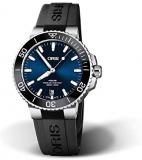
The most visible expression of a limited edition is usually the dial. Gradient finishes, textured surfaces and colour combinations tied to a specific cause or location are the tools used to separate a limited run from the standard catalogue. The Cotton Candy series, for instance, moved the Divers Sixty-Five into a bronze case in a 38 mm format with 100 metres of water resistance, a combination that reframes a familiar silhouette entirely.
These choices matter because they demonstrate how the brand treats its own archive. A bronze case patinas over time, so the watch changes with ownership. A gradient dial shifts in tone as light moves across it. Neither variation is available in permanent production, which is why the limited structure exists at all.
Case Engineering Across the Dive Lineage
Case sizes across limited releases range widely, and this is one of the more underrated selection criteria. The New York Harbor Limited Edition II sits at 43.50 mm and is rated to 30 bar. The Clean Ocean Limited Edition took a different route, using a 39.5 mm stainless steel case with a 14.2 mm thickness. On paper these are the same family of watch; on the wrist they wear very differently.
- 43.50 mm: substantial presence, suited to wearers who prefer a diver with visual weight.
- 41.50 mm: a middle position that appears in several limited references.
- 39.50 mm: restrained proportions that sit closer to a vintage diver profile.
- 38 mm: used in the bronze Divers Sixty-Five examples, including the Cotton Candy series.
Thickness deserves as much attention as diameter. A 14.2 mm case on a 39.5 mm watch has a noticeably different relationship to a shirt cuff than a slimmer profile, and dive watches with a rotating top ring always add height. Trying a reference on, or at least mapping the dimensions against a watch already owned, remains the most reliable method of avoiding a mismatch.
Reading Water Resistance in Context
The Aquis references carry 30 bar ratings, equivalent to 300 metres. The Divers Sixty-Five limited models sit at 100 metres. Both figures are honest statements of capability rather than marketing decoration, and both exceed what most owners will ever require.
The difference becomes relevant when a watch is treated as a working tool rather than a desk companion. A 300-metre rating reflects a screw-down crown, a robust case construction and a pressure-tested sealing system, and the minutes scale on the top ring allows timing from the moment a dive begins. A 100-metre watch is a lifestyle diver with historical grounding, appropriate for swimming and daily exposure to water but not built to the same operational standard.
Buyers often overestimate their need here. The more useful question is whether the watch will be worn in water at all, and whether the case height and weight that accompany the higher rating are acceptable on a daily basis.
Collectibility and the Second-Hand Question
A production cap of 2,000 pieces, as used for the New York Harbor Limited Edition II, is small enough to create scarcity but large enough that the watch is not impossible to locate. This is a sensible position for a brand that is not attempting to manufacture artificial rarity. The consequence for anyone considering a purchase is that a limited Oris behaves differently from a limited release by a brand with a long waiting list culture: it is bought primarily because the design is right, not because resale value is guaranteed.
Several details influence how a specific reference ages. Dial treatments tied to a temporary cause can lose relevance over time, while colourways and case materials with a broader design logic tend to remain legible. Thematic references linked to a permanent environmental project, for example the marine conservation work behind the Clean Ocean series, carry a clearer narrative than a one-off partnership event.
Completeness also matters more than average on limited runs. The set, the numbered case back and the original packaging form part of the object itself. A reference acquired without those elements is still a good watch, but it is no longer the collectible item the edition number implies.
Comparison shopping across brands can sharpen this thinking. Moving between a dive-focused release and an alternative such as the Breitling Superocean dive watches highlights how differently two brands balance case proportions, water resistance figures and price positioning within the same segment. Neither answer is universally correct, but the contrast clarifies which trade-offs suit an individual wearer.
Price Positioning and Where the Money Goes
Prices across the programme vary with specification rather than with the edition number. Publicly listed figures include a Limited Edition II in a 39.00 mm case at USD 2,950 and a further reference at 41.50 mm at USD 3,600. The Cotton Candy bronze models were offered in the region of USD 2,450 to USD 2,750 depending on strap or bracelet configuration.
Viewed against the broader market, these numbers place limited Oris releases in the accessible Swiss automatic category. The money is spent on case finishing, dial execution involving multiple layers or colour processes, and the complications of managing a defined production run rather than on an in-house movement with an exclusive architecture. That is a coherent proposition as long as it is understood at the point of purchase.
The alternative approach for the same budget is a high-volume reference, where the appeal rests on permanence rather than scarcity. The Breitling Superocean Heritage line occupies that territory, offering a heritage-derived design language without a production ceiling. The decision comes down to whether a defined run or an always-available design carries more weight.
How Wearers Describe the Experience
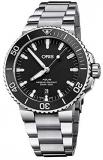
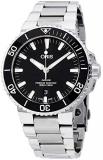
Ownership impressions of the Aquis line tend to circle around three qualities. The steel bracelet, where fitted, is frequently noted for its solidity and the security of its clasp. The bezel action on dive references is repeatedly described as crisp, with clear detents rather than slack movement. Luminous performance on the markers and hands is consistently reported as strong enough to remain readable through a full night.
Criticism, where it appears, usually concerns weight. A quartz reference and a 43.50 mm steel automatic diver are entirely different objects on the wrist, and moving from a compact dress watch to a full-size diver is felt immediately. For this reason, wearers moving up in size often report that the 39.5 mm references feel closer to a daily default.
Dial legibility is the other recurring point. Clear, high-contrast layouts and restrained printing suit the tool-watch premise, while heavily treated gradient dials favour visual interest over maximum reading contrast. Both approaches have supporters, and the choice depends on whether the watch is bought as an instrument or as a piece to look at.
Which Reference Suits Which Wearer
Someone who swims regularly and prefers a compact case should look at the 39.5 mm Clean Ocean reference, where the 300-metre rating and the smaller diameter coexist. A wearer wanting maximum wrist presence and a full dive specification will find the 43.50 mm New York Harbor model better aligned. Those drawn to warm, evolving materials belong in the bronze Divers Sixty-Five bracket, accepting the 100-metre rating and the patina that comes with the case. And a buyer who values a day-date display over a pure three-hand layout should prioritise references built on the Calibre 752.
The final criteria are the least glamorous but the most predictive of long-term satisfaction: does the case depth clear a shirt cuff, is the bracelet sizing adjustable without tools, and does the dial remain readable in dim light. A limited run solves none of these questions on its own.
What a limited Oris ultimately represents is a defined moment in a brand’s design thinking, captured on a fixed number of wrists. The mechanical package is dependable, the case engineering is coherent across the line, and the numbers behind each edition are documented and verifiable. For a collector who reads a watch as a record of intent rather than a symbol of status, that combination is what makes a numbered case back worth seeking out.