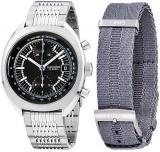
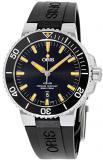
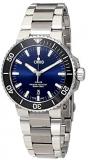
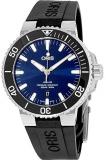
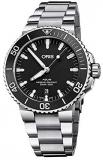
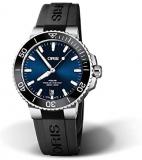
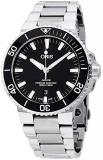
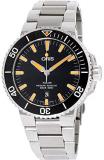
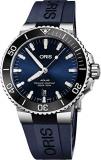
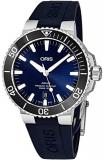
The Oris Chronograph range occupies a specific place in the Swiss mechanical landscape: a family of timing instruments built around water resistance and legibility rather than decorative flourish. Two platforms define the current lineup, the Divers Sixty-Five Chronograph and the Aquis Chronograph, and both trace their proportions and dial architecture back to the brand’s long history of producing working tools for divers and pilots.
The Divers Sixty-Five Chronograph arrives with a 40.00mm case, a monochromatic dial, 10 bar water resistance, and a 20mm interhorn width. The Aquis Chronograph scales upward, with select references reaching 45.50mm and a 43.5mm variant measuring roughly 16.2mm thick and approximately 51mm from lug tip to lug tip. That size gap is the first thing a prospective buyer should weigh.
Two Chronograph Platforms, Two Different Briefs
Separating the Divers Sixty-Five Chronograph from the Aquis Chronograph is not simply a matter of case diameter. Each platform answers a different question about how a mechanical stopwatch should behave on a wrist, and the answers show up in the bezel, the crystal, the dial furniture, and the water rating.
Divers Sixty-Five Chronograph: Heritage Proportions, Modern Timing
The Divers Sixty-Five Chronograph draws on the silhouette of the brand’s 1965 dive watch while adding the dual-register layout that collectors associate with mid-century chronographs. At 40.00mm, the case stays wearable across a wide range of wrists, and the monochromatic dial prevents the sub-registers and pushers from cluttering the visual field.
Its 10 bar rating, equivalent to 100 metres, covers swimming, snorkelling, and everyday contact with water, though it sits below the thresholds required for serious diving. The 20mm interhorn width is a practical detail as much as a stylistic one: it opens the watch to a broad selection of straps, from the factory bracelet to leather, rubber, or woven alternatives, which shifts the character of the piece considerably depending on the day.
Aquis Chronograph: Deeper Ratings, Larger Presence
The Aquis Chronograph moves in the opposite direction on every axis. Water resistance climbs to 300 metres, or 30 bar, placing it firmly in the professional dive-watch category. The case is assembled from multi-piece stainless steel, and the minutes scale sits on a ceramic top ring chosen for scratch resistance and colour stability under sun and saltwater exposure.
Inside, the movement beats at 28,800 vibrations per hour, or 4 Hz, a frequency that supports stable timekeeping and a smooth chronograph sweep. A gradient blue dial appears on certain references, reinforcing the underwater theme while keeping contrast high enough for quick reading at depth or in low light.
- Divers Sixty-Five Chronograph: 40.00mm case, 10 bar water resistance, 20mm interhorn width, monochromatic dial
- Aquis Chronograph: up to 45.50mm case, 43.5mm variant at roughly 16.2mm thick, 300m water resistance, ceramic top ring
- Movement cadence: 28,800 vph (4 Hz) on the Aquis Chronograph
The two platforms are not interchangeable, and that is the point. One leans on restraint and vintage proportion; the other commits to dive capability and a larger wrist presence. Matching the right one to a lifestyle matters more than comparing spec sheets line by line.
What A Mechanical Chronograph Actually Does
A chronograph adds elapsed-time measurement to a conventional movement, and doing that mechanically requires a dedicated set of components: a column wheel or cam system, a coupling mechanism, and levers that start, stop, and reset the central timing hand along with the sub-register hands. The appeal of the complication lies partly in watching those parts interact through an exhibition case back and partly in the engineering discipline needed to keep them reliable across years of daily use.
The 4 Hz beat rate shared by these movements produces eight increments per second on the running seconds hand, a cadence that reads as continuous to the eye. It also means the gear train and escapement operate at a rate that has proven durable across the modern Swiss mechanical industry, which is why so many tool watches settle on the same frequency.
Material choices follow a similar logic. Stainless steel resists corrosion and takes a polish well, while ceramic bezel inserts hold their colour and shrug off the scratches that accumulate on a watch worn near water, rock, or machinery. Pairing the two on the Aquis platform is not decorative; it reflects a decision about which surfaces take the most abuse.
Buyers surveying the wider market often weigh these references against other chronograph families with comparable ambitions, including the TAG Heuer Aquaracer range and the Omega Speedmaster line, both of which approach the dive-chronograph formula from different angles. A closer look at the TAG Heuer Grand Carrera shows how case architecture and dial layout can shift a chronograph’s character entirely.
Size, Balance, And The Daily Wearing Experience
Case diameter is the specification most buyers notice first, but lug-to-lug distance and thickness shape the wearing experience just as much. A watch measuring approximately 51mm from lug tip to lug tip will extend past the wrist on many wearers, even when the nominal diameter reads as moderate. The 43.5mm Aquis and the 40.00mm Divers Sixty-Five Chronograph therefore sit at opposite ends of the practical spectrum, and trying both on reveals the difference faster than any measurement can.
Chronograph pushers add physical complexity at the side of the case, and their position relative to the crown determines how the watch feels during wrist flexion. On a well-designed chronograph, the pushers sit slightly proud of the case band so they can be operated without looking, yet remain flush enough that they do not catch on a sleeve or glove. Getting that balance right is a small engineering problem with an outsized effect on daily comfort.
- Everyday wear: the 40.00mm Divers Sixty-Five Chronograph suits office, travel, and weekend use
- Water sports: the Aquis Chronograph’s 300m rating supports swimming and recreational diving
- Strap flexibility: a 20mm interhorn width on the Divers Sixty-Five allows quick visual shifts
Weight distribution matters as well. A multi-piece stainless steel case with a ceramic ring and a metal bracelet carries more mass than a comparable watch on rubber, and that weight can be an advantage or a drawback depending on preference. The bracelet found on the Divers Sixty-Five Chronograph reference, paired with the 40mm case, produces a more moderate presence on the wrist.
How The Oris Chronograph Sits Against Rivals
Swiss mechanical chronographs occupy a crowded field, and the Oris approach stands apart through its emphasis on functional dive-watch characteristics rather than pure dress appeal. Competing references such as the Rolex Explorer II and the Omega De Ville demonstrate how differently the same complication can be interpreted, one favouring fixed-bezel utility and the other refined urban formality.
What the Oris chronograph offers instead is a consistent focus on legibility, water resistance, and mechanical honesty. The sub-registers are placed for quick reading rather than symmetrical ornamentation, and the bezel markings are etched for grip and alignment. These are practical choices, and they trace directly back to the brand’s history of producing instruments for divers, pilots, and adventurers.
Where The Design Language Comes From
The dark dial, luminous markers, and rotating bezel of a dive chronograph are not arbitrary stylistic conventions. Each element solves a specific problem: legibility in low light, timing of elapsed intervals, and durability under water and impact. When a watchmaker applies those solutions to a mechanical chronograph, the result is a tool that happens to look purposeful because it is purposeful.
The vintage references that inspired the Divers Sixty-Five line carry that language forward without exaggeration. The graduated markers, the domed crystal profile in some versions, and the restrained colour palette echo an era when dive watches were working equipment rather than luxury statements.
Choosing Between The Two Oris Chronograph Platforms
A buyer weighing the Divers Sixty-Five Chronograph against the Aquis Chronograph should start with water resistance and case size, because those two variables drive nearly every other decision. A 100-metre rating with a 40mm case suits someone who wants a chronograph they can wear to dinner and to the pool. A 300-metre rating with a 43.5mm to 45.50mm case suits someone who dives, swims regularly, or simply prefers a substantial wrist presence.
Movement specifications remain consistent enough across the range that the choice rarely comes down to timekeeping. The 4 Hz frequency appears on the Aquis Chronograph, and the mechanical architecture follows the same principles of robust Swiss engineering throughout the lineup. What changes is the packaging: the case dimensions, the bezel material, the dial layout, and the strap interface.
For anyone building a collection around mechanical complications, the Oris chronograph represents a coherent choice because it does not pretend to be a dress watch or a dedicated racing instrument. It is a water-ready, mechanically honest chronograph with a design lineage that stretches back decades, and that consistency is precisely what makes it worth considering alongside the Oris collection of Swiss automatic dive watches.
The broader appeal lies in the way these watches balance ambition and restraint. A chronograph is a complicated machine, and wearing one connects the wearer to a tradition of mechanical problem-solving that continues to evolve even as smartwatches dominate daily convenience. The Oris chronograph keeps that tradition accessible, wearable, and ready for whatever the day brings.