The Hamilton Khaki Field Mechanical 38mm pairs a matt stainless steel case with a dark dial and light luminescent numerals, a layout derived directly from mid-century military issue rather than from contemporary fashion cycles. That detail matters because the Khaki line is not a styling exercise: it descends from watches Hamilton supplied to soldiers, and the current collection keeps the legible dial, the compact case and the strap-first philosophy intact.
Anyone weighing a first mechanical field watch against a smartwatch or a dress piece will find that the Khaki sits in a distinct category of its own, and the sections below break down exactly where it fits, which variant suits which wearer, and what to check before committing. The reference points include the Hamilton brand’s wider catalog of military-inspired models, which helps clarify what the Khaki does differently from the rest of the lineup.
What Actually Defines the Hamilton Khaki Line
The Khaki family is best understood as a design language rather than a single reference number. Across the collection, three constants recur: a matte or lightly brushed case that resists glare, a dial built around high-contrast numerals and indexes, and a strap setup that favors NATO or leather over integrated bracelets. Those choices are functional. A matte case does not throw reflections toward the wearer’s eye in daylight, and a legible dial reads at a glance rather than requiring a second look.
Hamilton’s own historical record notes that the military Khaki used the grade 649 movement with a hacking, or stop-second, device so that watches could be synchronized accurately across a unit. That single specification explains why hacking remains a point of pride in modern mechanical field watches: synchronized time is a tactical requirement, not a decoration. The modern Khaki Field Mechanical carries that lineage forward with a hand-wound caliber, while the Khaki Field Auto shifts to a self-winding H-10 movement rated at an 80-hour power reserve, according to Hamilton’s published specifications.
Mechanical Versus Automatic: The Real Divide
The hand-wound Khaki Field Mechanical is the purist’s choice. Winding becomes a daily ritual, the case stays thin, and there is no rotor to add bulk or motion. The trade-off is that the watch stops if forgotten, and there is no reserve to fall back on during a quiet weekend.
The Khaki Field Auto answers that with the H-10 caliber and its stated 80-hour power reserve, which means the watch can sit unused from Friday evening to Monday morning and still run. Hamilton lists a case thickness of 11mm, a lug width of 20mm, and water resistance of 10 bar (100m) for the 38mm automatic references, figures that place it firmly in everyday-wear territory rather than dedicated dive or pilot duty.
Case Size, Proportion and Wrist Fit
The 38mm case is the sweet spot of the Khaki range, and the reasons are structural rather than trend-driven. A field watch is meant to sit flat and unobtrusive under a cuff or a jacket sleeve, and 38mm with a 47mm lug-to-lug measurement, as specified by Hamilton for the automatic models, keeps the watch within the boundaries of most wrists without overhang. The 20mm lug width also opens up a large aftermarket strap ecosystem, which is central to the ownership experience.
Wearers with larger wrists sometimes prefer the broader Khaki references, but the 38mm remains the reference point because it preserves the original military proportion. Thickness at 11mm allows the case to slide under a shirt cuff without the awkward bump that thicker sport watches produce, and the matt finish hides the micro-scratches that inevitably accumulate on a daily-worn steel case.
- Case diameter: 38mm on the core mechanical and automatic references
- Case thickness: 11mm on the automatic variants
- Lug width: 20mm, compatible with a wide range of NATO and leather straps
- Water resistance: 10 bar (100m) on the automatic models
- Lug-to-lug: 47mm, as published by Hamilton
That combination is not accidental. A 100m rating covers rain, handwashing, swimming and the occasional accidental submersion, which is the realistic envelope for a watch worn in town and on trail alike. It is not a saturation-diving specification, and buyers who need that capability should look at dedicated diver categories instead.
Dial Legibility and Luminescence
The Khaki dial is a study in restraint. Light luminescent numerals and indexes sit against a dark ground on the classic references, while the white-dial variants invert the scheme with triangular indexes in an old-radium tone. Both approaches prioritize contrast, and both are readable in low light because the hands and hour markers carry luminous compound.
What separates a good field dial from a merely vintage-looking one is the hierarchy. On the Khaki, the hour numerals dominate, the minute track stays peripheral, and the branding is kept small. Nothing competes with the time. This is the lesson the collection inherited from issued military watches, where a glance had to deliver information instantly and without interpretation.
The White-Dial Variant and Its Character
The white-dial Khaki Field Mechanical changes the personality of the watch considerably. Against the matt steel case and a NATO strap, the pale dial reads as a summer field watch, less austere than the dark-dial versions but equally legible. Buyers who find black dials too uniform often gravitate to this reference precisely because it retains the military layout while shifting the mood.
Either way, the design principle holds: a field watch should be readable at arm’s length, in bad light, without squinting. The Khaki achieves that with proportion and contrast rather than with applied complexity.
Straps, Versatility and Daily Ownership
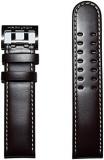
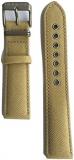
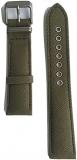
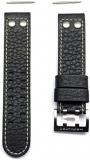
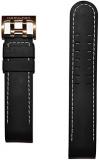
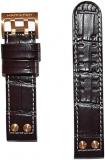
The NATO strap is part of the Khaki’s identity, not an accessory afterthought. A single-pass NATO keeps the watch head secure even if one spring bar fails, which is exactly why the format was adopted by military users. In civilian life, the practical benefit is that a 20mm NATO can be swapped in seconds without tools, letting one watch move from a canvas strap to leather to a perlon braid depending on the occasion.
This strap-first design also makes the Khaki unusually adaptable for a mechanical watch. On a leather strap it reads smart enough for an office; on a NATO it looks at home on a hike. Owners who appreciate that kind of flexibility often pair a field watch with a dress reference for formal occasions, in the way some keep Tissot Heritage models for the moments when a formal silhouette is required.
Ownership cost is another factor worth stating plainly. A mechanical field watch has no battery, no firmware updates, and no charging routine. It needs winding or wearing and an eventual service. That predictability is part of the appeal for buyers tired of devices that demand attention.
Hamilton Khaki in Context: Field Watches and Their Peers
The Khaki sits in a broader tradition of tool watches that were designed for a job before they became style objects. This is the same lineage that produced pilot chronographs, dive watches and exploration pieces. Collectors who follow that lineage often compare field, dive and pilot archetypes side by side, and Rolex Explorer references are a common reference point when discussing watches built for exposed, high-altitude conditions rather than office wear.
That comparison is useful precisely because it clarifies what the Khaki is not trying to do. It is not a luxury statement piece and not an instrument rated for extreme depth or altitude. It is a legible, mechanical, reasonably priced field watch with genuine military provenance, and it competes on honesty rather than on prestige. Buyers who want a field watch to actually wear in the field will find the Khaki’s combination of 38mm proportions, 100m water resistance and hand-wound or 80-hour automatic movements difficult to argue with.
How to Choose Between the Variants
The decision tree is short. Pick the mechanical if the daily winding ritual appeals and a thinner case matters. Pick the automatic if the watch will sit on a shelf between wears and the 80-hour reserve is worth the extra thickness. Pick the white dial if black feels too uniform, and pick a leather strap if the watch will be worn to work more often than on weekends.
Buyers who value a more elevated, decorative approach to watchmaking sometimes cross-shop within dress-oriented brands, and the Hamilton range’s breadth of finishes and dial variants makes it a reasonable stop in that broader search. The key is to decide first whether the watch is a tool or a statement, then filter accordingly.
Movement, Accuracy and Long-Term Care
The H-10 automatic movement in the Khaki Field Auto is a modern caliber with a stated 80-hour power reserve, which is a meaningful figure for a watch at this level. A longer reserve means the watch tolerates a desk-bound week without stopping, and it reduces the frequency of full re-winds. The hand-wound movement in the Field Mechanical is simpler by design and, for many owners, more satisfying to interact with.
Mechanical watches do drift from perfect time, and that is normal rather than a defect. The practical approach is to accept a small daily variance, set the watch when it matters, and have it regulated during service if the deviation grows. Hamilton’s hacking feature, present from the military era onward, makes precise setting straightforward because the seconds hand stops when the crown is pulled.
- Service interval: typically every several years, depending on wear and environment
- Magnetism: keep mechanical watches away from strong magnets such as tablet covers and speaker drivers
- Water resistance: have gaskets checked at service; the 100m rating depends on seal integrity
- Strap care: rinse NATO straps after heavy sweat or saltwater exposure and let them dry fully
None of this is exotic maintenance. A field watch is meant to be used, and the Khaki’s construction is simple enough that routine care keeps it running for decades. That longevity is a core part of the value proposition: a mechanical field watch is one of the few objects in daily life that can be repaired rather than replaced.
Why the Khaki Still Matters
The enduring appeal of the Hamilton Khaki is not nostalgia for its own sake. It is that the design brief has not changed. A readable dial, a robust case, a dependable movement and a strap that can be replaced in seconds remain the correct answers for a watch that is worn rather than displayed. The 38mm references, the 100m water resistance and the 80-hour automatic reserve are all in service of that brief.
For a first mechanical watch, the Khaki removes much of the anxiety: it is legible, affordable to maintain and difficult to damage through ordinary use. For an experienced collector, it offers a reference point against which more elaborate watches can be judged, and a reminder that watchmaking does not require complexity to be useful. The Khaki remains a field watch in the literal sense, built for people who need to know the time and would rather not think about the watch on their wrist while finding out.