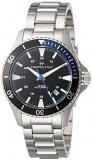
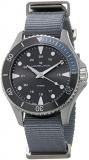
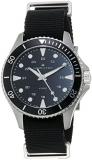
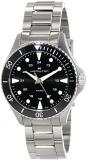
The Hamilton Khaki Navy Scuba Auto carries a 40mm stainless steel case, a screw-down crown, and a unidirectional 60-minute bezel, a combination that places it firmly within the tool-watch tradition rather than the fashion-dive segment. Hamilton has long drawn on its military and naval history, and the Khaki Navy line is where that heritage meets recreational diving requirements.
This guide examines what separates the Khaki Navy Scuba Auto from other dive-influenced watches, how the H-10 caliber shapes ownership, and which buyers will find the collection worth keeping on the wrist for years.
Naval Heritage and the Khaki Navy Line
Hamilton’s connection to marine timekeeping is documented rather than invented. During the Second World War, the company produced the Model 21 marine chronometer, a precision instrument that, according to Hamilton’s own historical records, kept time to within half a second per day and comfortably exceeded the Navy’s accuracy requirement of 1.55 seconds per day. That background gives the Khaki Navy name a factual anchor: this is a collection built on the premise that a watch used near water should be dependable first and decorative second.
The modern Khaki Navy range continues that thinking across several models, including the Scuba Auto and the Scuba Auto GMT variation, all sharing robust cases, rotating bezels, and meaningful water resistance. The design language stays deliberately restrained, which is one reason the line appeals to buyers who want dive capability without the bright colors and oversized proportions common in the category.
Case, Bezel, and Water Resistance
The 40mm case size is central to the Scuba Auto’s character. It sits comfortably within the range that suits most wrists, and it keeps the watch slim enough to slide under a shirt cuff, a practical concern for anyone who wears one watch across work and weekends. The unidirectional bezel rotates in one direction only, a safety convention in dive watch design that prevents accidental under-timing of a dive.
Water resistance is rated to 100 meters, and the screw-down crown reinforces that rating in daily use. It is worth being precise here: 100 meters is a specification suited to swimming and snorkeling, not to professional saturation diving. Hamilton positions the watch as a dive-influenced tool watch rather than a dedicated instrument for technical divers, and the specification matches that positioning.
For readers weighing the Khaki Navy against alternatives from other makers, the contrast with the broader field is informative. Exploring the range of diver-style references across the wider market shows how differently brands interpret the same brief, from bezel knurling to case finishing.
The H-10 Caliber and Real-World Autonomy
Inside the Scuba Auto sits the H-10 caliber, a self-winding movement with an 80-hour power reserve. That figure matters more than it might appear on a spec sheet. An 80-hour reserve means the watch can be set down on a Friday evening and still be running on Monday morning, which removes one of the small frictions that cause people to stop wearing mechanical watches. Hamilton also fits the movement with a sapphire crystal, protecting the dial from the scratches that accumulate on watches worn near water, sand, and rough surfaces.
Legibility is handled with Super-LumiNova applied to the hands and hour markers. The luminance is a functional necessity on a dive watch rather than a cosmetic flourish, and it performs the task of keeping time readable in low light, whether that means a night dive briefing or a darkened cabin.
Design Language and Everyday Wearability
The Scuba Auto’s dial layout is conventional in the best sense: applied indices, a clear minute track, and a date window placed where it does not interrupt the symmetry of the hour markers. The stainless steel case receives a mix of brushed and polished finishing, which keeps the watch from reading as purely utilitarian while avoiding the mirror-polished excess that makes some dive watches look out of place outside the water.
This balance is where the Khaki Navy earns its keep. A dive watch that only works with a wetsuit is a limited purchase; one that reads well with a sweater, a field jacket, or a linen shirt extends its value considerably. The 40mm diameter and moderate thickness are the main reasons the Scuba Auto manages that transition so cleanly.
- Case: Stainless steel, 40mm diameter
- Bezel: Unidirectional, 60-minute scale
- Crystal: Sapphire
- Movement: H-10 automatic, 80-hour power reserve
- Water resistance: 100 meters with screw-down crown
- Lume: Super-LumiNova on hands and markers
How the Khaki Navy Compares Within the Segment
The dive watch segment is crowded, and the Scuba Auto’s argument rests on a specific combination rather than on any single headline feature. Many competitors at similar positioning offer shorter power reserves or larger cases; others lean harder into vintage styling or into saturated dial colors. Hamilton’s version keeps the proportions moderate, the finishing restrained, and the movement’s autonomy generous.
Buyers who prefer a more overtly sporty aesthetic may find themselves drawn toward alternatives designed around motorsport and performance cues, and a closer look at the Breitling collection reveals a very different design philosophy toward case architecture and dial complexity.
The Scuba Auto GMT variation extends the range for travelers, adding a second time zone while retaining the family’s case proportions and water resistance philosophy. For buyers who cross time zones regularly, that model may be the more rational choice; for everyone else, the standard three-hand version keeps the dial cleaner and the watch thinner.
Who Should Consider the Khaki Navy
The clearest audience for the Scuba Auto is the one-watch wearer: someone who swims, travels, works in an office, and wants a mechanical watch that handles all three without demanding special treatment. The 100-meter rating, the screw-down crown, and the sapphire crystal cover the practical side; the restrained dial and moderate case size cover the aesthetic side.
A second audience is the collector looking for a dive watch that does not duplicate what is already in the box. The Scuba Auto occupies a middle ground that avoids both the entry-level quartz bracket and the luxury tier, and its naval provenance gives it a story that most sub-$1,000 divers cannot claim.
Those who favor a more heritage-forward dial treatment, with vintage-inspired typography and warmer tones, may find a different kind of appeal in how Tissot interprets its archive through modern reissues, a useful point of comparison for anyone deciding how much retro styling they want in a daily watch.
Ownership, Maintenance, and Long-Term Value
An automatic movement with an 80-hour reserve requires the usual care: periodic servicing, avoiding magnetic fields, and rinsing the case with fresh water after saltwater exposure. The sapphire crystal and stainless steel construction mean the exterior holds up well to daily wear, and the screw-down crown gasket is the component most worth monitoring over the years, since it is the seal that protects the water resistance rating.
Strap versatility is another factor in long-term satisfaction. The Scuba Auto works on a steel bracelet for formal settings and on a rubber or NATO strap for water use, and swapping between them changes the character of the watch considerably. That flexibility is often what separates a watch that gets worn from one that sits in a drawer.
The Enduring Case for a Purpose-Built Diver
The Khaki Navy Scuba Auto makes its case through restraint. It does not chase superlatives in case diameter or depth ratings; instead it delivers a 40mm steel case, a genuine 100-meter rating, a screw-down crown, sapphire protection, and an 80-hour automatic movement in a package that reads as appropriately engineered rather than overbuilt. The Model 21 marine chronometer that anchors Hamilton’s naval history set a standard of precision, and while a modern recreational dive watch is a different instrument entirely, the collection’s design priorities reflect that same regard for function over ornament. For divers, swimmers, and everyday wearers who want a mechanical watch with a clear purpose and a documented lineage, the Khaki Navy remains a considered choice.