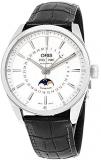
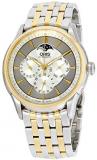
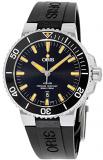
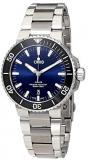
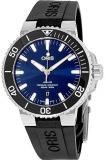
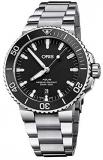
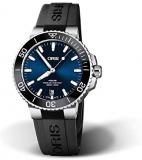
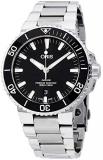
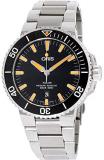
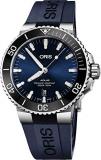
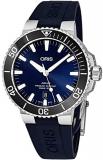
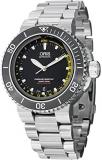
The Oris automatic watch is a direct product of a decision made in H枚lstein in 1904, when the company was founded with a single stated aim: to build fine mechanical watches and nothing else. More than a century later that focus has not shifted, and the brand remains one of the few independent Swiss manufacturers still committed to mechanical movements alone. For buyers who want a self-winding watch with a genuine engineering story behind it rather than a marketing one, this is a meaningful place to start looking.
The heart of the modern line is the Calibre 400, an automatic movement announced with specifications that stand out even among far more expensive Swiss peers: a five-day power reserve, elevated resistance to magnetic fields, and a ten-year warranty as standard. Those three numbers frame almost every purchase decision in this segment, and they are worth understanding in detail before choosing a reference.
What Makes an Oris Automatic Movement Different
The company’s mechanical history runs through a series of calibres rather than a single flagship engine. According to historical records of the firm, it was permitted to produce Swiss lever escapement movements, the first of which was the automatic Calibre 645, followed shortly afterwards by the Calibre 652. That lineage matters because it shows automatic winding has been core business here since the mid-twentieth century, not a recent addition to a quartz catalogue.
The Calibre 400 represents the current expression of that lineage. Oris states that it delivers a five-day power reserve, which translates to roughly 120 hours of stored energy when fully wound. In practical terms, a watch can be set aside on a Friday evening and still be running accurately on Wednesday morning, an advantage that removes the ritual of resetting time and date after a quiet weekend.
Power Reserve and Real-World Wearing
Standard automatic movements in this price bracket typically offer between 38 and 80 hours of autonomy. A five-day reserve changes how a watch fits into a rotation. Owners who alternate between several pieces no longer need a winder to keep the movement alive, and travellers can pack a single mechanical watch for a week-long trip without concern. The specification is measurable, verifiable, and directly relevant to daily use.
Anti-Magnetism as a Practical Specification
Oris also markets the Calibre 400 as offering elevated levels of anti-magnetism compared with conventional movements. Modern life surrounds a wristwatch with magnetic fields: laptop speakers, tablet covers, phone cases, and the magnetic clasps on bags. When a balance spring becomes magnetised, the watch typically runs fast or erratically. A movement engineered to tolerate stronger fields reduces the chance of that complaint appearing at a service desk, and it is one of the quieter but more useful upgrades in contemporary mechanical watchmaking.
Design Language Across the Automatic Collections
The brand’s output is organised into a handful of families rather than one monolithic line, and each family interprets the same mechanical brief differently. Divers’ models prioritise legibility and rotating bezels in the traditional tool-watch manner, while pilot-inspired pieces lean on large numerals and high-contrast dials. Within the Oris range, buyers can move between bronze-cased heritage designs, angular steel sports watches, and restrained dress references without ever leaving mechanical horology.
Case finishing tends to alternate brushed and polished surfaces, a technique that keeps a watch visually interesting without making it flashy. Dials frequently use applied indices and generous luminous compound, and several references pair a sunburst or gradient finish with a contrasting chapter ring. The overall effect is sporty but considered, closer to mid-century instrument design than to jewellery.
- Calibre 400: automatic, five-day power reserve, elevated anti-magnetism
- Calibre 645 and 652: earlier automatic engines in the company’s Swiss lever lineage
- Warranty: ten years as stated for Calibre 400 references
- Case materials: stainless steel, bronze, and mixed finishes across families
- Water resistance: diver-oriented models are built for swimming and surface water sports
Because the collections span so many briefs, the sensible approach is to fix a case size and a bezel type first, then work outwards to dial colour and strap. A 39mm to 42mm case suits most wrists, and a diver’s bezel reads more casually than a plain polished bezel of the same diameter.
How the Automatic Line Compares With Rivals
Placed against other Swiss mechanical watches at similar prices, the five-day reserve is the clearest point of separation. Many competitors in the same bracket rely on movements with roughly two days of autonomy, and some use-derivative calibres shared across several brands. An in-house engine with published specifications and a decade of warranty coverage is a different proposition, and it shifts the conversation from decoration to ownership cost.
Buyers weighing alternatives often look at chronograph-focused collections from other houses, or at entry points into famous racing lines. For context, the Oris brand’s independent status is itself part of the appeal: the company answers to no conglomerate, which is why its engineering decisions read as unusually consistent across families.
| Decision Factor | What to Check |
|---|---|
| Movement Autonomy | Five-day reserve on Calibre 400 versus roughly two days on many rivals |
| Magnetic Resistance | Elevated anti-magnetism reduces rate drift near everyday electronics |
| Warranty Term | Ten years stated for Calibre 400 references |
| Case Diameter | 39mm to 42mm covers most wrists for daily wear |
| Bezel Type | Rotating diver bezel reads casual; plain polished bezel reads dressier |
| Water Resistance | Diver models suit swimming; dress references suit desk and evening wear |
Read across those rows and two answers usually emerge. Someone who wants one mechanical watch for everything should prioritise the longest power reserve and the widest water resistance they can afford. Someone building a collection can afford to chase a specific dial or case material instead, because the movement platform underneath will be equally robust either way.
Ownership, Servicing, and Long-Term Value
A mechanical watch is a maintenance commitment as much as a purchase. Automatic movements contain hundreds of components, and lubricants degrade over time regardless of how carefully a watch is worn. Service intervals of roughly five to seven years are normal for Swiss calibres; a ten-year warranty on the movement reduces the financial exposure in the early part of ownership but does not remove the need for eventual servicing.
The independent structure of the company also affects long-term ownership. Brands inside large groups sometimes discontinue calibres quickly when a platform is replaced, which complicates parts availability decades later. A smaller manufacturer with fewer movement families has a simpler parts story, and the fact that the same automatic engine sits across multiple collections means the service network sees it often.
Strap and bracelet choice matters more than buyers expect. A steel bracelet adds visual weight and suits warmer months and office wear, while a rubber or leather strap transforms the same case into something lighter and more casual. Owners who plan to keep one watch for a decade should budget for at least one additional strap to keep the piece usable across seasons.
Resale is worth a measured view. Independent Swiss mechanical watches do not hold value like the most hyped luxury sports models, and no buyer should treat one as an investment. What they do offer is predictable depreciation and a genuine engineering product, which is a healthier arrangement for anyone who intends to wear the watch rather than store it.
Choosing the Right Reference
The most reliable way through the catalogue is to sort by intended use. A swimmer or watersports enthusiast should begin with the diver-oriented references, where a rotating bezel, screw-down crown, and appropriate water resistance are standard. A traveller or office wearer should start with the three-hand references that use the longest-reserve calibre, since autonomy and slimness matter more than depth rating in daily life. A collector chasing character should look at bronze cases and dials with unusual textures, because those age visibly and develop patina that steel never will.
Whichever direction the search takes, the automatic platform should be checked on three points: which calibre is inside, what the stated power reserve is, and whether the warranty terms match the price being asked. Those three questions separate a considered purchase from an impulse one, and they apply equally whether the watch is the tenth in a collection or the first.
A mechanical watch built in H枚lstein with a five-day reserve is, in the end, a small argument about how everyday objects should be made. It asks to be wound by the movement of a wrist, it keeps its own time while set aside for days, and it can be serviced rather than replaced. That combination is rarer at this price than it should be, and it is the reason the automatic line continues to draw buyers who value how a thing works as much as how it looks.