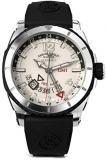
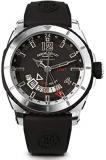
The Longines Spirit Zulu Time carries a bidirectional rotating bezel with a ceramic insert, a detail that reframes how a travelling watch signals its second time zone. Behind that bezel sits a self-winding mechanical movement beating at 25,200 vibrations per hour, fitted with a monocrystalline silicon balance-spring and rated for a power reserve of up to 72 hours.
The Zulu Name and Its Aviation Lineage
Zulu is the phonetic alphabet designation for the letter Z, and in aviation and military timekeeping it stands for Coordinated Universal Time. A GMT hand set to Zulu time lets a pilot, navigator or frequent flyer hold one fixed reference while the local hour hand jumps forward or backward on landing. Longines anchors the Spirit Zulu Time in that tradition, positioning the model within a Spirit family whose design vocabulary is drawn from cockpit instruments rather than from the boardroom.
That design intent is legible from across the room. The dial is matte, the numerals are large and applied, and the GMT/24-hour hand carries a distinct arrow tip that separates it instantly from the hour and minute hands. Both the 39.00 mm and 42.00 mm references follow this template, so the choice between them comes down to wrist presence rather than to any downgrade in specification.
Two Case Sizes, One Specification Standard
Longines publishes both Spirit Zulu Time references with the same core engine, which simplifies the decision considerably. The 39.00 mm version in black matte and the 39.00 mm anthracite dial model share the calibre and the 72-hour reserve; the 42.00 mm reference in anthracite repeats the arrangement at a larger diameter. Nothing about the movement, the balance-spring material or the GMT complication changes with case size.
- Movement: Self-winding mechanical, 25,200 vph
- Regulation organ: Monocrystalline silicon balance-spring
- Power reserve: Up to 72 hours
- Functions: Hours, minutes, seconds, date, GMT/24-hour hand
- Bezel: Bidirectional rotating with ceramic insert
The silicon balance-spring is the technical centrepiece here rather than a decorative footnote. Silicon is non-magnetic, temperature-stable and resistant to corrosion, qualities that matter in a watch whose owner may move between aircraft cabins, alpine air and humid coastal cities in a single week. A balance-spring that resists magnetic fields and thermal drift supports rate stability across those conditions, which is precisely the job description of a travel watch.
Reading the Dial at Speed
A GMT hand only earns its place if it can be read without hesitation, and the Spirit Zulu Time resolves the problem through contrast rather than through colour alone. The 24-hour hand tracks against a graduated scale, and the bezel insert provides a second index for a third zone when the bezel is rotated. A date window sits at a conventional position without interrupting the applied numeral layout.
The anthracite and black matte dial variants both prioritise legibility over shimmer, a sensible choice given that the Spirit line borrows from cockpit instrumentation. In low light the hands and markers remain distinguishable, which is the practical test any GMT watch has to pass. Collectors who prioritise ornate dial finishing will find richer treatments elsewhere in the segment, but the Spirit Zulu Time is aimed squarely at the reader who wants instant comprehension of three time signals.
The Ceramic Bezel as a Functional Choice
Bezel inserts sit at the sharp end of daily wear. Ceramic resists scratching and colour fade far better than anodised aluminium, holds its edge definition over years of rotation, and does not accumulate the soft dents that alloy inserts pick up in a pocket or against a doorframe. For a watch designed around a rotating 24-hour scale, that durability directly protects the function: a faded or scratched insert compromises the legibility of the scale it exists to provide. The bidirectional action rather than a unidirectional ratchet also reflects the GMT’s two-way travel logic, since a second zone can sit ahead of or behind home time with equal frequency.
How the Spirit Zulu Time Fits the Wider Market
The aviation GMT segment is crowded, and the sensible way to evaluate the Spirit Zulu Time is to compare the philosophy behind each option rather than to rank them. Rolex approaches the complication through the Rolex GMT-Master II line, a design built around a two-tone ceramic bezel and a long association with intercontinental pilots. Breitling, meanwhile, frames aviation timing through the slide-rule aesthetics of the Breitling Navitimer collection, where the rotating bezel performs computational duties rather than zone indication.
Longines takes a quieter route. The Spirit Zulu Time offers a silicon-regulated movement, a ceramic 24-hour bezel and a 72-hour power reserve in a case designed for daily wear, without leaning on motorsport or dive watch iconography. Readers cross-shopping that broader landscape can explore Longines watches built for travel and daily wear, which shows how the Spirit sits alongside its heritage dress and dive lines. The comparison that matters for most buyers is not which watch outranks another, but which bezel scale and dial layout each owner will actually use.
Power Reserve and Ownership Rhythm
Up to 72 hours of reserve changes the ownership routine in a concrete way. A watch left on a desk from Friday evening will still be running on Monday morning, so the GMT hand does not need to be reset after a weekend away from the wrist. For a rotating collection where a travel watch is worn for trips rather than daily, that tolerance removes the small friction of a stopped movement and a re-setting ritual before every departure.
The self-winding architecture keeps the operation simple: crown in, movement wound by wrist motion, no battery cycle to schedule. Owners who travel with more than one piece and alternate frequently will still want a winder or a brief hand-wind before departure, and the instruction manual for the calibre sets out the correct crown positions for the GMT and date adjustments so that neither is moved at an unsuitable hour.
Which Wrist and Which Reference
Case diameter is the single decision most buyers face. The 39.00 mm references suit wrists that sit in the six to seven inch range and wear well under a shirt cuff, while the 42.00 mm anthracite version gives the painted numerals and bezel scale more room and reads larger in low light. Someone buying a first serious GMT watch and intending to wear it with tailoring will generally be served by the smaller case; someone with a broader wrist who wants the bezel scale to be instantly legible without a second glance will lean the other way.
Dial colour follows the same logic. The black matte option is the more restrained pairing for formal wear, while the anthracite dial introduces a slight warmth that responds well to natural light. Neither choice carries a mechanical penalty, because the calibre, the silicon balance-spring and the 72-hour reserve are constant across the range.
Where the Zulu Time Belongs on a Watch List
The Spirit Zulu Time occupies a specific and defensible position: a pilot-styled GMT watch with a silicon-regulated movement and a ceramic 24-hour bezel, offered in two case sizes that share identical internals. Its appeal rests on function rather than on theatre, and on a reserve long enough to tolerate real travel schedules.
Travellers who want a second time zone they can read at a glance, a bezel that survives contact with daily life, and a movement insulated from magnetic and thermal distraction will find the brief answered without excess. That combination of a Zulu reference, a ceramic scale and a weekend-proof power reserve is what gives the Spirit Zulu Time its enduring place among modern aviation watches.