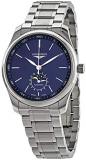
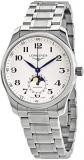
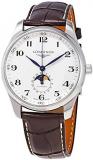
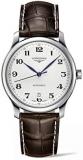
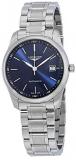
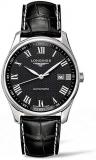
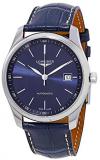
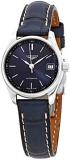
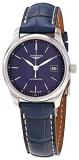
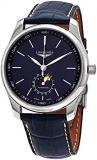
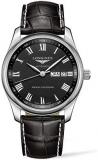
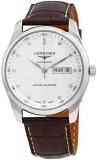
The Longines Master Automatic Moonphase stands as one of the most compelling offerings in the brand’s extensive catalog, blending traditional watchmaking virtues with a complication that has fascinated horology enthusiasts for generations. This timepiece represents a thoughtful balance between everyday functionality and the romantic allure of tracking lunar cycles, making it a versatile addition to any serious collection. The model exemplifies how a mid-luxury Swiss manufacture can deliver mechanical sophistication without venturing into inaccessible price territories, carving out a distinct position in the crowded dress watch segment. For those exploring the broader landscape of Swiss watchmaking, the brand’s heritage offers a fascinating counterpoint to other maisons with different historical trajectories.
Understanding the Master Collection Lineage
The Master Collection, introduced in 2005, was conceived as a platform to celebrate Longines’ technical heritage while offering contemporary consumers access to complications typically reserved for higher-priced competitors. The collection’s design language draws from the brand’s mid-century catalog, featuring restrained case profiles, dauphine hands, and applied indices that prioritize legibility and elegance. This approach aligns with the brand’s longstanding philosophy of producing “elegance is an attitude” timepieces, a positioning refined over decades of consistent design evolution. The collection systematically expanded over the years, introducing chronograph, annual calendar, and retrograde variants, yet the moonphase iteration consistently remains among the most sought-after configurations. This enduring popularity stems from the complication’s visual appeal and its demonstration of mechanical sophistication within a framework of understated aesthetics. Collectors often note that the Master Collection serves as an accessible entry point into complications, occupying a space where technical capability meets wearable versatility.
The moonphase variant, which emerged in the collection’s early years, established a template that continues to define the model today. Its combination of a complete calendar display alongside a precision lunar indicator offers substantial horological content within an elegant 40mm case, a diameter that balances contemporary preferences with enduring classicism. The inclusion of a moonphase complication historically indicated significant watchmaking capability, and Longines perpetuated this tradition by equipping the Master line with in-house calibers developed in partnership with ETA, including the L899 series which derives from the dependable A31.L01 architecture. This movement generation provides both reliability and extended power reserves, addressing modern expectations while maintaining serviceability across the brand’s global network, an advantage of vertically integrated production strategies.
A Deeper Look at the Moonphase Display
The moonphase aperture, located at 6 o’clock, presents a stylized celestial disc featuring a starry backdrop against which the lunar sphere advances through its 29.5-day cycle. This display complexity exceeds simpler implementations by incorporating a precision gearing system that requires adjustment only every approximately 105 years, a detail appreciated by purists who verify such specifications. The outer date ring, indicated by a central hand with a contrasting crescent shape, requires no interpretation, while the day and month windows complete the calendar architecture through carefully positioned apertures at 12 o’clock. These functional elements integrate within a dial surface available in several configurations, including silver, black, and blue variations, each contributing distinct character to the overall composition. The dial layout demonstrates thoughtful information hierarchy, ensuring that the moonphase receives appropriate visual prominence despite its simultaneous coexistence with three additional calendar functions, an arrangement that challenges other brands with similar complications to match its coherence.
The visual treatment of the lunar display varies across references, with some versions featuring a guilloch茅-textured moon disc and others adopting a standard polished finish. The silvered versions employ a classic sunburst pattern that interacts dynamically with lighting conditions, while the newer blue and green iterations expand the collection’s contemporary appeal without abandoning its dressier roots. The applied indices, executed in polished steel, maintain consistency with the case finish, while the date numerals appear in a clean serif typeface reinforcing the traditional character. Luminous treatment is intentionally restrained, appearing only on hours, minutes, and the date hand, prioritizing the calendar’s legibility rather than creating a sport instrument effect. This decision differentiates the timepiece from tool-watch competitors while ensuring nighttime legibility suffices for civilian contexts.
Movement Architecture and Technical Substance
Underlying the elegant facade, the automatic movement provides substantial technical credibility through components visible via the exhibition caseback. The bridge decoration includes Geneva stripes, perlage, and blued screws, presenting a visual sophistication unexpected at typical street prices. The oscillating rotor bears the Longines signature, completing a presentation that encourages prolonged examination through the sapphire window. Furthermore, the movement incorporates a silicon balance spring in contemporary generations, delivered by the L888.5 caliber with 72 hours of reserve in modern versions, enhancement that secures official chronometer certification for select references. These technical attributes, when considered alongside the aesthetic refinements, deliver a value proposition that competitive alternatives frequently struggle to match when categorizing specification sets. Technicians and horological journalists consistently acknowledge that performance metrics, including amplitude stability and positional accuracy, achieve execution standards worthy of evaluation by industry measurement protocols.
The 40mm case, executed in multiple finishes including polished steel and two-tone combinations, follows traditional proportions with straight lugs and a modest profile suited to dress shirts. Water resistance extends to depths of 30 meters, providing sufficient protection for daily contingencies while acknowledging the timepiece’s intended environment remains the boardroom rather than the beach. The caseback’s deep engravings maintain decorative tradition, and the signed crown displays dual protective guards that subtly enhance the silhouette’s utility without capitulating to sporty trends overly prominent in modern collections. These case details contribute to a wearing experience benefiting from successful weight distribution across the lug width, ensuring comfort during extended wear periods exceeding typical usage cycles.
For prospective owners researching the Longines Master Automatic Moonphase, the sheer depth of design evolution since its release warrants attention. The catalog spans multiple references, accommodating preferences for different dials, case metals, and strap options from affordable steel bracelets to premium leather and textured finishes. The introduction of 42mm versions during specific production phases addressed changing consumer expectations regarding wrist presence and broadened accessibility across physiognomy variations, highlighting manufacturing flexibility in response to shifting market dynamics. Price positioning inevitably varies across references and production years, with significant divergence noted across the two-tone and full-gold configurations relative to entry-level steel versions, offering selection opportunities across a budget spectrum while preserving the complication’s core value within each framework.
Within the horological universe, the connotation of specific complications profoundly defines market perception. This timepiece’s calendar arrangement, comprehensive within its category boundaries, holds relevance for daily management of professional and social commitments. The moonphase adds undeniable charm, entering a tradition of observatory precision harking back to navigation requirements from centuries past. Savvy individuals often perceive such elements as indicative of broader technical lineage, and this model undisputedly inherited from its proven predecessors rather than from experimental quick iterations. From this lineage emerges confident integrity that production consistency amplifies across contemporary operations, ensuring that quality expectations remain systematically satisfied. For additional perspectives on alternative complication executions, examining the Omega Seamaster’s approach to calendar-equipped dive watches provides interesting references from a different brand tradition, with each maison presenting unique philosophical solutions to horological challenges, and enthusiasts benefit from understanding these distinctions when refining their collecting focus.
Design Analysis and Aesthetic Appeal
The dial’s arrangement reveals a maturity of design that reveals itself progressively through observation. Initial encounter presents an elegant composition; prolonged analysis uncovers how the moonphase integrates without disturbing the calendar’s readability. Each component’s proportions undergo careful adjustment, exemplified through the day and month window’s positioning relative to the crown, ensuring aligning typography and framing that presents these functions as deliberate design intents rather than merely functional additions. The varied dial releases, from matte to glossy, complement case colors with considered chromatic relationships, addressing divergent consumer preferences while maintaining recognizable collection identity. Attention focuses on the subtle details – the seconds hand’s slim profile, date numerals’ generous presentation, and the motif beneath the moon suggesting cosmic infinity with tastefulness – elements combining into a unified expression absent of contradictions commonly found in multi-complication outputs.
The wearing experience at 40mm, with a height closely matching its width due to an 8.5mm movement case construction, positions itself between classic styles favoring suit interactions and contemporary demands for substance presence on the wrist. Purchase decisions necessarily balance a preference for self-winding convenience against greater aesthetic regularity characteristic of dress contexts, but this model reconciles through automatic operation paired with unobtrusive case proportions accommodating shirt cuff environments. The buckle, deploying in standard configurations with signed closure elements, ensures secure retention, while quick-release spring bars enable swaps between strap styles without specialized tools, enhancing daily adaptability across changing wardrobe circumstances. The power reserve’s generous extension over conventional 38-hour benchmarks reduces the frequency of rewinding and date correction after periods of rest, a user-focused feature gaining appreciation through regular interplay and months of ownership familiarity, distinct from arguments that matter only during comparative spec evaluation.
This timepiece will satisfy those whose appreciation extends beyond mere time telling toward an understanding of how mechanical complexity enriches an object’s value, even when that complexity’s practical manifestation remains subtle. The Longines Master Automatic Moonphase is a compelling representation of tradition embracing capability, delivering connoisseurship accessibly. Assembled with global service networks and a reputation solidified through decades of collection development, this model asserts itself as a singular choice within its competitive environment, representing a foundation for embarking on lifelong horological appreciation or a gratifying stand-alone addition achieving versatile performance with distinguished character.