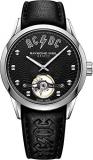
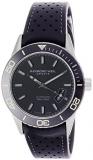
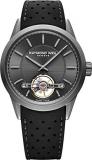
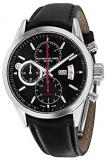
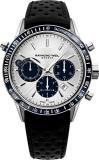
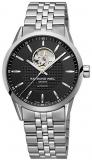
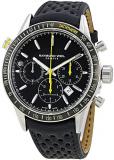
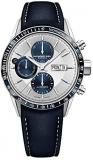
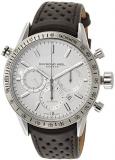
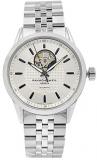
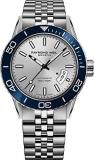
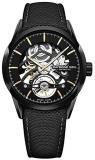
The Raymond Weil Freelancer lineup spans everything from a 40 mm complete calendar to a 43 mm chronograph with a green dial, giving the collection an unusually wide footprint within a single family name. That range matters, because the Freelancer is not one watch but a design language that Raymond Weil has applied to dressy calendars, racing-inspired chronographs, and titanium tool models alike.
For anyone researching the series today, the challenge is less about finding a Freelancer and more about choosing which expression of it matches a given wrist and wardrobe. The notes below separate the collection into its key variants and explain what each one actually brings to the table.
A Collection Defined by Movement and Dial Variety
Raymond Weil has built the Freelancer around a small number of mechanical platforms, then varied the presentation around them. The result is a series where a buyer can move between a skeletonized dial, a calendar complication, and a chronograph without leaving the same design family. That coherence is deliberate. Case lines, lug shapes, and bracelet architecture recur across the range so that a Freelancer looks like a Freelancer regardless of which function sits on the dial.
Three broad groupings stand out. The first covers time-and-date automatics in steel, often with textured or gradient dials. The second is the chronograph line, which includes both a standard three-register automatic and a titanium-cased version. The third is the complication tier, where the Freelancer hosts a complete calendar and other calendar-driven displays. Each grouping speaks to a different buyer, but they share the same architectural DNA.
Raymond Weil Freelancer Automatic: The Core Proposition
The Freelancer Automatic is the series entry point for buyers who want a Swiss mechanical movement without a chronograph complication. The design brief here is restraint framed by presence: a reasonably sized steel case, a dial with enough texture to catch light, and a silhouette that works under a shirt cuff as easily as it does with a sweater. Textured green and gradient dials have become signature choices within this group, giving the model a visual identity that distinguishes it from plainer Swiss automatics at similar positioning.
What makes this tier compelling is the movement transparency. Open case backs are common across the Freelancer range, and they turn the watch into a small mechanical exhibit. Owners can watch the oscillating weight swing and the escapement pulse, which is the specific pleasure that draws many collectors to automatic watches in the first place. Battery-free operation and a sweeping seconds hand complete the traditional mechanical experience.
Calibre RW1212 and the Movement Story
The name RW1212 appears repeatedly in connection with the Freelancer, and it is worth understanding why. It is an automatic calibre that Raymond Weil has used across several Freelancer references, including green-dial variants reviewed widely by the enthusiast press. The designation reflects the brand’s habit of associating mechanical platforms with specific product lines rather than treating movements as anonymous internals.
For a buyer, the practical implications are what count. An automatic calibre in this class removes the battery change cycle entirely and rewards regular wear with consistent timekeeping. The flip side is that mechanical movements benefit from being worn or stored on a winder, and they are more sensitive to shock than a quartz module. These are standard trade-offs in the Swiss automatic segment, not flaws specific to the Freelancer, but they are worth understanding before committing.
Raymond Weil Freelancer Chronograph: Function Meets Motorsport
The chronograph variants broaden the Freelancer’s personality considerably. A black-dial automatic chronograph with three subdials and a tachymeter scale is a familiar configuration, and it is the version most often associated with the model in retailer listings. The layout places elapsed-time reading at the center of the dial’s hierarchy, which shifts the watch from quiet companion to engaged instrument.
There is also a titanium-cased chronograph in the family, and it deserves separate attention. Titanium reduces weight noticeably compared with steel, and the case in this reference is described as satin-finished, which gives it a more technical, less polished character. According to published specifications, that model measures roughly 13.7 mm thick, carries a 10 ATM rating, and can record up to twelve hours of timing. The combination of a lighter case and a long timing capacity makes it the most purpose-driven Freelancer for buyers who actually intend to use the chronograph.
Steel chronograph references in the range also appear with PVD coatings. One widely documented example, reference 2785-BC5-20001, uses a stainless steel case with a black PVD finish at 42 mm in diameter and a 100 m water resistance rating. That specification set, pairing a dark coated case with a 42 mm diameter, positions the watch as a more casual, assertive option than the uncoated models.
Case Sizes, Water Resistance, and Everyday Wearability
Diameter across the Freelancer family runs from 40 mm to 43 mm, with 42 mm appearing frequently among the chronographs. This is a moderate spread that keeps the collection accessible to a wide range of wrists. A 40 mm complete calendar sits at the dressy end, while a 43 mm chronograph occupies the sporty end, and neither feels out of character for the line.
Water resistance is typically rated at 100 m, or 10 bar, across the references where that figure is published. That rating covers hand washing, rain, and swimming, though it does not extend to serious diving. For a watch that is primarily a daily wearer with occasional aquatic exposure, 100 m is a practical and appropriate specification.
- Case materials: stainless steel, black PVD-coated steel, and satin-finished titanium
- Diameters: 40 mm, 42 mm, and 43 mm depending on the reference
- Water resistance: commonly 100 m (10 bar) where specified
- Movement: automatic calibres, including the RW1212 and the RW5000 chronograph platform
- Complications: time and date, chronograph, and complete calendar
The spread of materials is worth noting because it changes the wearing experience more than spec sheets suggest. Titanium reads darker and warmer than polished steel, and it picks up scratches in a different way. A PVD-coated case hides surface marks better than bare steel but can show wear at edges over years of use. Buyers weighing a Freelancer against alternatives in the same segment can compare these material choices directly with what a full-featured Raymond Weil collection offers across its broader range of Swiss automatics and quartz references.
Why the Freelancer Appeals to Contemporary Collectors
The Freelancer occupies a specific niche in the Swiss watch landscape. It is a mechanical watch from an independent family-owned brand, positioned above entry-level quartz offerings and below the luxury houses, and it leans on design variety rather than a single iconic silhouette. That combination suits collectors who want mechanical credibility, visual distinction, and a case size that fits without dominating the wrist.
The series also rewards buyers who care about dial execution. Textured finishes, gradient colorways, and skeletonized elements appear across the range, which means the Freelancer rarely looks generic on the wrist. In a market where many steel automatics converge on the same visual formula, that attention to surface detail is a genuine point of differentiation.
Reliability expectations are aligned with the segment. An automatic movement from a Swiss manufacturer at this level is designed for daily service and long-term ownership, provided the watch receives routine maintenance and avoids severe impacts. Buyers moving from quartz watches should factor servicing intervals into their ownership plan, since mechanical watch care is a different discipline.
Sizing, Dial Selection, and Buyer Guidance
Choosing a Freelancer comes down to three decisions: complication, case size, and dial treatment. Buyers who want a dress-oriented mechanical watch with a bit of calendar functionality gravitate toward the 40 mm complete calendar. Those who want visual drama without chronograph complexity tend toward textured or green-dial automatics. And buyers who want a technical, lightweight tool-oriented piece should look specifically at the titanium chronograph.
Dial decisions matter as much as case size in practice. Black dials absorb light and read as more formal; green and gradient dials shift with angle and add character; textured finishes catch highlights in a way flat dials cannot. Since the Freelancer range offers all three, trying references side by side is the most reliable way to judge which one holds up under daily lighting.
Coordinating With a Broader Collection
Many buyers approach the Freelancer as an addition rather than a first purchase. In that context, it pairs naturally with other Swiss and sports references, including an Omega Speedmaster for chronograph variety and a Rolex Yacht-Master when a nautical, precious-metal-accented option is part of the mix.
Movement Longevity and Ownership Costs
Over a multi-year horizon, the Freelancer’s automatic calibres require periodic servicing just as any mechanical watch does. Budgeting for that service and protecting the watch from hard impacts will do more for longevity than any accessory. Owners who rotate several mechanical watches on a winder, or who wear the Freelancer consistently, generally see the most stable timekeeping performance.
What the Raymond Weil Freelancer ultimately offers is range without incoherence: a single series flexible enough to serve dress occasions, weekend wear, and genuine chronograph use, anchored by Swiss automatic movements and dial work that resists the ordinary. For collectors drawn to mechanical watches with personality and practical sizing, it remains a quietly persuasive option.