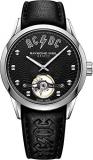
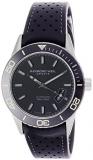
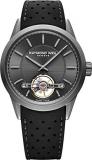
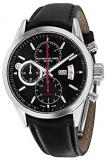
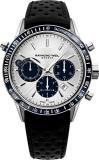
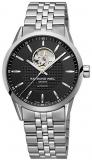
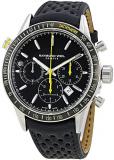
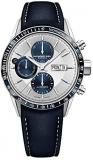
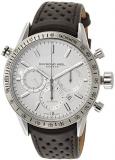
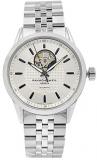
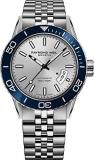
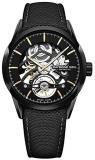
The Raymond Weil Freelancer Automatic builds its identity around a Swiss self-winding movement inside a case that spans several sizes, from a compact 36 mm reference to broader 40 mm and 42 mm executions. That range matters because it lets one design language serve wrists of different proportions without forcing a compromise on presence or comfort.
The collection occupies a space between sport and dress, a balance Swiss watchmaking often pursues but rarely lands as cleanly. Raymond Weil’s independent Swiss watchmaking has shaped the Freelancer around that middle ground, giving it a versatility that suits a boardroom, a weekend drive, and an evening dinner alike.
A Self-Winding Heart With Real-World Range
Automatic winding sits at the core of the Freelancer’s appeal. Mechanical watches in this class draw energy from the motion of the wrist, store it in a mainspring, and release it through a regulating organ that beats at a steady frequency. The result is a living mechanism rather than a battery-driven circuit, and for many wearers that distinction is the entire point.
Raymond Weil has used proven Swiss automatic calibres across the Freelancer range, including variants built on well-established ebauche platforms that watchmakers have refined for decades. One notable example is the RW3281 calibre used in the Complete Calendar version, a movement based on a Sellita architecture with a calendar module, delivering around 56 hours of power reserve according to the brand’s published specification.
That reserve figure deserves context. Fifty-six hours means the watch can be set down on a Friday evening and still be running on Monday morning, which removes one of the small daily rituals that puts people off mechanical ownership. For anyone moving between a desk job and an active weekend, that margin is genuinely useful.
Case Construction and the Diver’s Influence
Across the Freelancer line, stainless steel dominates the case and bracelet materials. Finishing alternates between brushed surfaces and polished bevels, a contrast that catches light along the case flanks and gives the watch a more expensive read than its positioning might suggest. Solid end-links and screw-in bracelet connectors appear on several references, details that speak to a construction philosophy closer to tool watch practice than to fashion-first assembly.
Water resistance varies by reference. Some Freelancer models carry a 100 m rating, suitable for swimming and showering, while dedicated diver variants push to 300 m, matching the expectations of serious aquatic use. A ceramic bezel insert appears on the diver-oriented executions, a material chosen for its resistance to scratching and fading compared with anodised aluminium.
- Case sizes: 36 mm, 38 mm, 40 mm, and 42 mm depending on reference
- Case material: Stainless steel, frequently with alternating brushed and polished finishes
- Water resistance: 100 m on standard models, up to 300 m on diver variants
- Bezel: Ceramic insert on diver-focused references
- Bracelet: Steel with solid links and screw-in connectors on selected models
The breadth of this lineup is part of the point. A 36 mm Freelancer and a 42 mm diver share a family resemblance but serve entirely different wearers, and Raymond Weil has resisted the temptation to force every reference into a single oversized mould.
Dial Design and the Date Complication
Freelancer dials lean toward colour. Blue appears frequently, sometimes in two-tone configurations paired with contrasting bracelet finishes, and the collection has embraced richer hues alongside more conventional black and silver options. Applied indices and faceted hands give the dial depth, while luminous coatings on hands and markers keep legibility intact after dark.
The date function is a near-constant across the range. On the Complete Calendar reference, that expands into a fuller calendar display, a complication that adds mechanical complexity and a more architectural dial layout. Such displays require careful sub-dial placement to avoid visual crowding, and the redesigned 2025 Complete Calendar addresses this with a cleaner arrangement than its predecessor.
There is a practical argument for the date window that goes beyond tradition. For anyone who signs documents, fills forms, or simply checks the day without reaching for a phone, a mechanical date at three o’clock or six o’clock is a small but constant convenience. It is the kind of feature that becomes invisible until it is missing.
Where the Freelancer Sits in the Swiss Landscape
Raymond Weil occupies a specific tier in Swiss watchmaking, sitting above entry-level quartz but below the haute horlogerie houses. Within that space, the Freelancer competes with automatic sports watches from peers across the industry, each with its own emphasis on movement development, case finishing, or heritage storytelling.
The comparison is instructive rather than competitive. Where some brands chase technical one-upmanship, Raymond Weil has tended to prioritise wearability and design coherence, using dependable third-party Swiss calibres and putting the saved engineering budget into case finishing, dial execution, and bracelet quality. Buyers who value tactile refinement over spec-sheet bravado often find that trade-off appealing.
That positioning also shapes resale and ownership expectations. A Freelancer is unlikely to be treated as an investment piece, but it delivers a level of Swiss mechanical craftsmanship that holds up over years of daily wear, and servicing remains straightforward because the underlying movements are widely supported.
Living With an Automatic Freelancer
Daily use reveals the details that photographs miss. The crown action on a well-finished automatic should feel positive without grit, and the winding rotor should spin freely without an audible rattle. Bracelet articulation matters just as much, and the solid-link construction used across much of the Freelancer range tends to feel more substantial than folded-link alternatives.
Accuracy expectations are realistic rather than lab-grade. Swiss automatic movements in this class are typically regulated to within a handful of seconds per day, which is more than adequate for everyday timekeeping. Owners who care about precision can have a watchmaker adjust the rate during routine servicing.
Strap and bracelet swapping is another practical pleasure. A leather strap transforms the Freelancer into something closer to a dress watch, while the steel bracelet keeps it casual and sporty. Fewer than a minute of work with a spring bar tool is usually all that separates the two looks.
Why the Collection Endures
Raymond Weil founded the company in 1976, and the brand has remained family-owned and independent, a rarity in an industry dominated by large luxury conglomerates. That independence shows in the Freelancer’s design continuity: the line evolves gradually rather than lurching between identities, which gives owners confidence that a purchase will not look dated in three years.
The automatic Freelancer occupies a sensible spot for buyers stepping into mechanical watch ownership. It offers a genuine Swiss movement, a well-made steel case, and a versatile appearance without demanding the spend associated with prestige-tier brands. For collectors who already own several pieces, it functions as an easy everyday option that does not need to be babied.
What ultimately distinguishes the Freelancer is restraint. It does not try to be a dive computer, a dress chronometer, and a heritage piece simultaneously. It is a Swiss automatic watch built to be worn often, finished well enough to be noticed, and priced so that wearing it never feels like a risk.