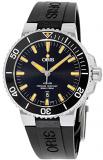
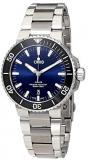
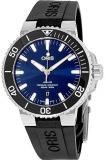
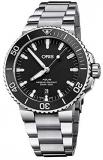
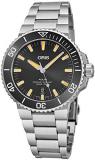
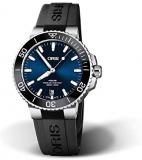
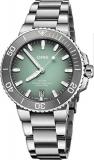
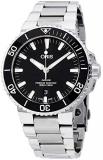
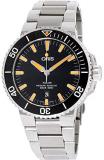
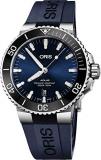
The Oris Aquis is built around a set of principles that date back to the brand’s founding in H枚lstein in 1904: mechanical movements, purposeful design, and genuine everyday usability. The Aquis line takes those principles underwater, then brings them back to the surface for daily wear. Dive watch styling has been a central pillar of the Oris brand’s output for decades, and the Aquis represents the most focused expression of that heritage.
What separates the Aquis from countless other dive-style watches is not a single headline feature but the way its details fit together. The case is sculpted with integrated lugs that flow into the bracelet or strap without a visible break, giving the watch a continuous, architectural profile. That design decision is not purely aesthetic. Integrated lugs protect the spring bars, reduce snagging, and distribute the weight of the watch more evenly across the wrist.
A Case Built for Water and for Daily Life
The Aquis family spans multiple case sizes, with 39.5mm, 41.5mm, and 43.5mm versions appearing across the range. That spread matters because a diver’s watch is only as good as its fit. A 43.5mm Aquis Date measures roughly 12mm thick with a lug-to-lug distance close to 50mm, which keeps it wearable for a broad range of wrist sizes despite the substantial case diameter. The 41.5mm variant has become the reference point for many buyers, sitting in the middle ground between a compact everyday watch and a full-sized professional tool.
Water resistance across the line varies by model, from 300 metres on standard Aquis Date references up to 500 metres on specialized versions. The higher-rated references include features such as a depth gauge or a helium escape valve, depending on the configuration. For the majority of wearers, the practical takeaway is simpler: any Aquis is rated far beyond what recreational diving requires, which means swimming, snorkeling, and everyday exposure to water are comfortably within its design envelope.
Materials and the Oris Approach to Durability
Oris builds the Aquis around stainless steel as its default case material, with finishing that alternates between brushed surfaces and polished edges. That combination is deliberate. Brushed steel hides the small scratches that accumulate through daily wear, while polished bevels catch light and give the case definition. Several references also use ceramic for the bezel insert, a material chosen for its resistance to fading and scratching compared with anodized aluminum.
The sapphire crystal, applied with an anti-reflective coating on the inside, protects the dial without the distortion associated with mineral glass. Legibility is treated as a functional requirement rather than a stylistic afterthought: applied indices, broad hands, and generous luminous compound ensure the dial remains readable in low light, which is the entire point of a dive watch’s visual language.
The bracelet deserves separate mention. Oris equips most Aquis references with a steel bracelet featuring a clasp that allows tool-free micro-adjustment, a detail that matters for divers who wear wetsuits of different thicknesses and for anyone whose wrist size fluctuates with temperature.
Movements: Caliber 400 and the Sellita-Based Options
Two broad movement families appear across the Aquis range. Entry and mid-range references typically use the Oris 733, a Sellita-based automatic caliber with a power reserve around 38 hours. The more recent and technically ambitious references use the in-house Caliber 400, an automatic movement with a five-day power reserve, anti-magnetic properties, and a ten-year recommended service interval. Oris states that the Caliber 400 was designed to reduce the ownership burden that traditionally comes with mechanical watches.
That distinction is worth understanding before choosing a reference. The 733-powered models offer proven reliability at a lower price point, while Caliber 400 models deliver longer autonomy between wears and a more generous service schedule. Both approaches reflect the same underlying philosophy: mechanical watches should be robust, serviceable, and intended for regular use rather than display.
Limited Editions and the Wider Aquis Family
The Aquis line has expanded well beyond the core Date models. Oris has produced limited editions tied to environmental partnerships, including references limited to just 72 pieces that pair a 41.5mm case and a steel bezel with the in-house Caliber 400. Other editions run to just a few hundred pieces and are sold through specific channels. Limited editions in this line are not merely cosmetic variations; they often introduce different bezel materials, unique dial textures, or case constructions that later inform standard production models.
Buyers weighing a dive watch against other categories have plenty of alternatives, from Longines to more specialized sports lines. What distinguishes the Aquis within its segment is the consistency of its design language across sizes and price points. A 39.5mm model and a 43.5mm model are recognizably the same watch, scaled rather than redesigned.
Choosing the Right Aquis for Your Wrist
Case size is the first decision. A 39.5mm Aquis suits smaller wrists or wearers who prefer a lower profile, while the 43.5mm version delivers more wrist presence and typically more water resistance in specialized configurations. The 41.5mm remains the safest middle choice for most buyers, and it is the size most frequently used for limited editions and special references.
Movement is the second decision. If the watch will be worn daily, the Caliber 400’s five-day reserve and extended service interval reduce maintenance friction. If it will be part of a rotation, the 733’s shorter reserve means the watch may need resetting after a few days off the wrist, but the movement is well understood and widely serviceable.
Bracelet or rubber strap is the third. The steel bracelet suits office and casual wear equally well, while rubber options lean more heavily toward water sports and warm-weather use. Some references ship with the ability to swap between the two through Oris’s quick-change system, which removes the need for tools.
The Aquis in the Context of Modern Dive Watches
The dive watch category has drifted in two directions over the past two decades. One direction treats the format as a style exercise, prioritizing vintage cues and slim cases over genuine water resistance. The other direction pushes toward ever-greater depth ratings and specialized tool features that most owners will never use. The Aquis occupies a middle position. It maintains real dive-watch specifications, including meaningful water resistance ratings and robust bezel construction, while keeping the case proportions and finishing appropriate for daily wear.
This balance is why the Aquis has become a reference point within the broader Oris catalog and among independent Swiss brands more generally. The watch does not rely on a single gimmick. Its value comes from the accumulation of details: the integrated case design, the ceramic bezel options, the choice between proven and in-house movements, and the sheer number of size and configuration options that let a buyer find a version that fits.
For anyone looking at the category, the Aquis is best understood as a long-term watch rather than a novelty. Its servicing requirements are predictable, its design language is stable, and its specifications remain relevant regardless of how diving trends evolve. That is the quieter argument for a mechanical dive watch in an era of disposable everything, and it is the argument the Oris Aquis makes most convincingly.