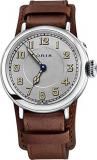
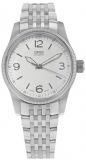
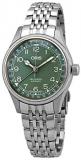
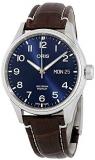
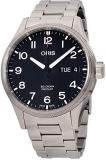
The Oris Big Crown Bronze Pointer Date measures 40.00 mm across and incorporates a multi-piece bronze case with a stainless steel case back, a detail Oris includes to limit skin contact with the copper alloy. The combination gives the watch its defining trait: a case that darkens, spots, and matures with wear, so no two examples age identically.
That variability sits at the heart of the appeal. Bronze is not a static material, and the Big Crown line, which traces back to the pilot watches Oris supplied from the late 1930s, uses it to connect a functional 20th-century instrument to a modern collector’s wrist. The reference 01 754 7741 3167-07 8 20 01 carries this through with a green dial, while the 01 754 7741 3167-07 5 20 58BR pairs its bronze case with a dark brown leather strap and a matching bronze buckle.
A Case That Records Every Wearing
Bronze develops a patina through oxidation, and the specific alloy matters as much as the shape. Oris uses a multi-piece construction rather than a single block, and the stainless steel case back serves a practical purpose beyond contrast: it reduces the surface area of bronze touching the wrist, which limits both skin discoloration and the greenish residue that copper alloys can leave behind. The result is a case that still ages visibly on the bezel, lugs, and flanks, where it catches air, moisture, and perspiration.
The 40.00 mm diameter and roughly 12 mm height keep the proportions wearable rather than oversized, so the bronze reads as a deliberate material choice rather than a novelty. Owners who prefer an even, darkened tone can leave the watch unworn in open air for a few days; those who prefer an uneven, lived-in finish can wear it through the summer.
The Pointer Date Complication and Its Origins
Rather than a conventional date window, the Big Crown points to the current date with a fourth central hand that sweeps around a printed scale on the dial’s perimeter. The design is legible at a glance and unusual among modern automatics, and it has been part of the Big Crown family since the 1930s, when Oris developed large crowns specifically so pilots wearing leather gloves could adjust the watch without removing them.
That large crown remains on the current model, and its fluted bronze surface is both the line’s namesake feature and a tactile reminder of the watch’s instrument roots. The aviation context also explains the restrained dial layout: applied indices, luminous hands, and a clear, uncluttered reading of the time, with the date scale added on the outer edge rather than interrupting the center.
Calibre 754: Automatic Winding in Daily Use
The movement is Calibre 754, a self-winding automatic with a diameter of 25.60 mm and 11 1/2 lignes. It runs at 28,800 vibrations per hour, or 4 Hz, a frequency that supports stable rate-keeping across normal daily wear. Because it is automatic, there is no battery to replace; energy comes from wrist motion, which suits a watch intended to be worn rather than stored.
In everyday use, the combination of automatic winding and a date display by hand is unusually practical. The pointer date is quick to read and does not require the wearer to hunt for a small aperture, and the luminous hands and markers remain usable in low light, a feature inherited from the pilot-watch brief. Water resistance is rated at 5 bar, sufficient for rain, handwashing, and brief immersion, though not for swimming or diving.
- Case: Multi-piece bronze with stainless steel case back
- Diameter: 40.00 mm, approximately 12 mm thick
- Movement: Calibre 754 automatic, 28,800 A/h, 4 Hz
- Complication: Pointer date by a fourth central hand
- Strap options: Leather with bronze buckle, or bracelet
- Water resistance: 5 bar
Where Bronze Fits in a Collection
Bronze sits between steel and precious metal in both cost and character. It carries the warmth of gold without the same price, and it develops the kind of surface history that polished steel resists. For collectors who already own steel sports watches, a bronze piece changes the rotation: it becomes the watch worn on days when small marks and changing color are part of the point, rather than something to be avoided.
Within the brand’s own range, the Big Crown line has expanded over the years, and the Oris collection shows how consistently the brand returns to the same formula: a purposeful case, a legible dial, and a complication tied to a real historical function. That consistency is also why the Big Crown remains the reference point for the brand’s pilot-watch identity.
Strap and Dial Variations
The dark brown leather strap with a bronze buckle is the most natural pairing, since the leather darkens alongside the case and keeps the overall look cohesive. A bracelet version exists as well, offering a more overtly metallic contrast against the bronze, and dial options include green and brown, both of which shift character as the case patinas. Green dials tend to read as cooler and more modern, while brown dials sit closer to the vintage reference points of mid-century pilot watches.
Because the strap and buckle can be changed without altering the watch’s core identity, the Big Crown Bronze adapts to different contexts: a leather strap for office and travel, a sturdier strap for weekends. The bronze buckle continues the material story, so the watch presents a consistent finish whether it is worn with tailoring or a field jacket.
Why Patina Rewards Long-Term Ownership
Patina is the primary reason a bronze watch stays interesting. The surface changes through normal exposure, and each small mark becomes part of the watch rather than damage to be repaired. That quality sets bronze apart from most case materials, and it also means the watch’s appearance is partly determined by its owner’s habits: climate, frequency of wear, and skin chemistry all play a role.
The stainless steel case back and the 40.00 mm sizing keep this character from becoming a liability in daily wear, so the bronze experience is manageable rather than purely collectible. For anyone weighing a bronze option against conventional steel, that balance is the deciding factor.
The Pilot-Watch Legacy Behind the Model
Oris’s pilot-watch history and the Big Crown name both inform the current model, which explains why the design has remained recognizable across decades. The large crown, done in bronze here, was originally a functional solution for pilots; today it is a design signature that links a modern watch to a working past. That continuity is unusual, and it gives the Bronze Pointer Date a narrative that many contemporary releases lack.
The bronze pointer-date models sit alongside the brand’s field-inspired and modern-diving designs, and the range of Oris watches reflects a lineup built around legible, mechanical timepieces. Oris positions this combination of heritage cues and accessible materials as central to the brand’s identity, and the Big Crown Bronze Pointer Date carries that positioning in a single reference.
Choosing the Right Reference
Prospective buyers should confirm the exact strap and dial combination before purchase, since a bronze buckle and leather strap is not the same ownership experience as a metal bracelet. It is also worth verifying case size expectations: the 40.00 mm case wears closer to a classic pilot watch than to a modern oversized piece, and the roughly 12 mm profile sits comfortably under a shirt cuff. Since water resistance is 5 bar, the watch is suited to daily life rather than water sports, and the automatic movement should be allowed to run regularly to stay wound.
For anyone drawn to a mechanical watch with a genuinely individual surface, the combination of a bronze case, a pointer date scaled around the dial, and an automatic Calibre 754 keeps the Oris Big Crown Bronze Pointer Date distinctive in appearance and straightforward to live with.