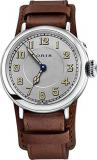
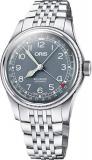
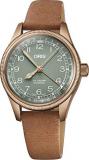
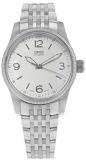
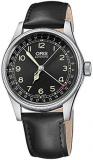
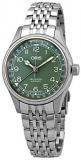
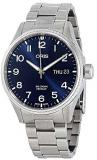
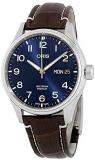
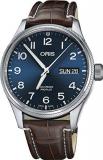
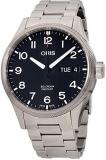
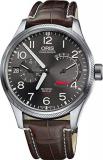
Swiss manufacturer Oris introduced the mechanical altimeter watch as a practical instrument for aviators and mountaineers, pairing a standard timekeeping mechanism with an aneroid barometer module integrated into the dial. Rather than relying on electronic sensors or battery power, this configuration uses air pressure to rotate the inner bezel scale, allowing the wearer to read altitude changes through a simple mechanical system that demands no external power source. The approach underscores the brand’s long-standing philosophy of producing functional tool watches that serve specific professional needs.
The Big Crown name from Oris traces back to the 1930s, when oversized winding crowns were introduced to improve ease of use for pilots wearing thick gloves. This heritage is retained in contemporary pieces, ensuring the crown remains proportionally large and deeply grooved for maximum grip. Over the decades, that design language has remained consistent, even as movements and case engineering have evolved. The height-measuring complication itself is a speciality most commonly associated with vintage pilot instruments, and Oris stands as one of the few companies producing this function in mechanical form today, which places the watch within a rather exclusive slice of horological production.
Pressure-Based Technology and Its Practical Limits
A mechanical altimeter operates on the principle that air pressure decreases predictably with increasing elevation. A sealed aneroid capsule within the case expands and contracts as external pressure shifts, and this movement is translated through gearing to a hand or ring that indicates the resulting altitude. In the Oris Big Crown edition, the altitude is read against a scale on the dial’s periphery, often in both metres and feet depending on the market variant. Field calibration is required before every excursion, and the instrument remains dependent on correct adjustment at a known reference point, a necessary discipline that electronic loggers do not demand from their users. It therefore appeals strongly to enthusiasts who value manual engagement with their tools.
Additionally, the same pressure sensor underlying the altitude function may provide limited weather forecasting insight when observed over several hours, since a falling barometric value typically suggests approaching low pressure. However, Oris frames this as a secondary observation rather than a dedicated barometer device, and owners should not assume that it replaces a proper meteorological station. The capability nonetheless adds an extra layer of perceptual awareness, allowing wearers to notice measurable pressure shifts before visible weather changes occur, an intangible benefit many fields users appreciate during outdoor work.
Build Quality, Legibility, and Sizing
The Oris Big Crown Altimeter typically appears in a substantial steel case measuring around 46 millimetres in diameter, sized to accommodate the additional mechanical module without sacrificing dial readability. That relatively large footprint provides generous surface area for the altitude scale, ensuring crisp numerals and swift reference during demanding conditions. Water resistance remains present, although the model is usually specified to moderate depth limits, reflecting its intended use in dry high-altitude environments rather than underwater exploration. Consequently, divers should look toward dedicated saturation models when aquatic performance is required, while keeping this piece for exposure above the treeline.
Dial legibility receives careful attention, with bold markers and luminous-coated hands providing confident reading in challenging light. A chronograph variant and the three-hand iteration offer different levels of stopwatch functionality, while both display the central altitude ring as their most distinctive visual element. The resulting face carries clear aviation-derived personality, echoing tools worn by professional aircrews throughout the last century, while remaining equally at home on a mountain trail or as part of an everyday casual outfit. Its unmistakable appearance sets the watch apart from conventional sports timepieces.
A Defining Piece Among Mechanical Altimeter Watches
While the modern market offers multiple ways to measure height electronically, a mechanical air-pressure instrument provides its own set of advantages that appeal to certain users. It operates without charging infrastructure, remains immune to firmware updates, and accompanies the wearer in exactly the same manner timepieces have for generations. The aneroid mechanism itself is a masterpiece of miniaturisation, requiring precise manufacturing tolerances and secure sealing for reliable behaviour across varying altitudes, building lasting value from its complex assembly of small yet robust components.
For high-altitude enthusiasts, collecting an altimeter-equipped piece represents a practical edge over conventional wrist instruments. The feature is accessible directly through the crown, offering rapid context about elevation gained during hiking, skiing, or mountaineering. Similarly, admirers of tool-watch authenticity may simply appreciate the instrumentation as an expression of mechanical skill and direct usability. It brings with it a level of self-reliance wherein the watch owner influences the precision through careful presetting and maintenance effort.
Additionally, this model increases its versatility through companion factors common across the manufacturer’s catalogue. Attachment options include a durable steel bracelet in addition to leather straps, meaning owners may adapt the look between field excursions and everyday office wear. Sapphire crystal protects the principal surfaces from scratches over years of regular handling, while robust crown guards reduce the possibility of damage during rough activity. Replaceable standard dimension straps also ease serviceability, extending practical ownership experience. For those exploring the broader landscape of Swiss tool watchmaking, a look at the Oris catalogue reveals how consistently this philosophy of purposeful design carries across multiple collections.
When comparing carefully, the Oris Big Crown Altimeter takes obvious precedence over most contemporary references for users seeking genuine mechanical height indication. It remains practically unique within accessible Swiss production, since very few rival firms manufacture equivalent aneroid watches today outside specialised micro-brands. The blend of heritage, craftsmanship, uncommon complication, and authentic tool purpose thus positions this timepiece clearly for those who expect more from a wrist instrument than basic time display or run-of-the-mill digital features.
For summer sports enthusiasts, hikers, and pilots alike, this expression of classic aviation engineering deserves serious consideration among mechanical tool watches. Its foundation in genuine pressure-driven measurement supplies a tangible connection to the surrounding environment, encouraging the wearer to engage with natural conditions rather than passively receive data. The design speaks in understated and functional terms of dependable precision in demanding settings, exactly where traditional Swiss mechanical excellence proves most invaluable.
Finally, selecting the Oris Big Crown Altimeter watch invites its owner into a narrative that connects historical aviation, landscape supervision, and mechanical discovery, strengthening the bond between human movement and the measured environment. Every adventure above the plains turns into an informed experience, relying on an old-world system of proven certainty when new technology might faint, freeze, or lose connection in remote surroundings. Such self-sufficiency distinguishes those who select their instruments for true reasons, precisely what this striking model delivers.