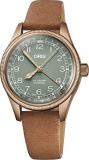
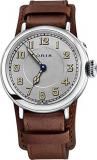
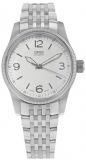
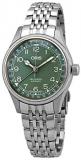
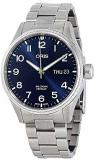
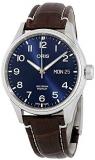
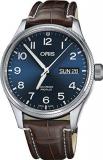
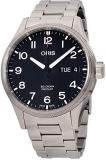
The Oris Big Crown Bronze Pointer Date ships with a case that will not look the same after a year of regular wear, and that is the entire point. Bronze reacts with moisture, skin oils, and airborne compounds to form a patina that records how and where a watch has been worn. Within the Oris lineup, the Big Crown family has carried a pilot-watch identity since 1938, and wrapping that heritage in solid bronze gives the design a warmth that stainless steel cannot replicate.
This article examines what makes the bronze Big Crown a distinctive proposition, from its alloy composition and case architecture to the automatic movement inside, and considers how it fits into a broader collecting landscape alongside other bronze and heritage-inspired references. For anyone weighing a first bronze purchase or adding to an existing rotation, the sections below set out the specifications and the practical questions worth answering before buying.
Why Bronze Became a Modern Watchmaking Material
Bronze is not a new material in horology. Marine chronometers and early dive instruments relied on copper alloys for their resistance to saltwater corrosion, and the same reasoning applies today. What changed is collector appetite. As vintage-inspired designs moved to the centre of the market, brands began to treat patina as a feature rather than a flaw.
The Oris Big Crown Bronze Pointer Date reflects that shift. Its case is not a decorative coating over steel, but a solid bronze construction, so the surface reaction occurs throughout the metal rather than flaking away.
Case Architecture and Dimensions
The numbers behind this reference matter because bronze wears differently from steel. According to specifications published by Oris, the case measures 40.00 mm in diameter and 12 mm in thickness, with a lug-to-lug span of roughly 48.6 mm. That combination keeps the watch wearable on average wrists while preserving the presence a pilot design requires.
A 50-metre water resistance rating places the Big Crown squarely in everyday territory rather than in dive-watch territory, which is consistent with its aviation roots. The crown itself is oversized, a signature inherited from the original 1938 model, when pilots needed to operate the winding mechanism while wearing leather gloves.
- Case diameter: 40.00 mm
- Case thickness: 12 mm
- Lug-to-lug: approximately 48.6 mm
- Water resistance: 50 metres (5 bar)
- Case material: solid bronze, multi-piece construction
The Pointer Date Complication
The central detail that separates this reference from many three-hand watches is the pointer date. Rather than a window cut into the dial, a fourth hand sweeps the perimeter to indicate the day of the month, tracking a scale printed around the chapter ring. The system has been part of the Big Crown line for decades and gives the dial a balanced, instrument-like layout.
Reading the date at a glance requires adapting to the hand rather than a numeral aperture, and that small cognitive adjustment is part of the model’s charm. It also keeps the dial surface uninterrupted, which suits the deep green tone used on the bronze version.
Movement and Reliability
Inside sits an automatic calibre based on the Oris 754, a self-winding movement with a power reserve suited to daily wear. Automatic winding removes the need for batteries and means the watch stays ready as long as it is worn regularly. Oris has long built its reputation on mechanical movements at accessible price points, and the automatic Big Crown continues that approach.
Service intervals for a movement of this type typically fall between four and six years depending on use, and the see-through case back on related Big Crown references allows owners to observe the rotor at work.
Living With Patina
Owners should expect the bronze surface to darken and mottle over time. Humidity, skin oils, and airborne sulphur compounds all accelerate the process. Some collectors welcome the result; others prefer to slow it down.
- Accept the change: let the patina develop naturally for a personal, weathered finish.
- Control the process: wiping the case with a soft, dry cloth after wear limits uneven spotting.
- Reset the finish: a gentle polish with a non-abrasive compound can return bronze close to its original tone.
Placement Within a Collection
A bronze pilot watch occupies a specific niche. It suits buyers who already own a steel daily wearer and want something with more visual texture, or travellers drawn to the adventure associations of early aviation instruments. Strap changes alter the character substantially: a brown leather strap emphasises the vintage tone, while a green or khaki textile strap pushes the watch toward field use.
The broader landscape of bronze references has expanded considerably, from dive watches to chronographs, and comparing the Big Crown against those alternatives clarifies where its strengths lie. Its case dimensions keep it versatile, and the pointer date offers a complication that is legible and unusual at the same time.
Bronze Versus Steel: A Practical Comparison
Many buyers hesitate between the bronze reference and its stainless-steel sibling. The distinction is not merely cosmetic. Steel resists corrosion and maintains its finish indefinitely, while bronze reacts and evolves. Steel is heavier in appearance if not always in weight, and it photographs consistently. Bronze photographs unpredictably, which is precisely why enthusiasts seek it out.
| Attribute | Bronze Version | Steel Version |
|---|---|---|
| Case appearance over time | Develops patina | Finish remains stable |
| Resistance to corrosion | Reacts to moisture and air | High |
| Weight feel on wrist | Substantial | Comparable |
| Dial pairing | Green tones | Multiple options |
| Maintenance needs | Periodic cleaning | Minimal |
The table makes the central trade-off clear. Buyers who want a watch that looks identical in five years should choose steel. Buyers who want a watch that looks unmistakably theirs should choose bronze.
The Big Crown in Oris History
Oris introduced the Big Crown in 1938 as a pilot’s watch with an enlarged crown for gloved hands. That functional origin has anchored the line for more than eight decades, and the design language has remained remarkably consistent: legible dial, prominent crown, understated case. The Pointer Date arrived as a practical alternative to a date window and became one of the brand’s signature complications.
Over the years the family has expanded to include anniversary editions, oversized variants, and models using a range of case metals.
Collectors evaluating the bronze reference often compare it against other heritage tool watches, including those built for maritime and field use. The engineering behind the automatic calibre is consistent across Oris collections, and reviews of examples such as the Oris collection show how different brands approach the same automatic principles with different finishing philosophies and movement architectures.
What Makes This Reference Worth Considering
The bronze Big Crown earns attention for reasons that go beyond novelty. The 40 mm case fits a wide range of wrists, the pointer date adds genuine utility, and the automatic movement removes the burden of battery replacement. Above all, the material choice turns the watch into an object that records where it has been.
Prospective owners should weigh three questions before committing. First, does the prospect of a changing finish appeal or irritate? Second, will the 50-metre water resistance rating satisfy the intended activities, given that swimming is technically possible but not the design brief? Third, does the green dial harmonise with the wardrobe it will accompany?
Answer those honestly and the decision becomes straightforward. The bronze Big Crown is not a watch for someone who wants a static object. It is a watch for someone who wants the object to age alongside them, carrying a pilot-watch lineage and a mechanical heart into daily life.