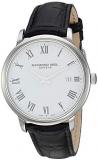
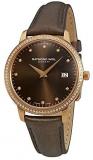
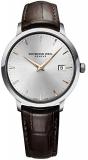
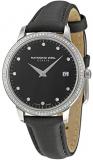
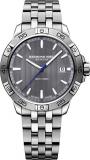
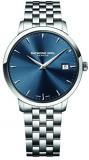
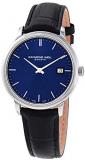
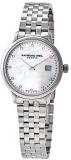
The Raymond Weil Toccata makes its case through subtraction. No oversized case, no aggressive bezel geometry, no dial clutter competing for attention. What remains is a slim, balanced dress watch that slides beneath a shirt cuff and reads clearly at a glance, a formula the Swiss brand has refined across both round and rectangular silhouettes.
The name borrows from musical terminology, where a toccata is a composition designed to display a performer’s touch and dexterity. That reference signals the collection’s intent: precision, rhythm, and lightness of execution rather than complication count or sports utility.
Design Language and Case Architecture
The Toccata line spans two primary silhouettes. The round models generally measure between 39mm and 41mm in diameter, while the rectangular Toccata Heritage editions adopt more compact dimensions. Case thickness defines the range, with the smaller rectangular quartz reference measuring roughly 5.1mm deep and the mechanical version approximately 6.95mm.
This emphasis on thinness serves a practical purpose. A dress watch meant to disappear under formal attire must sit close to the wrist without creating bulk or catching on fabric. The Toccata achieves this through careful case profiling and a modest lug-to-lug measurement that keeps the watch stable during wrist movement.
Case finishing follows traditional Swiss practice. Polished surfaces on the bezel and case sides catch ambient light, producing the understated shimmer that separates a well-executed dress watch from a utilitarian timepiece. According to Raymond Weil, the rectangular Toccata Heritage draws directly from the shaped watches popular during the mid-twentieth century, when elegance often meant embracing geometry beyond the conventional circle.
Dials and Legibility
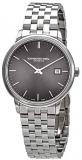
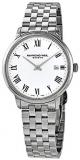
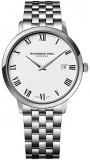
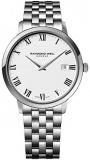
Toccata dials favour clarity above ornamentation. Sunray-finished surfaces in silver, white, or anthracite create subtle depth as the dial catches changing light angles throughout the day. Applied indices, typically rhodium-plated batons, sit slightly above the dial plane and cast miniature shadows that reinforce legibility without adding visual clutter.
The hand set varies by reference. Simple leaf or baton hands match the minimalist ethos, while some models incorporate blued-steel accents that echo traditional watchmaking techniques. A discreet date aperture, positioned at three or six o’clock depending on the reference, provides practical functionality without disrupting the dial’s visual balance.
This dial philosophy aligns with the approach seen across refined European watchmaking, where readability and proportion take precedence over decorative excess. The principle remains consistent: a dress watch should communicate time instantly, not demand careful scrutiny.
Movement Options and Technology
The Toccata collection offers two distinct movement types, each serving different wearer priorities. Quartz-powered references rely on battery operation, delivering accurate timekeeping with minimal maintenance requirements. These models suit individuals who rotate several watches and prefer not to reset timepieces after periods of inactivity.
Mechanical versions, particularly within the Toccata Heritage line, employ hand-wound movements. The RW 4100 calibre powers the mechanical Heritage model, a movement that requires the wearer to wind the crown manually. This interaction creates a tactile connection between owner and timepiece, a ritual that appeals to enthusiasts who appreciate mechanical watchmaking’s traditional character.
Raymond Weil positions these mechanical references as offering the classic dress watch experience at an accessible point within the luxury market. The specification includes a power reserve sufficient for overnight and weekend wear without requiring daily attention from the owner.
Collection Range and Pricing Position
The Toccata family spans a range of references designed to address different aesthetic preferences and wrist sizes. Official guidance from the brand positions these watches within the entry-to-mid luxury segment, offering Swiss manufacture without the premium commanded by heritage houses with century-long legacies.
Available configurations include:
- Case shapes: Round and rectangular options
- Movements: Quartz and hand-wound mechanical
- Dial colours: Silver, white, anthracite, and blue variants
- Strap options: Leather, stainless steel bracelet, and mesh configurations
- Sizes: Compact rectangular dimensions and standard round diameters
This breadth allows the Toccata to function as a first dress watch for younger buyers or as a refined addition to an established collection. The accessible-luxury positioning reflects a broader market trend toward well-made, uncomplicated timepieces at rational prices.
Historical Context and Brand Positioning
Raymond Weil founded the company in 1976, during a period of significant turmoil in the Swiss watch industry. The quartz crisis had destabilised traditional manufactures, and many established brands were struggling. Operating independently has allowed the company to pursue specific market segments without the pressure of large corporate ownership.
Within this independent framework, the Toccata serves a clear strategic role. While competitor brands chase complications, oversized sports watches, or heritage revivals, the Toccata represents something simpler: a well-proportioned dress watch available at a price point that makes fine watch ownership achievable. The brand states that the name references musical composition, reinforcing a positioning around refined taste and cultural appreciation rather than high-performance tool capabilities.
This positioning places the collection in a conversation alongside other forms of classical elegance, where the measure of success is refinement rather than technical specification quantity.
Care and Ownership Considerations
Dress watches demand different care priorities compared to sports models. The Toccata’s slim case and formal styling mean it should avoid exposure to swimming, diving, or contact sports unless a specific reference offers enhanced water resistance. Standard models typically carry modest water-resistance ratings appropriate for hand washing and rain but not for submersion.
Quartz models require battery replacement every few years, a straightforward service that any qualified watchmaker can perform. Mechanical and hand-wound references benefit from periodic servicing intervals of five to seven years, when lubricants should be refreshed and the movement inspected for wear. Leather straps will wear over time and represent the most frequently replaced component, offering owners an opportunity to change the watch’s character through strap selection.
Aesthetic durability matters as much as mechanical longevity. The Toccata’s classic proportions and restrained dial designs are unlikely to date quickly. A reference with a silver dial and stainless steel case will read equally well in 2025 and in a decade, unlike trend-driven designs that privilege novelty over permanence.
This quality extends to the watch’s ability to move between contexts. While dress watches traditionally pair with formal attire, the Toccata’s uncluttered aesthetic works equally well with business casual clothing, making it a genuine daily wearer rather than a special-occasion piece consigned to storage for most of the year.
Final Thoughts on the Toccata Philosophy
The Toccata succeeds because it understands what it is not. It does not compete with luxury sports watches on versatility or ruggedness. It does not claim to offer collectible horological significance. Instead, it delivers exactly what a dress watch should: slim-fitted elegance, clear legibility, reliable Swiss construction, and a price that moves refined watch ownership closer to reality. For buyers who appreciate restraint over spectacle, the Toccata presents an argument in harmony with the understated spirit of classical watchmaking, a philosophy shared by the broader Raymond Weil brand’s approach to accessible Swiss elegance.