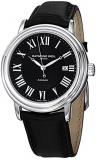
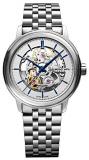
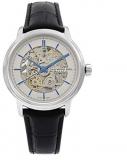
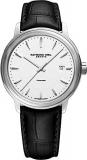
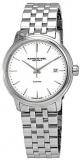
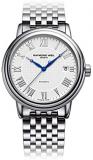
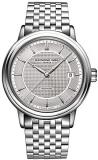
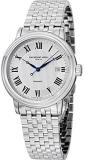
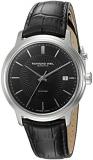
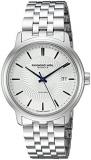
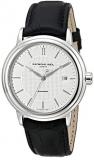
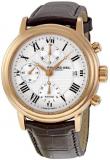
The Raymond Weil Maestro Automatic carries proportions rooted in mid-century dress-watch tradition, with a slim polished case and a dial built for legibility rather than spectacle. Since the maison was established in Geneva in 1976, Raymond Weil has positioned itself between mass-market quartz and haute horlogerie, and the Maestro line expresses that middle path clearly: a mechanical watch intended for daily wear rather than vault storage.
This guide examines the Maestro Automatic across design, movement architecture, materials, and ownership realities, so readers can judge whether it fits their wrist and their habits.
Design Language Rooted in Restraint
The Maestro Automatic avoids the oversized, hyper-masculine cues that dominated watch design through the 2000s and 2010s. Its case, typically around 39.5mm in diameter and roughly 9mm thick, is sized for shirt cuffs and evening sleeves alike. The lugs curve downward rather than jutting straight out, which lets the case sit close to the wrist instead of riding high on it. That single geometric decision does more for comfort than any marketing claim about ergonomics.
The bezel is narrow, which enlarges the apparent dial aperture and gives the watch a visual presence larger than its dimensions suggest. Finishing leans toward high polish on the case flanks and bezel, with occasional brushed accents on the lugs. Polished steel amplifies light but shows micro-scratches sooner than brushed surfaces, a trade-off most dress-watch owners accept without complaint.
Dial Composition and Readability
Dial options across the Maestro Automatic family include silver, white, black, and occasional blue or anthracite tones. Applied indices rather than printed markers catch light at angles, adding depth that flat dials cannot replicate. Hands are typically leaf-shaped or dauphine-style, polished and faceted so they remain readable in most lighting without luminous paint. That omission is deliberate: lume would compromise the clean aesthetic that defines the line.
A date window at 3 o’clock handles daily practicality. Some references use a large date display, which adds visual interest while preserving dial symmetry. When a railroad-style minute track appears, it frames the dial with a precision that echoes classical horological conventions rather than contemporary minimalism.
Movement Architecture and Mechanical Integrity
Inside the Maestro Automatic beats a self-winding mechanical movement, generally based on a Swiss ebauche refined to Raymond Weil’s specifications. Power reserve lands at approximately 38 hours, which means the watch can be set down on Friday evening and still running by Monday morning if worn regularly during the week. The oscillating weight tensions the mainspring through wrist motion, removing batteries from the equation entirely.
Many references include an exhibition case back, letting owners watch the balance wheel oscillate and the rotor spin. Finishing at this price point is functional rather than decorative, though Geneva stripes and blued screws appear on select calibres. Accuracy generally falls within standard Swiss expectations, around -/+ 15 seconds per day or better depending on the specific movement. Positional variation is normal at this level, and owners report satisfactory timekeeping with consistent wear.
- Power reserve: Approximately 38 hours
- Winding: Automatic with manual winding capability
- Jewels: Typically 25 or 26 depending on calibre
- Frequency: 28,800 vibrations per hour (4 Hz)
- Case back: Exhibition on most references
These figures place the Maestro Automatic in the mainstream of Swiss mechanical watchmaking, prioritizing dependable daily performance over exotic complications.
Living With Automatic Winding
For anyone moving from quartz to mechanical, the Maestro requires a small mental shift. Worn daily, it stays wound and ready. Rotated within a collection, it needs a watch winder or a brief manual wind each morning. The crown operates smoothly for time and date setting, with a positive click at each position. Avoiding date adjustments between 9 PM and 3 AM prevents strain on the date-change mechanism, a rule that applies to virtually every mechanical watch with a quick-set date.
Materials, Craftsmanship, and the Geneva Supply Chain
Geneva carries weight in watchmaking even for brands outside the traditional haute horlogerie elite. Raymond Weil draws on that ecosystem: skilled assemblers, established component suppliers, and a supply chain refined over generations. Case finishing, dial printing, and movement regulation all happen within a network that understands Swiss-made standards.
Sapphire crystal protects the dial on most references, offering scratch resistance that mineral glass cannot match. For a daily-worn dress watch, that upgrade matters over years of use. Water resistance typically sits at 50 meters, sufficient for hand washing and rain but not swimming. The Maestro is a formal companion, not a poolside accessory, and treating it accordingly preserves both function and finish.
Leather straps fitted to many Maestro models are supple and well-finished, with alligator-pattern embossing or genuine leather depending on the variant. Quick-release spring bars on some references make strap changes tool-free, letting owners shift from formal black leather to brown or blue depending on the occasion. Steel bracelet versions offer a sportier alternative within the same dress-watch silhouette.
Positioning Among Contemporary Swiss Dress Watches
The Maestro Automatic competes in the accessible luxury tier, where buyers weigh brand heritage, design appeal, movement quality, and serviceability. Raymond Weil scores well on serviceability and design, holds its own on movement quality, and offers a different flavor of heritage than century-old maisons. The comparison extends beyond specifications into how each watch feels on the wrist and how easily it integrates into a wardrobe.
The Maestro appeals to buyers who find sport watches too casual for daily office wear but want something more substantial than a fashion-brand quartz piece. It occupies a middle ground: mechanical credibility without an investment-watch price tag or the intimidation factor of haute horlogerie. Many owners pair a Maestro with a more rugged sports watch, assigning each to its intended context. For those drawn to sportier aesthetics within the same brand universe, the Raymond Weil collection offers alternatives that share the same underlying quality standards.
Collecting and Long-Term Ownership
The Maestro Automatic is not typically acquired as an appreciating asset. Its value lies in daily enjoyment rather than investment returns. Well-maintained examples hold reasonable resale value, and limited editions or unusual dial variants attract interest from dedicated Raymond Weil collectors. Long-term costs are predictable: a service every five to seven years keeps the movement healthy, parts availability through the brand’s network is generally reliable, and leather straps will need replacement more frequently than the watch itself.
The Wearing Experience Beyond Specifications
Specifications tell only part of the story. The Maestro Automatic earns affection through subtler qualities: the gentle sweep of the seconds hand, the weight of the case on the wrist, the ritual of winding and setting a mechanical watch each morning. These are not features that appear on a spec sheet, but they explain why mechanical watches persist in an era of smart devices and quartz accuracy.
On the wrist, the Maestro feels considered. It does not dominate the arm the way a chronograph or dive watch might, yet it does not disappear either. The dial catches light in a way that rewards occasional glances, and the case finishing invites tactile engagement. For wearers who appreciate these sensory dimensions of watch ownership, the Maestro delivers an experience that exceeds what its price point suggests.
The watch also functions as a conversation piece without being ostentatious. Those unfamiliar with Raymond Weil may ask about it; those who know the brand recognize the Maestro as a sensible choice rather than a status play. This balance of recognition and understatement suits professionals who prefer their accessories to whisper rather than shout.
Technical Snapshot and Reference Guide
| Specification | Detail |
|---|---|
| Case Diameter | Approximately 39.5mm |
| Case Material | Polished stainless steel |
| Movement | Automatic, Swiss-made |
| Power Reserve | Approximately 38 hours |
| Crystal | Sapphire (most references) |
| Water Resistance | 50 meters |
| Dial Options | Silver, white, black, blue, anthracite |
| Strap | Leather or steel bracelet depending on reference |
These specifications vary slightly across the Maestro Automatic family, which includes moon phase variants, small seconds models, and open-balance designs. Buyers should consult individual reference pages for exact details before purchase.
Who Should Consider the Maestro Automatic
The Maestro Automatic suits several buyer profiles. The first is the professional who needs a watch that works with suits and business casual attire but wants mechanical credibility rather than a quartz fashion piece. The second is the emerging collector seeking a first mechanical watch that offers Swiss provenance without a daunting price or servicing burden. The third is the seasoned enthusiast looking for an affordable dress watch to round out a collection dominated by sports or tool watches.
It is less suited to those needing high water resistance, luminous visibility in darkness, or rugged shock resistance. It is also not the right choice for buyers seeking investment-grade watches or those who prefer quartz convenience. Knowing these boundaries helps align expectations with the product’s actual strengths.
Practical Ownership Tips
- Wind the watch manually 20-30 turns when first setting it after a period of non-use
- Avoid adjusting the date between 9 PM and 3 AM when the date-change mechanism is engaged
- Store on a watch winder or wear regularly to maintain power reserve
- Wipe the case and strap with a soft cloth after wearing to remove oils and moisture
- Schedule servicing every five to seven years or when timekeeping drifts noticeably
These simple habits preserve both function and appearance, extending the watch’s service life well beyond its warranty period.
A Quiet Counterpoint to Oversized Watch Design
The Raymond Weil Maestro Automatic represents a specific philosophy: that a watch can be elegant without being precious, mechanical without being demanding, and Swiss without being exclusive. It occupies a space where craftsmanship meets practicality, offering owners a daily reminder that timekeeping can be both functional and beautiful.
In a market saturated with oversized cases, tactical aesthetics, and digital integration, the Maestro’s restraint feels almost countercultural. It asks nothing of its wearer except to appreciate the quiet rhythm of a mechanical movement and the satisfaction of a well-proportioned design. For those who answer that call, the Maestro Automatic delivers enduring value that transcends trends and specifications alike.