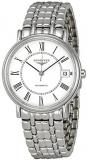
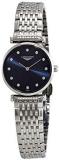
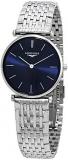
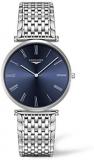
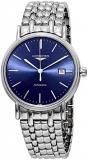
The Longines Conquest L3.759.4.58.6 pairs a 41.00 mm stainless steel case with a black lacquered polished dial, a configuration that speaks to the brand’s long-standing focus on legible, understated sports watches. Screw-in crown construction and water resistance to 30 bar place this reference firmly in territory where daily wear and outdoor use overlap without compromise.
Quartz timekeeping has occupied a specific and important place within the Longines catalog for decades. While automatic calibres often dominate conversations among collectors, the quartz movement offers a distinct set of advantages that align closely with how most people actually use a watch: set it, wear it, and trust it to remain accurate for months at a time. The wider Longines collection reflects this philosophy across multiple lines, positioning battery-powered calibres not as a compromise but as a deliberate engineering choice.
How a Quartz Calibre Actually Works
Understanding what happens inside a quartz watch clarifies why these movements achieve the accuracy they do. Longines explains that a quartz calibre relies on a battery and a vibrating quartz crystal to regulate time. That crystal oscillates 32,768 times per second, a frequency chosen because it divides neatly into a one-second pulse through a series of electronic stages. The result is a timekeeping rate that mechanical escapements simply cannot match in everyday conditions.
To put that in perspective, a traditional balance wheel inside an automatic movement oscillates 28,800 times per hour, roughly eight beats per second, and advances the wheel train 691,200 times per day. The quartz crystal, by contrast, completes over 2.8 billion oscillations in the same 24-hour period. This difference in frequency is the fundamental reason quartz watches typically drift only a few seconds per month, while even well-regulated mechanical movements may vary by several seconds per day.
Longines has published detailed guidance on the practical accuracy of both automatic and quartz calibres, noting that factors such as temperature, battery condition, and positional variation affect quartz performance far less than they affect mechanical rate. For someone who wants a watch that reads correctly without weekly adjustment, this is the central appeal.
The Conquest Reference in Detail
The Conquest L3.759.4.58.6 demonstrates how Longines applies quartz technology within a robust, sport-oriented framework. The 41.00 mm stainless steel case provides substantial wrist presence without tipping into oversized territory, and the black lacquered polished dial creates a deep, reflective surface that shifts character depending on the light.
Case and Crystal Construction
Scratch-resistant sapphire crystal protects the dial, a material choice that signals the watch’s intended role as a daily companion rather than a display-piece only. The screw-in crown contributes to the 30-bar water resistance rating, which translates to suitability for swimming, snorkeling, and water sports. Stainless steel offers corrosion resistance and takes a polished finish well, giving the case a brightness that complements the dark dial.
The date function at the dial adds practical utility without cluttering the layout. Longines has long favored balanced, symmetrical dial designs, and the Conquest follows that tradition, with applied indices, clean hands, and no unnecessary ornamentation.
Why Quartz Suits This Platform
A sports watch built for water resistance and daily durability benefits from a movement that requires minimal attention. An automatic calibre in a watch worn intermittently may lose power reserve and require resetting; a quartz calibre holds its charge for years and maintains accuracy throughout. For the Conquest’s target user, someone who wants a reliable, well-finished Swiss watch for active use, the quartz movement is arguably the more logical pairing.
Quartz Versus Automatic: A Question of Use Case
The automatic-versus-quartz debate often generates more heat than light. Both technologies serve legitimate purposes, and the right choice depends entirely on how the watch will be worn. Automatic movements appeal to those who value mechanical craftsmanship, the sweep of a seconds hand, and the connection to centuries of horological tradition. Quartz movements appeal to those who prioritize accuracy, low maintenance, and the freedom to pick up a watch after two weeks in a drawer and find it still running correctly.
Longines produces both types across its collections, which suggests the brand does not view one as inherently superior. The automatic calibres, with their oscillating balance wheels and mainsprings, represent a different expression of the same fundamental goal: measuring time reliably. The quartz calibres achieve that goal through a different mechanism, one that happens to be more accurate and more convenient for many wearers.
What matters more than the movement type is the overall quality of the watch, including case finishing, dial execution, crystal material, water resistance, and the coherence of the design. In these areas, the Conquest quartz reference holds its own against automatic alternatives at similar price points.
Design Language and Everyday Versatility
The Conquest line occupies a middle ground between pure tool watches and dress pieces. Its stainless steel case and bracelet, combined with a black dial and moderate 41 mm dimensions, allow it to move between contexts without feeling out of place. This versatility is a deliberate design outcome, not an accident: Longines has refined the Conquest formula over decades to serve people who want one watch that handles most situations.
- Case: 41.00 mm stainless steel with screw-in crown
- Dial: Black lacquered polished finish with date function
- Crystal: Scratch-resistant sapphire
- Water resistance: 30 bar
- Movement: Quartz calibre
The black lacquered dial deserves particular attention. Unlike matte or sunray finishes, a lacquered surface creates a mirror-like depth that changes as the wrist moves. It reads as formal in low light and sporty in bright conditions, which reinforces the watch’s all-purpose positioning.
The Broader Case for Battery-Powered Swiss Watches
Swiss quartz watches occupy a unique position in the market. They offer the precision and reliability associated with quartz technology, delivered with the case finishing, dial quality, and brand heritage of a traditional Swiss manufacturer. For buyers who want a watch that simply works, accurate, durable, and well-made, this combination is difficult to argue against.
The Longines approach to quartz reflects the same attention to detail applied to its mechanical lines. Movements are housed in properly finished cases, protected by sapphire crystal, and rated for meaningful water resistance. Nothing about the construction suggests a reduced standard.
There is also a practical dimension: quartz watches typically require only a battery replacement every few years and no winding or setting rituals. For someone who values simplicity in ownership, this is not a minor point. It is the entire argument.
A Longines Quartz Watch in Context
Within the wider landscape of Swiss watchmaking, the Longines Conquest L3.759.4.58.6 represents a specific and well-considered proposition. It combines a movement technology known for accuracy and low maintenance with a case and dial execution that meets the expectations of a heritage brand. The result is a watch that performs its core function, telling accurate time, without demanding anything more from its owner than occasional battery service.
For anyone considering a quartz watch from a Swiss maison, the Conquest reference offers a clear demonstration of what that combination looks like when executed with care. Its 41 mm stainless steel case, black lacquered dial, sapphire crystal, and 30-bar water resistance together form a coherent package that serves daily wear, travel, and recreational water activity alike.
The appeal of a Longines quartz watch lies partly in what it does not require: no winding, no setting after a weekend off the wrist, no concern about magnetic fields affecting rate. It simply measures time, quietly and accurately, which is ultimately the purpose for which it was built.