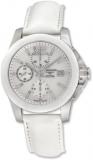
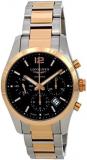
The Longines HydroConquest 44 measures exactly 44.00 mm across the case, a dimension that places it firmly in the large-format dive watch category rather than the middle ground. Longines lists this reference family with a stainless steel case, a sunray-finished dial, and water resistance rated to 30 bar (300 metres). Those three numbers define what the watch is: a purpose-built diver with a dress-adjacent finish, sized for wrists that can carry real presence.
Dive watches occupy an unusual position in modern collecting. Most owners never take them below ten metres, yet the specification sheet still matters, because a 300-metre rating signals a particular standard of case construction, gasket engineering, and crown sealing. The HydroConquest series has carried that standard since it entered the Longines catalogue, and the 44 mm variant is the most overtly tool-oriented expression of the line.
Case Architecture and the Logic of 44 mm
Case diameter is never just a number. On a dive watch, it determines dial legibility, bezel circumference, and the amount of torque the crown must resist under pressure. At 44 mm, the HydroConquest gains a broader unidirectional rotating bezel with room for clearly graduated minute markers, and the dial itself can breathe, giving the hands and indices enough separation to stay readable in poor light.
The stainless steel case is paired with a screw-down crown and case back, the two seals that make a 300-metre rating achievable. Longines builds the HydroConquest as a genuine diving instrument rather than a water-resistant sports watch, and the construction reflects that: a substantial bezel grip, a crown protected by guards, and lugs proportioned to keep the watch stable on the wrist despite its size.
Wearability at this diameter depends heavily on wrist geometry. A 44 mm case with short lugs sits closer to the wrist than the raw figure suggests, while a long lug-to-lug span can make the watch feel larger than its diameter. Buyers moving up from a 39 mm or 41 mm daily wearer should treat the 44 mm HydroConquest as a distinct fit decision, not an automatic upgrade.
The Sunray Dial and Legibility Under Water
Longines offers the 44 mm HydroConquest with dials including blue sunray and black sunray finishes. The sunray effect is a mechanical brushing pattern that radiates from the centre, catching light across the surface and shifting in tone as the wrist moves. It is a cosmetic treatment, but on a dive watch it also does functional work, because a dial that reflects light unevenly remains readable at angles where a flat matte surface would lose contrast.
Applied indices and broad hands carry luminous coating, the element that determines whether a dive watch is usable in low light. The standard the industry works to here is ISO 6425, the international certification for diving watches, which specifies minimum legibility requirements for a diver in darkness. Longines positions the HydroConquest as a dive watch in that tradition, and the dial layout, with large markers and a clearly differentiated minute hand, follows the conventions that certification demands.
The date window sits at 3 o’clock on the references documented by Longines. It is a practical addition that slightly interrupts dial symmetry, a trade-off most dive watch buyers accept because daily wear benefits from a date function more than from perfect dial balance.
Movement, Frequency, and a 72-Hour Reserve
The automatic movement inside the 44 mm HydroConquest runs at 25,200 vibrations per hour and delivers a power reserve of up to 72 hours. Those two figures say more about the watch than any marketing language could. The 25,200 vph frequency, equivalent to 3.5 Hz, sits between the 3 Hz and 4 Hz standards common in Swiss movements, and it is a deliberate compromise: a lower beat rate than 4 Hz reduces wear on the escapement and extends service intervals, while retaining enough stability for reliable timekeeping.
The 72-hour reserve is the more consequential specification for real ownership. Three days of autonomy means the watch can sit on a bedside table from Friday evening through Monday morning and still be running accurately when it returns to the wrist. For anyone rotating between several watches, that reserve removes the ritual of resetting the time before every wear, a convenience that matters more in practice than a marginally higher beat rate.
Automatic winding relies on the motion of the wrist to tension the mainspring through a rotor. It is a system that has powered dive watches for decades because it eliminates battery replacement and keeps the case sealed, which is exactly why a screw-down case back and an automatic movement belong together on a 300-metre watch.
300 Metres of Water Resistance and What It Requires
A 30 bar rating equals 300 metres of static pressure resistance, the benchmark that separates serious dive watches from water-resistant sports models. Achieving it requires more than a thick case. The crystal must be seated against a compressible gasket, the case back must seal under a screwed thread, and the crown must lock down with its own O-ring system.
Pressure ratings are tested statically, meaning the watch is subjected to the stated pressure in a controlled vessel. That is different from dynamic pressure encountered when a diver moves through water, which is why ISO 6425 adds tests for thermal shock, saltwater corrosion, and legibility, not just static pressure. A 300-metre rating is therefore best read as evidence of build quality rather than a literal dive limit for recreational use.
The practical takeaway for most owners is simpler. A 300-metre watch can be worn for swimming, snorkelling, and water sports without a second thought, and the rating provides a comfortable margin over the 100-metre and 200-metre figures found on general-purpose sports watches.
The Bracelet, the Clasp, and Daily Practicality
The HydroConquest 44 is supplied on a stainless steel bracelet, with the case and bracelet finished to a standard consistent with the rest of the Longines catalogue. A steel bracelet on a dive watch is a deliberate choice: it balances the visual weight of a large case, resists saltwater when rinsed after use, and allows fine adjustment at the clasp for wrist swelling in heat.
Divers extend over a wetsuit, but most owners will use the micro-adjustment positions to tune fit through the seasons. That adjustment range is one of the least discussed yet most felt aspects of ownership, because a 44 mm steel watch that fits poorly will feel heavy by the end of a working day, while the same watch with a correctly sized bracelet disappears on the wrist.
The HydroConquest Line and Where 44 mm Sits
The HydroConquest family is not a single watch. Longines produces the line in multiple case sizes, including a 41.00 mm version alongside the 44 mm references, and offers automatic or quartz movements depending on the model. That structure matters for buyers, because the 44 mm is a specific choice within a range rather than the default.
The smaller 41 mm references suit wrists where a 44 mm case would overhang, and they retain the same 300-metre rating and sunray dial treatment. Buyers comparing the two should decide on fit first and specification second, since the core engineering is shared across the line. Where the 44 mm distinguishes itself is in wrist presence and dial proportion, not in capability.
Longines has built dive watches within a broader catalogue that stretches from the Conquest collection through to dress-oriented families, and the HydroConquest inherits the brand’s approach of combining technical specifications with restrained design. Reviewing the Longines brand’s full catalogue shows where the dive line sits relative to the dress and chronograph families, which helps frame the HydroConquest as a tool watch rather than a compromise.
How the HydroConquest 44 Compares Within the Dive Category
The 300-metre automatic dive watch segment is crowded, and the HydroConquest 44 competes on specification value rather than on heritage storytelling alone. Its combination of a 72-hour reserve, a 300-metre rating, and a steel bracelet places it against established alternatives from several Swiss houses.
Buyers weighing options often look at how each brand handles the bezel action, the lume performance, and the service network, because those are the variables that shape long-term ownership more than the dial colour. The HydroConquest’s case construction and movement specification give it a defensible position in that comparison, particularly for buyers who prioritise reserve and water resistance over complications.
It is worth noting that dive watch design has converged around a recognisable formula, and differentiation now comes from proportion, finishing, and movement efficiency. A 44 mm case with a sunray dial and a three-day reserve is a coherent package, and the choices Longines made here favour usability over novelty.
Service, Longevity, and the Ownership Calculation
An automatic dive watch is a long-term object, and the ownership calculation extends beyond the purchase. The 25,200 vph movement benefits from periodic servicing, typically every five to seven years depending on wear, and the gaskets that maintain the 300-metre rating should be inspected at the same interval. Longines publishes user manuals by watch name and reference, which makes identifying the correct service guidance for a specific HydroConquest reference straightforward.
The steel bracelet is designed to be refinished, and polished surfaces can be restored during service, which extends the cosmetic life of the watch considerably. Buyers should factor that into the decision, because a dive watch worn daily will accumulate desk-diving marks on the clasp and bezel edge.
Choosing Between the 44 mm and Its Siblings
The decision between case sizes comes down to wrist measurement and intended use. A 44 mm dive watch on a 17 cm wrist will read as a statement piece, while the same watch on a 19 cm wrist looks proportionate. Trying both sizes, or measuring the lug-to-lug span of a watch already owned, is more reliable than judging from photographs.
Dial colour is the second decision, and it is largely aesthetic. Blue sunray shifts more dramatically with light and reads as slightly more casual, while black sunray is the more traditional dive watch choice and pairs more easily with formal wear. Neither affects legibility in any meaningful way once the luminous markers are considered.
The final consideration is movement type. The automatic references deliver the 72-hour reserve and the mechanical character that many buyers want from a dive watch, while quartz versions in the line offer lower maintenance and greater accuracy. The automatic is the choice for anyone who values the winding relationship with the watch.
The Longines HydroConquest 44 is a watch that states its purpose clearly through its specifications: a 44.00 mm steel case, a 300-metre rating, and a 72-hour automatic movement running at 25,200 vibrations per hour. It does not chase complications or novelty, and that restraint is precisely what makes it a credible daily dive watch for owners who want a tool that also looks considered on the wrist.